
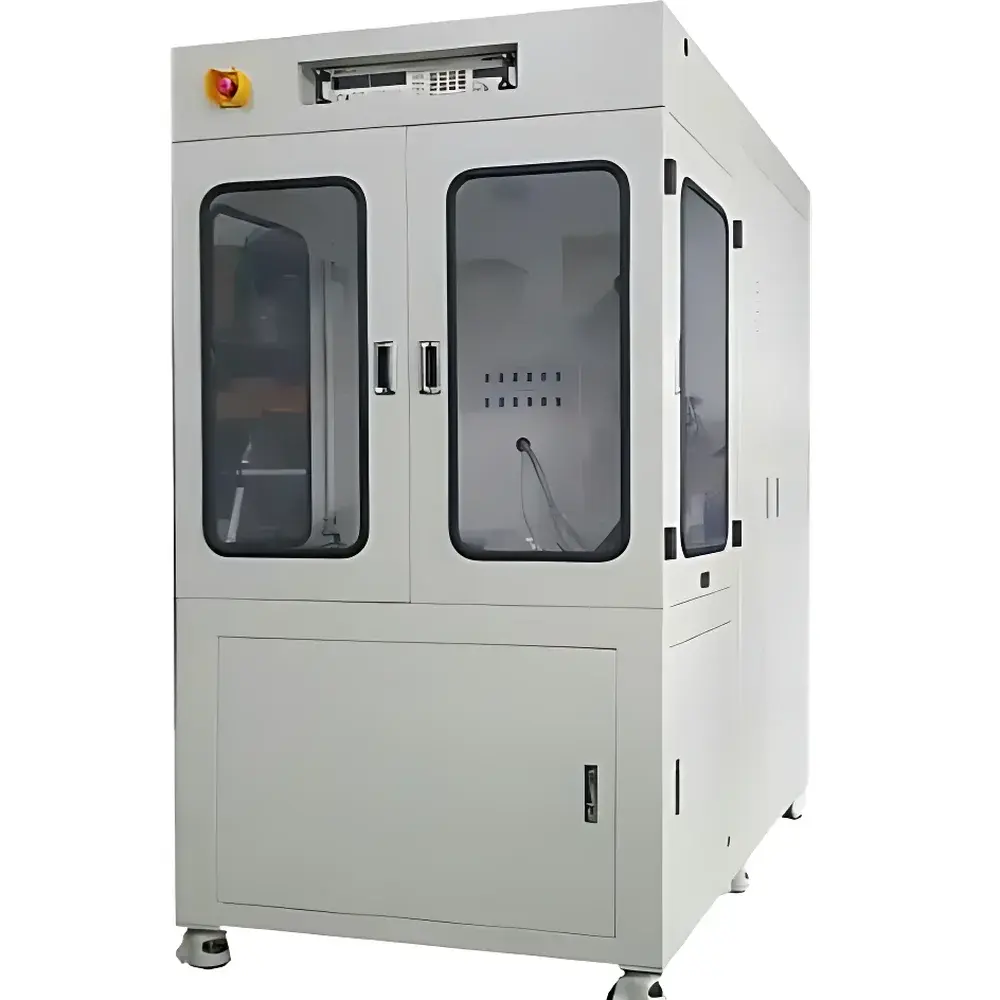
AIWEI 7–10 kW Fuel Cell Stack Test Station
| Brand | AIWEI |
|---|---|
| Model | 7–10 kW Fuel Cell Stack Test Station |
| Category | Electrochemical Workstation |
| Power Rating | 7–10 kW |
| Current Range | ±600 A / ±1000 A |
| Voltage Range | 0–60 V / 0–120 V / 0–400 V (configurable) |
| Cooling | Liquid-cooled electronic load modules (9 kW / 12 kW) |
| Enclosure | Floor-standing modular cabinet (1100 W × 1800 D × 2000 H mm) |
| Input Power | 3-phase 220 VAC or 380 VAC, max. 75 A |
| Anode Gas Flow Control | H₂/N₂, up to 150 SLPM |
| Cathode Gas Flow Control | Air/N₂, up to 500 SLPM |
| Humidification | Bubble-type or membrane-type humidifiers with temperature-controlled water bath, liquid-level monitoring, wet/bypass mode |
| Water Management | Automated DI-water injection, 50 L thermal reservoir with heating (up to 95 °C) and cooling, conductivity monitoring, integrated deionization filtration |
| Backpressure Control | 0–3.5 bar, proportional pressure regulation, ΔP < 2 kPa at max flow, differential pressure control for anode/cathode inlet/outlet |
| Preheater | SUS316 tubing (anode: 1/2″, cathode: 3/4″), inline gas temperature control |
| Condensate Handling | Auto-drain water traps with heat sink & fan cooling |
| Software | LabVIEW-based control suite with real-time DAQ, automated test protocols (load-following, polarization, EIS), GLP-compliant audit trail (optional), FDA 21 CFR Part 11 ready (with optional digital signature module) |
| Optional Modules | Individual cell voltage monitoring (±5 V per cell, channel-selectable), multi-channel EIS (10 mHz–10 kHz), HFR/IR/Ohmic resistance extraction, stack discharge resistive load bank (1–2 kW) |
Overview
The AIWEI 7–10 kW Fuel Cell Stack Test Station is a fully integrated, laboratory- and pilot-scale electrochemical testing platform engineered for rigorous evaluation of proton exchange membrane (PEM) and phosphoric acid fuel cell (PAFC) stacks under dynamic, controlled, and reproducible operating conditions. Built upon a robust electrochemical workstation architecture, the system implements galvanostatic, potentiostatic, and power-regulated operation modes, enabling precise current/voltage/power cycling, polarization curve acquisition, and long-term durability assessment. Its core measurement principle relies on high-fidelity four-wire voltage sensing, calibrated shunt-based current measurement, and synchronized multi-channel analog/digital data acquisition — all coordinated via a deterministic LabVIEW Real-Time execution engine. Designed for compliance with ISO 8528-10 (fuel cell testing standards), ASTM D6821 (PEMFC performance characterization), and IEC 62282-2 (safety and performance requirements), the station supports full-stack validation across automotive, stationary power, and auxiliary power unit (APU) applications.
Key Features
- Modular, floor-standing enclosure with industrial-grade mechanical rigidity and electromagnetic interference (EMI)-shielded internal routing for signal integrity.
- Dual-range liquid-cooled electronic load modules (9 kW and 12 kW configurations) supporting continuous operation at ±600 A / ±1000 A with voltage scalability up to 400 V DC.
- Independent, closed-loop gas conditioning subsystems for anode (H₂/N₂) and cathode (air/N₂), each equipped with mass flow controllers (MFCs), preheaters, humidifiers, and backpressure regulators — all digitally synchronized.
- Automated water management system featuring 50 L thermostatically controlled reservoir, integrated deionization filter, conductivity sensor, and fail-safe float-level monitoring with auto-refill logic.
- Real-time differential pressure control across stack inlet/outlet manifolds, enabling precise stoichiometry tuning and mitigation of localized flooding or drying.
- LabVIEW-based control software with built-in test sequence editor, customizable alarm thresholds, event-triggered data logging, and export to CSV, HDF5, and MATLAB-compatible formats.
Sample Compatibility & Compliance
The station accommodates PEM fuel cell stacks ranging from 20 to 200 cells, with active areas from 100 cm² to 400 cm² per cell. It supports both hydrogen–air and hydrogen–oxygen operation, as well as nitrogen purging and inert-gas startup protocols. All fluidic and electrical interfaces comply with UL 61010-1, CE EN 61326-1 (EMC), and IEC 61000-4 series immunity standards. Gas handling components meet ISO 8573-1 Class 2 purity requirements for compressed gases. Optional add-ons — including single-cell voltage monitoring and multi-channel electrochemical impedance spectroscopy (EIS) — are designed to meet GLP/GMP documentation requirements and support 21 CFR Part 11 compliance when configured with user authentication, electronic signatures, and audit-trail logging.
Software & Data Management
The embedded LabVIEW software provides a unified interface for hardware configuration, real-time visualization (live voltage/current/power curves, gas flow rates, temperatures, pressures), and automated protocol execution. Predefined test templates include polarization sweeps, constant-current hold, cyclic load-following, and accelerated stress tests (ASTs). Data is acquired at ≥1 kHz sampling rate per channel, timestamped with microsecond resolution, and stored in structured binary format with metadata tagging (operator ID, test ID, environmental conditions). The system supports remote monitoring via secure HTTPS API and integrates with enterprise LIMS through OPC UA or MQTT brokers. Optional data archiving includes automatic backup to network-attached storage (NAS) and configurable retention policies aligned with ISO/IEC 17025 clause 7.5.2.
Applications
- Performance mapping of commercial and prototype PEM stacks under variable load, humidity, temperature, and stoichiometric conditions.
- Durability and degradation analysis via open-circuit voltage (OCV) decay monitoring, electrochemical surface area (ECSA) tracking, and high-frequency resistance (HFR) trending over 1,000+ hour tests.
- Validation of balance-of-plant (BoP) component interactions — e.g., humidifier efficiency vs. stack water balance, backpressure impact on oxygen transport resistance.
- Development and verification of model-based control algorithms for fuel cell systems, including feedforward air flow control and adaptive humidification strategies.
- Support for DOE Hydrogen Program targets (e.g., 8,000-hour lifetime, <10 µV/h voltage decay) and EU FCH JU certification pathways.
FAQ
What is the maximum continuous power rating of this station?
The system is rated for sustained operation at 7–10 kW depending on configuration; the 12 kW electronic load module allows transient peaks up to 12 kW for ≤5 minutes.
Does the station support automated EIS measurements during load cycling?
Yes — optional multi-channel EIS hardware enables superimposed AC perturbation (10 mHz–10 kHz) during DC load steps, with phase-resolved impedance spectra synchronized to voltage/current transients.
Can the software generate reports compliant with ISO 8528-10 Annex B?
Yes — report templates include mandatory parameters: polarization curve data, HFR values, mass transport loss estimation, and statistical uncertainty quantification per test point.
Is third-party calibration documentation provided with delivery?
Each unit ships with NIST-traceable calibration certificates for current shunts, pressure transducers, thermocouples, and MFCs, valid for 12 months from commissioning.
What level of cybersecurity is implemented for remote access?
Remote connectivity uses TLS 1.2+ encrypted tunnels; role-based access control (RBAC) enforces operator, engineer, and administrator privilege tiers; all sessions are logged and exportable for SOC2 or ISO 27001 audits.
Related Products




