
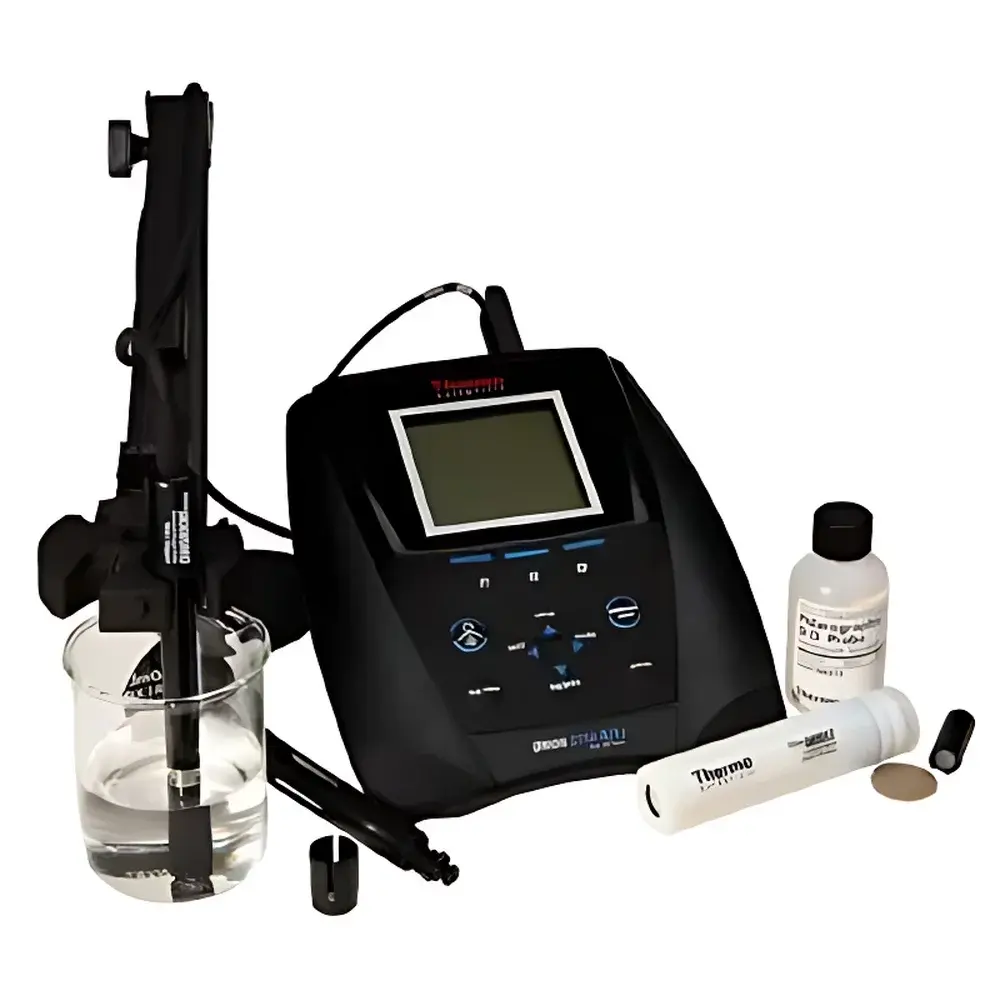
Orion Star A Benchtop/Portable pH and Dissolved Oxygen Meter
| Origin | USA |
|---|---|
| Manufacturer Type | Authorized Distributor |
| Origin Category | Imported |
| Model | Orion Star A |
| Pricing | Available Upon Request |
Overview
The Orion Star A Benchtop/Portable pH and Dissolved Oxygen Meter is a dual-parameter, GLP-compliant analytical instrument engineered for rigorous water quality assessment in environmental monitoring, wastewater treatment, aquaculture, drinking water utilities, and field-based ecological research. It integrates high-precision potentiometric pH measurement with two distinct dissolved oxygen (DO) detection methodologies—Clark-type polarographic and luminescent-based RDO (Ruthenium-based Dissolved Oxygen)—within a single, unified platform. The instrument operates on fundamental electrochemical principles: pH is determined via Nernstian potential response across a glass membrane electrode relative to a stable reference, while polarographic DO quantification relies on oxygen reduction current at a cathode under controlled polarization voltage; RDO measurement exploits the dynamic quenching of ruthenium complex luminescence by molecular oxygen, offering drift-free, maintenance-light performance. Designed for operational flexibility, the Star A supports both benchtop laboratory deployment (IP54-rated enclosure) and ruggedized field use (IP67-rated portable variant), powered interchangeably by four AA alkaline batteries or universal AC adapters (100–240 V AC).
Key Features
- Dual-mode DO probe recognition: Automatic detection and configuration for either polarographic or RDO optical sensors—no manual mode switching required.
- Intelligent measurement stabilization: AUTO-READ™ algorithm locks readings upon signal stability and displays visual confirmation, reducing operator interpretation error.
- Configurable data acquisition: Supports manual, timed-interval (user-defined from 1 second to 24 hours), and continuous logging modes.
- Multi-language interface: Six selectable display languages—including English, Chinese, Spanish, French, German, and Portuguese—facilitating international team deployment and regulatory alignment.
- Advanced pH calibration management: Up to five-point calibration with post-calibration slope and offset editing to refine calibration curves without full recalibration.
- Buffer auto-recognition: Seamless identification of USA, NIST, and DIN standard pH buffer sets during calibration setup.
- Robust connectivity: Dual communication interfaces—USB (virtual COM port) and RS232—with native compatibility for Thermo Fisher Scientific’s Orion™ Com software for secure data export, firmware updates, and audit-trail generation.
- Comprehensive environmental compensation: Integrated barometric pressure correction (450.0–850.0 mmHg) and salinity adjustment (0–45 ppt), including automatic coupling with optional conductivity modules.
Sample Compatibility & Compliance
The Orion Star A accommodates standard BNC pH electrodes and reference half-cells, as well as industry-standard 9-pin mini-DIN polarographic and RDO probes—including Thermo Fisher’s Orion ROSS™ Ultra pH electrodes and Orion RDO® Pro sensors. Its measurement architecture complies with key international standards governing environmental analysis, including ASTM D888 (Standard Test Methods for Dissolved Oxygen in Water), ISO 5814 (Water Quality — Determination of Dissolved Oxygen — Electrochemical Probe Method), and EPA Method 360.1 (for polarographic DO). All data storage adheres to Good Laboratory Practice (GLP) requirements: each entry includes timestamp, operator ID (configurable), electrode serial number, calibration history, ambient temperature, pressure, and salinity settings—enabling full traceability for regulatory submissions and internal QA/QC audits.
Software & Data Management
Data generated by the Star A is structured to support compliance with FDA 21 CFR Part 11 when used with validated configurations. Orion Com software provides encrypted data transfer, user-access controls, electronic signature capability, and immutable audit trails for all calibration events, measurement sessions, and configuration changes. Up to 5000 data points (2000 on benchtop variant) are stored onboard with full metadata. Export formats include CSV and Excel-compatible .xls, suitable for integration into LIMS environments. Firmware updates preserve calibration constants and user preferences, ensuring continuity across maintenance cycles.
Applications
- Regulatory wastewater discharge monitoring per NPDES permit requirements
- In-situ river, lake, and estuarine DO profiling across tidal gradients and thermal stratification zones
- Drinking water distribution system integrity verification (e.g., detecting stagnation-induced anoxia)
- Aquaculture pond health management—correlating pH shifts with DO saturation dynamics
- Wetland restoration project baseline and long-term trend analysis
- Educational laboratory instruction in environmental chemistry and limnology
FAQ
Does the Orion Star A support both pH and DO measurements simultaneously?
Yes—the instrument performs concurrent real-time pH and DO measurement using independently optimized sensor circuits and signal processing paths.
Can I use third-party pH electrodes or DO probes with this meter?
Only Thermo Fisher-certified electrodes and probes are guaranteed for accuracy, temperature compensation, and firmware compatibility; non-OEM sensors may compromise calibration integrity and GLP compliance.
What does GLP-compliant data storage entail on this device?
Each stored reading includes date/time stamp, operator ID, sensor ID, calibration verification status, atmospheric pressure, salinity setting, and temperature—meeting ISO/IEC 17025 and EPA data validation criteria.
Is the IP67 rating applicable to both the meter body and the probe connection port?
The IP67 rating applies to the portable unit’s main housing only; probe connectors require proper mating and O-ring maintenance to retain ingress protection during submersion.
How frequently should the polarographic DO membrane be replaced?
Thermo Fisher recommends membrane replacement every 2–4 weeks under continuous use, or immediately following exposure to sulfides, heavy metals, or particulate-laden samples.
Related Products







