
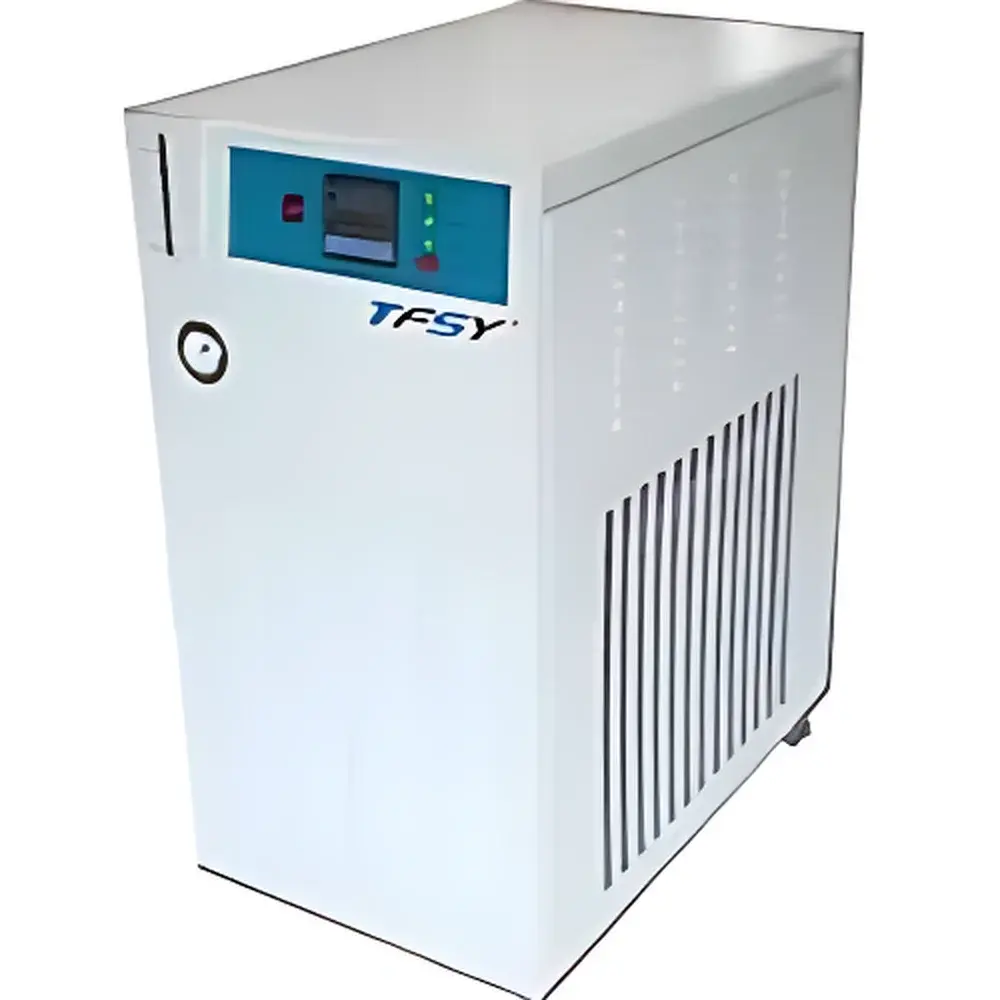
TF-LS Series Precision Circulating Chillers (TF-LS-2500 / LS-1000 / LS-600 / LS-1500)
| Origin | Shanghai, China |
|---|---|
| Manufacturer Type | Authorized Distributor |
| Product Origin | Domestic (PRC) |
| Models | TF-LS-2500 / LS-1000 / LS-600 / LS-1500 |
| Refrigeration Capacity | 2.5 kW / 1.0 kW / 0.6 kW / 1.5 kW |
| Water Tank Volume | 20 L / 12 L / 4 L / 15 L |
| Pump Head | 20 m / 20 m / 6 m / 20 m |
| Temperature Stability | ±1.0 °C (±0.1 °C optional) |
| Power Supply | 3-phase 380 V, 50 Hz (optional 220 V / 415 V, 50–60 Hz) |
| Refrigerant | R22 / R134a / R407C |
| Compressor Type | Hermetic scroll or reciprocating (model-dependent) |
| Evaporator | Titanium-tube immersion coil or 316 stainless steel plate heat exchanger |
| Safety Protections | High/low pressure switch, compressor overheat & overload, flow loss, phase failure, anti-freeze, and overtemperature cutoff |
Overview
The TF-LS Series Precision Circulating Chillers are engineered for stable, continuous thermal management of high-sensitivity laboratory and industrial equipment requiring precise coolant temperature control. These units operate on vapor-compression refrigeration principles—utilizing a hermetic compressor, thermostatic expansion valve (TXV), copper-aluminum finned condenser, and either titanium-coil or 316 stainless steel plate-type evaporators—to deliver consistent cooling performance across variable ambient conditions. Designed to meet the stringent thermal stability demands of analytical instrumentation—including graphite furnace atomic absorption spectrometers (GFAAS), inductively coupled plasma optical emission spectrometers (ICP-OES), ICP-mass spectrometers (ICP-MS), X-ray fluorescence (XRF) analyzers, X-ray diffractometers (XRD), scanning electron microscopes (SEM), and transmission electron microscopes (TEM)—the TF-LS series maintains setpoint accuracy within ±1.0 °C (±0.1 °C with optional high-precision PID controller), minimizing thermal drift during extended acquisition cycles. Their compact footprint, modular architecture, and compatibility with deionized or ultrapure water circuits make them suitable for integration into Class 100–1000 cleanroom environments and GLP/GMP-compliant laboratories.
Key Features
- Microprocessor-based PLC control system with intuitive keypad interface and real-time digital display of coolant temperature, flow status, and fault codes
- Imported hermetic compressors (U.S./Japanese origin) with low-noise operation, high energy efficiency, and extended service life under continuous duty cycles
- Corrosion-resistant fluid path components: titanium-tube immersion evaporators (TF-LS-2500) or 316 stainless steel plate heat exchangers (LS-1000/1500), compatible with DI water and low-conductivity coolants
- Industrial-grade centrifugal pumps featuring stainless steel impellers and shafts, delivering rated head up to 20 m with flow rates scalable to match instrument inlet requirements (e.g., 10–30 L/min)
- Comprehensive safety architecture including dual-stage temperature monitoring (tank + outlet), electronic flow switch detection, high/low refrigerant pressure cutoffs, phase sequence verification, and anti-freeze protection
- Electrical components sourced from globally certified suppliers (e.g., Schneider Electric contactors, thermal relays, and circuit breakers) ensuring long-term reliability and compliance with IEC 61000-6-2/6-4 EMC standards
- Ergonomic powder-coated steel enclosure with quick-release side panels for tool-free access to internal components and routine maintenance
Sample Compatibility & Compliance
The TF-LS Series supports closed-loop circulation of deionized water, 30% ethylene glycol/water mixtures, or other non-corrosive heat-transfer fluids meeting ASTM D1122 and ISO 2160 specifications. Units are validated for use with instruments requiring stable coolant supply at flow rates between 5–40 L/min and inlet pressures of 0.1–0.6 MPa. All models comply with CE marking requirements (2014/30/EU EMC Directive, 2014/35/EU LVD Directive) and conform to RoHS 2011/65/EU restrictions on hazardous substances. For regulated environments, optional audit-trail-enabled firmware supports FDA 21 CFR Part 11–compliant electronic recordkeeping when integrated with validated laboratory information management systems (LIMS). Units undergo factory calibration per ISO/IEC 17025–accredited procedures, with traceable NIST-certified reference thermistors installed at critical measurement points.
Software & Data Management
While the base configuration operates via embedded PLC logic without external software dependency, optional RS-485 Modbus RTU or Ethernet TCP/IP interfaces enable remote monitoring and parameter adjustment via SCADA platforms or custom LabVIEW/Python scripts. The controller logs operational data—including cumulative runtime, compressor cycles, temperature deviation history, and alarm events—for up to 30 days onboard. Data export is supported via USB flash drive (FAT32 format) in CSV format, facilitating trend analysis in Excel or statistical process control (SPC) tools. Firmware updates are performed offline using signed binary files to maintain integrity; no cloud connectivity or internet exposure is required, preserving network security in air-gapped lab infrastructures.
Applications
- Laboratory analytical instruments: GFAAS, ICP-OES, ICP-MS, XRF, XRD, SEM, TEM, laser-induced breakdown spectroscopy (LIBS) systems
- Medical and diagnostic equipment: MRI gradient coil cooling, PET/CT detector thermal stabilization, surgical laser consoles
- Industrial manufacturing: CO₂ and fiber laser cutting/welding systems, CNC spindle chillers, vacuum pump cooling, semiconductor lithography tools
- Research infrastructure: Synchrotron beamline optics, superconducting magnet support systems, cryogenic precooling stages
FAQ
What is the maximum allowable coolant temperature deviation during steady-state operation?
Under nominal load and ambient conditions ≤35 °C, temperature stability is maintained within ±1.0 °C of setpoint; models equipped with high-resolution PID controllers achieve ±0.1 °C with optional calibration verification.
Can these chillers be used with ultrapure water (UPW) systems?
Yes—titanium evaporators (TF-LS-2500) and 316 stainless steel heat exchangers (LS-1000/1500) are fully compatible with UPW (resistivity ≥18.2 MΩ·cm) and prevent metallic ion leaching that could compromise sensitive detectors.
Is remote monitoring capability standard or optional?
Remote communication (Modbus RTU or Ethernet) is optional; all units include local HMI with full diagnostics but require add-on interface modules for network integration.
Do the units meet international electrical safety standards for export?
Yes—CE-marked units comply with EN 61000-6-2 (immunity) and EN 61000-6-4 (emissions), as well as EN 60204-1 (machine safety); documentation includes EU Declaration of Conformity and test reports from accredited third-party labs.
What maintenance intervals are recommended for optimal performance?
Quarterly inspection of condenser fins and pump strainer; annual replacement of refrigerant dryer filter and verification of refrigerant charge; biannual calibration of temperature sensors against traceable references per ISO/IEC 17025 guidelines.



