
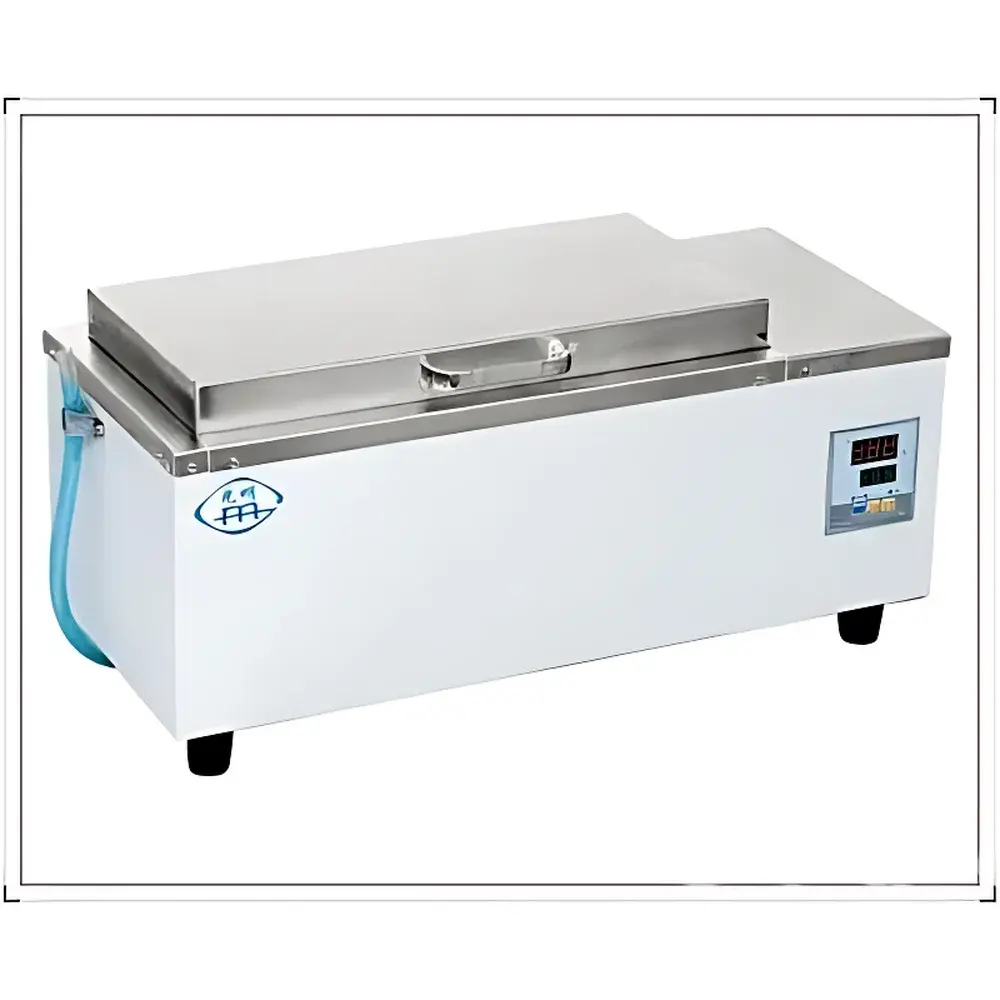
Shanghai Huaheng HHW21-420 & HHW21-600 Digital Programmable Water/Oil Bath Circulators
| Origin | Shanghai, China |
|---|---|
| Manufacturer Type | Authorized Distributor |
| Country of Origin | PRC |
| Model | HHW21-420 / HHW21-600 |
| Power Rating | 500 W (HHW21-420) / 750 W (HHW21-600) |
| Chamber Dimensions (W×D×H) | 420×180×105 mm (HHW21-420) / 600×300×150 mm (HHW21-600) |
| Temperature Range | 37–65 °C |
| Control System | Microprocessor-based digital PID controller with LED display |
| Construction | Electrostatically coated steel exterior |
| Compliance | CE-marked per EN 61000-6-3 (EMC) and EN 61000-6-2 (Immunity) |
Overview
The Shanghai Huaheng HHW21-420 and HHW21-600 Digital Programmable Water/Oil Bath Circulators are precision-engineered thermal conditioning systems designed for stable, uniform temperature control in laboratory environments. These units operate on the principle of resistive heating combined with passive convection and optional low-speed circulation (via integrated bath stirrer or external pump compatibility), delivering consistent thermal energy across the working chamber. Unlike open-beaker water baths, the HHW21 series features a fully enclosed stainless steel tank with insulated lid and microprocessor-regulated feedback loop—enabling ±0.3 °C temperature stability at setpoint under steady-state conditions. The system is calibrated for operation within the biologically and chemically relevant range of 37 °C to 65 °C, making it suitable for applications requiring precise thermal maintenance without active refrigeration or high-temperature capability.
Key Features
- Microprocessor-based PID temperature controller with LED digital display for real-time monitoring and programmable setpoint recall
- High-reliability 304 stainless steel inner tank and lid—resistant to corrosion from aqueous solutions, saline buffers, and mild organic solvents
- Electrostatically applied powder-coated carbon steel exterior for mechanical durability and chemical splash resistance
- Dual-model scalability: HHW21-420 (420 × 180 × 105 mm chamber, 500 W heater) for benchtop assays and small-volume incubation; HHW21-600 (600 × 300 × 150 mm chamber, 750 W heater) for multi-vessel processing or larger sample arrays
- Over-temperature cut-off protection and dry-run safety interlock to prevent heater damage during low-fluid conditions
- Front-panel accessible calibration offset adjustment (±5.0 °C range) for traceable instrument verification against NIST-traceable reference thermometers
Sample Compatibility & Compliance
These circulators accommodate standard laboratory glassware including beakers (up to 2 L), Erlenmeyer flasks, test tube racks, serological pipette holders, and microbiological culture trays. The flat-bottomed tank geometry ensures optimal thermal coupling with immersed vessels. Units comply with EN 61000-6-3 (radiated and conducted electromagnetic emissions) and EN 61000-6-2 (electromagnetic immunity), supporting integration into regulated lab infrastructure. While not classified as medical devices under FDA 21 CFR Part 820, their thermal performance meets ISO/IEC 17025 clause 5.4.2 requirements for equipment used in accredited testing laboratories—particularly for sample equilibration prior to viscosity measurement, enzyme kinetics, serum stability assessment, or pharmaceutical dissolution pre-conditioning. Optional documentation packages include factory calibration certificates (traceable to national metrology institutes) and IQ/OQ templates for GLP/GMP-aligned validation.
Software & Data Management
The HHW21 series operates as a standalone analog-digital hybrid system with no embedded firmware upgradability or USB/Ethernet connectivity. However, its analog voltage output (0–5 V DC proportional to internal sensor reading) is compatible with third-party data loggers (e.g., Omega OM-DAQPRO, Keysight 34972A) for time-stamped temperature trending. All models support manual recording per ISO/IEC 17025 clause 4.13.2.1—requiring users to maintain handwritten or electronic logs of operational parameters, calibration dates, and maintenance interventions. For labs implementing 21 CFR Part 11 compliance, external audit trails must be generated via validated logging hardware or LIMS-integrated acquisition modules—not through the unit’s native interface.
Applications
- Constant-temperature incubation of serum samples, antigen-antibody reaction mixtures, and diagnostic reagents per CLSI EP21-A guidelines
- Controlled evaporation and concentration of solvent-sensitive compounds in analytical chemistry workflows
- Pre-equilibration of viscometer spindles, density meters, and refractometer cells prior to measurement
- Thermal activation of thermostable enzymes (e.g., Taq polymerase dilution buffers) and heat-inactivation of serum complement proteins
- Boiling-point sterilization of reusable glassware and metal instruments using sustained 65 °C immersion (validated per ISO 15883-1 Annex B for low-temperature disinfection)
- Supporting ASTM D1298 (crude oil density), ASTM D4052 (liquid density by digital densitometry), and USP environmental conditioning protocols
FAQ
Can this unit be used with silicone oil or other heat-transfer fluids?
Yes—the 304 stainless steel tank is chemically compatible with mineral oils, silicone oils (up to 200 °C), and glycerol-water mixtures. However, maximum operating temperature remains limited to 65 °C per controller firmware; exceeding this may void warranty and compromise sensor longevity.
Is external circulation possible for connecting to jacketed reactors or external coils?
The HHW21 series does not include built-in circulation pumps or inlet/outlet ports. For closed-loop external circulation, users must integrate an external peristaltic or centrifugal pump rated for the selected fluid and temperature range.
Does the unit meet IP rating requirements for wet-lab environments?
It carries no formal IP rating. While the enclosure resists incidental splashes, it is not sealed against continuous moisture exposure or submersion. Installation requires placement on level, non-porous surfaces with adequate ventilation clearance (≥10 cm on all sides).
What documentation is provided for regulatory audits?
Each unit ships with a Declaration of Conformity (CE), factory calibration record (at 37 °C and 65 °C), and user manual in English. Optional GMP-grade documentation—including calibration SOPs, preventive maintenance logs, and IQ/OQ checklists—is available upon request.
How often should temperature calibration be performed?
Per ISO/IEC 17025 section 6.4.10, calibration interval shall be determined by usage frequency, criticality of application, and historical stability data. For routine QC use, annual verification against a NIST-traceable thermometer is recommended; for GLP studies, calibration before each batch is advised.



