
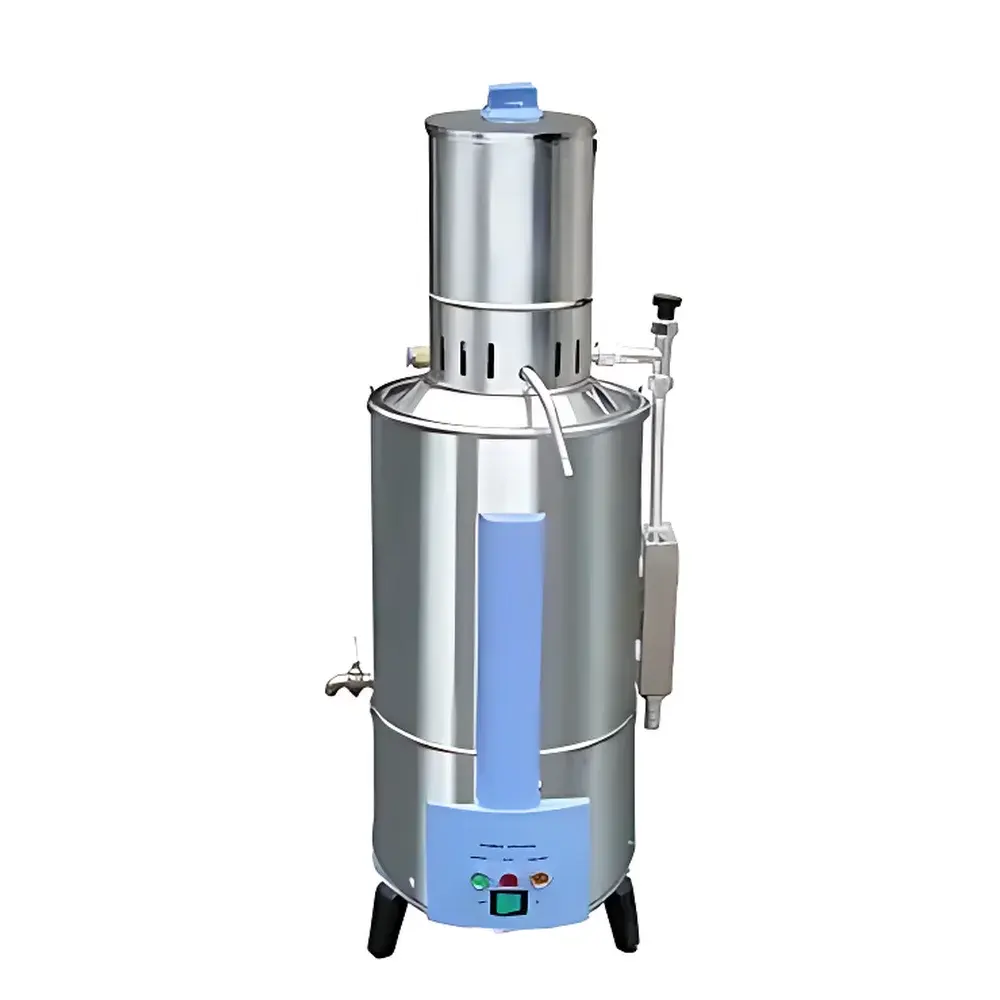
YA.ZDI-5 Stainless Steel Electric Distillation Apparatus with Automatic Dry-Run Protection
| Model | YA.ZDI-5 |
|---|---|
| Output Rate | 5 L/h |
| Power Supply | 220 V AC |
| Heating Power | 4.5 kW |
| Net Weight | 9 kg |
| Dimensions (L×W×H) | 830 × 360 × 370 mm |
| Construction Material | AISI 304 Stainless Steel |
| Safety Features | Auto-refill system, dry-run cutoff, status indicator lights, insulated control panel guard, dual-direction pressure-regulated valve, internal baffle-type flow control |
Overview
The YA.ZDI-5 Stainless Steel Electric Distillation Apparatus with Automatic Dry-Run Protection is a benchtop-scale, continuous-feed steam-distillation unit engineered for reliable production of Type III purified water in compliance with ISO 3696:1987 and ASTM D1193-20. It operates on the principle of thermal phase separation: feed water is heated to boiling in a stainless steel evaporator chamber; steam rises through a vapor path into a cooled condenser coil, where it undergoes phase reversion to liquid form under controlled thermal gradient conditions. The resulting distillate—free of non-volatile ions, organic contaminants, particulates, and microorganisms—is collected as high-purity water suitable for general laboratory use, including buffer preparation, media formulation, instrument rinsing, and non-critical analytical applications. Designed for uninterrupted operation in environments where municipal water supply may fluctuate, the unit integrates fail-safe thermal and level-sensing logic to prevent heater element exposure during low-water conditions.
Key Features
- Full AISI 304 stainless steel construction—including evaporator chamber, condenser housing, collection vessel, and piping—ensures long-term resistance to chloride-induced pitting, scaling, and corrosion from hard or chlorinated feed water.
- Automated dry-run protection circuitry continuously monitors water level in the boiling chamber via conductive probes; power to the heating element is cut within ≤2 seconds upon detection of sub-minimum fluid level.
- Integrated float-controlled auto-refill system maintains consistent operating volume without manual intervention, supporting unattended 8–12 hour cycles when paired with a stable feed source.
- Dual-direction adjustable pressure relief valve enables fine-tuning of vapor pressure differential across the condenser, optimizing condensation efficiency and minimizing carryover risk.
- Front-panel LED indicators provide real-time status feedback for power-on, heating active, water level normal, and dry-run alarm states.
- Thermally insulated control enclosure with recessed mounting prevents surface temperatures exceeding 45 °C during extended operation, meeting IEC 61010-1 touch-safety requirements for laboratory equipment.
- Baffle-type internal vapor routing minimizes entrainment of droplets or aerosols by inducing laminar flow separation prior to condensation, improving distillate purity consistency.
Sample Compatibility & Compliance
The YA.ZDI-5 accepts tap water, deionized water, or softened municipal supplies as input. It is not intended for seawater, highly turbid, or chemically aggressive industrial effluents. Distillate quality meets or exceeds specifications for Type III water per ISO 3696 (conductivity ≤ 0.5 mS/m at 25 °C), and supports GLP-aligned documentation when operated with batch log entries. Unit design conforms to IEC 61010-1:2010 for electrical safety and EN 60529 IP20 ingress protection. No external cooling water connection is required—the condenser relies on ambient air convection, simplifying installation in standard lab settings without chilled water infrastructure.
Software & Data Management
This apparatus operates as a standalone analog-electromechanical system with no embedded firmware, network interface, or digital data logging capability. All operational parameters are set manually via front-panel controls; no software drivers, configuration utilities, or cloud connectivity are provided. For regulated environments requiring audit trails, users must implement external procedural documentation (e.g., handwritten logs or LIMS-integrated batch records) tracking start/stop times, feed water source, operator ID, and daily output volume. While not compliant with FDA 21 CFR Part 11 out-of-the-box, its deterministic mechanical behavior and absence of programmable logic simplify validation protocols for GMP-adjacent workflows where electronic signatures are not mandated.
Applications
- Preparation of solvent-grade water for HPLC mobile phase dilution (non-gradient, non-UV-sensitive methods)
- Rinsing of volumetric glassware and pipettes in QC/QA laboratories
- Feedstock for autoclave reservoirs and humidification systems
- Media and reagent preparation in microbiology and cell culture support labs
- Calibration standard dilution in wet chemistry testing (e.g., titrations, colorimetry)
- General-purpose purified water in teaching laboratories and field-deployable units
FAQ
What feed water quality is recommended for optimal performance?
Tap water with total dissolved solids (TDS) below 500 ppm and free chlorine concentration under 2 mg/L is preferred. Pre-filtration through a 5-µm sediment filter and activated carbon cartridge is advised for municipal sources with variable hardness or disinfectant residuals.
Can this unit produce water suitable for HPLC or LC-MS applications?
No. The YA.ZDI-5 delivers Type III water only. It lacks post-distillation polishing (e.g., UV oxidation, ultrafiltration) required for Type I ultrapure water specifications (e.g., resistivity ≥18.2 MΩ·cm, TOC < 5 ppb).
Is routine maintenance required beyond cleaning?
Yes. Descaling of the evaporator chamber every 100–150 operating hours using 5% citric acid solution is necessary to maintain thermal efficiency and prevent nucleation-site fouling. Condenser fins should be inspected quarterly for dust accumulation.
Does the unit include a built-in storage tank?
No. Distillate exits continuously via gravity-fed outlet tubing. Users must connect an external collection container (e.g., polypropylene carboy or stainless carafe) sized for anticipated hourly yield.
What is the expected service life under standard lab usage?
With proper feed water pretreatment and adherence to descaling intervals, the heating element and stainless structure demonstrate ≥5 years of functional service life under 4–6 hours/day intermittent operation.



