
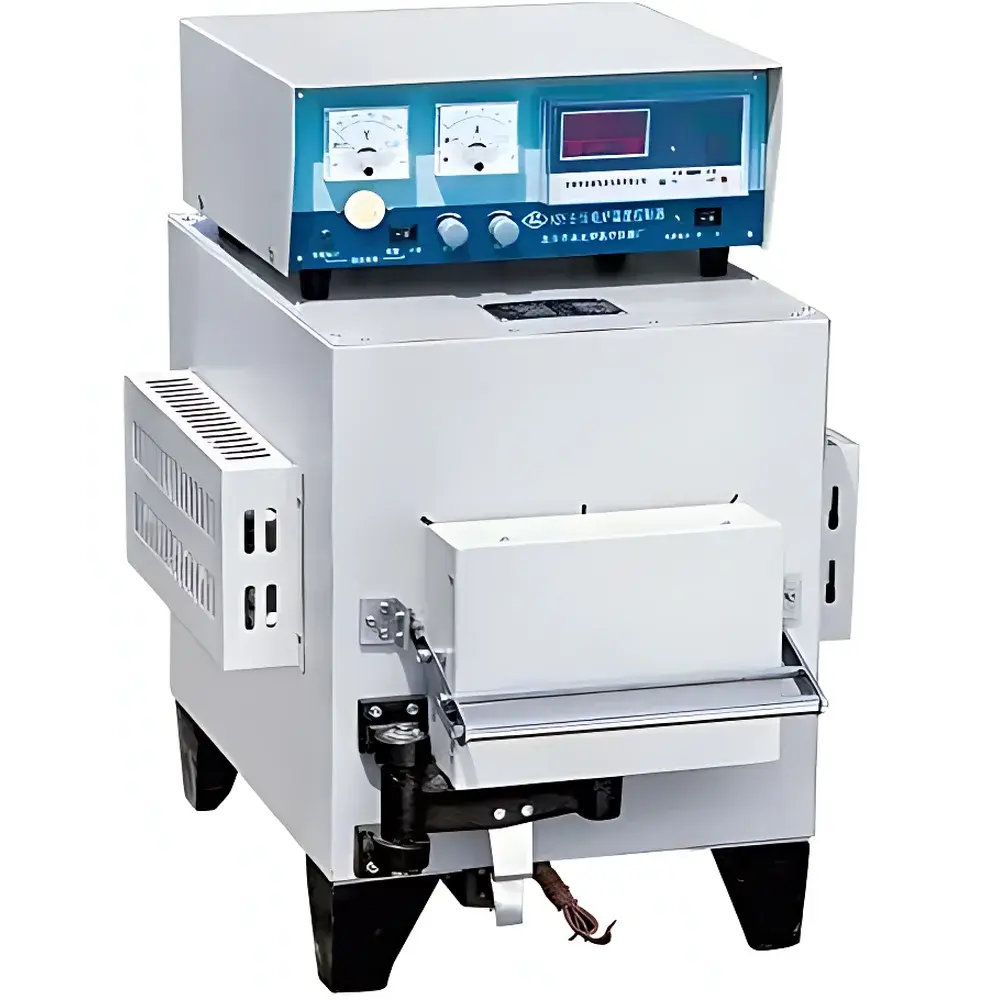
Shanghai Xinke SX-2.5-12 / SX-5-12 / SX-10-12 Benchtop Muffle Furnace Series
| Origin | Shanghai, China |
|---|---|
| Manufacturer Type | Authorized Distributor |
| Country of Origin | PRC |
| Model | SX-2.5-12 |
| Rated Temperature | 1200 °C |
| Voltage/Power | 220 V / 2.5 kW (SX-2.5-12) |
| Internal Chamber Dimensions (W×D×H) | 200 × 120 × 80 mm |
| Compliance | CE-marked per EN 61000-6-3 & EN 61000-6-4 |
Overview
The Shanghai Xinke SX-2.5-12, SX-5-12, and SX-10-12 benchtop muffle furnaces are precision-engineered, periodic-duty resistance-heated thermal systems designed for controlled high-temperature applications in analytical laboratories, materials research facilities, and quality control environments. These furnaces operate on the principle of radiant heating via embedded Kanthal A1 or equivalent high-resistance alloy heating elements, fully isolated within a refractory ceramic fiber insulation matrix. The muffle design ensures complete thermal and chemical separation between the heating chamber and the external environment—critical for ashing, calcination, gravimetric analysis, and heat treatment processes where contamination or atmospheric interference must be minimized. With a maximum operating temperature of 1200 °C, the series supports standardized thermal protocols aligned with ASTM E1529 (fire-test-response), ISO 1171 (ash content determination), and USP & EP monographs requiring precise thermal ramping and soak stability.
Key Features
- Robust welded steel outer casing with electrostatic epoxy-polyester powder coating for corrosion resistance and mechanical durability under routine lab handling.
- High-density ceramic fiber insulation (density ≥ 128 kg/m³) between furnace chamber and shell, providing thermal conductivity < 0.09 W/(m·K) at 1000 °C and minimizing external surface temperature rise (< 55 °C at ambient).
- Refractory chamber lined with high-purity alumina-silica firebrick (Al₂O₃ ≥ 45%, SiO₂ ≥ 50%), rated for continuous operation up to 1200 °C and resistant to thermal shock and alkali/acid vapor exposure.
- Counterbalanced lever-latch door mechanism enabling smooth, repeatable sealing without gaskets—ensuring consistent chamber atmosphere integrity during heating cycles.
- Integrated over-temperature protection via independent bimetallic cut-off switch (set point: 1250 °C), compliant with IEC 61010-1 Clause 11.3 for Class II laboratory equipment.
- Front-panel digital controller with PID algorithm, ±1 °C temperature uniformity across chamber volume (per ASTM E220 calibration standard), and programmable ramp/soak profiles (up to 8 segments).
Sample Compatibility & Compliance
The SX-series accommodates crucibles (alumina, platinum, quartz, stainless steel), ceramic boats, and small metallic specimens up to 200 g mass per cycle. Chamber dimensions support standard ASTM G162 and ISO 6874 sample holders. All models comply with GLP documentation requirements through optional RS-232/USB data logging (with timestamped temperature records). Electrical safety certification includes CE marking per EN 61000-6-3 (EMI emission) and EN 61000-6-4 (immunity), and full conformity with IEC 61010-1:2010 + A1:2019 for measurement, control, and laboratory use. Optional factory calibration certificate traceable to NIM (National Institute of Metrology, China) is available upon request.
Software & Data Management
While the base configuration features an integrated microprocessor-based controller with local setpoint adjustment and real-time temperature display, optional PC connectivity enables advanced thermal protocol management. The optional XinkeTherm™ LabLink software (Windows-compatible) supports full-cycle logging—including ramp rate, dwell time, peak temperature, and cooling curve—with export to CSV or PDF formats. Audit trail functionality meets FDA 21 CFR Part 11 requirements when paired with user-access controls and electronic signature modules. Data files include automatic metadata stamping (operator ID, instrument serial number, calibration status) to satisfy ISO/IEC 17025 clause 7.7 traceability mandates.
Applications
- Gravimetric analysis: ash content determination in foodstuffs (AOAC 942.05), pharmaceutical excipients (USP <281>), and environmental samples (EPA Method 2540F).
- Thermal pretreatment: pre-ignition of filter papers and crucibles prior to combustion analysis (ASTM D3174, ISO 1171).
- Heat treatment of small components: annealing, stress-relieving, and tempering of tool steels and non-ferrous alloys (per ASTM A967 and AMS 2750E pyrometry class requirements).
- Materials synthesis: solid-state reaction sintering of oxide ceramics, catalyst precursor decomposition, and lithium-ion battery cathode material calcination.
- Calibration reference: serving as stable thermal sources for thermocouple verification (per ASTM E230/E230M) and infrared thermometer validation.
FAQ
What is the recommended maintenance interval for the heating elements and insulation?
Heating elements require visual inspection every 200 operational hours; replacement is advised after 1500–2000 h at 1200 °C. Ceramic fiber insulation should be checked for cracking or compression loss annually—repacking is required if density falls below 110 kg/m³.
Can these furnaces be used under inert or reducing atmospheres?
No—the standard configuration lacks gas inlet/outlet ports or sealed atmosphere capability. For controlled-atmosphere applications, consult the SX-G series with flanged quartz tube inserts and dual-gas mass flow controllers.
Is third-party calibration included with purchase?
Factory calibration at 100 °C, 600 °C, and 1000 °C is provided with NIST-traceable certificate. Full 3-point on-site calibration by accredited labs (e.g., A2LA or UKAS) is available as an add-on service.
How does temperature uniformity compare across chamber volume?
Per internal validation per ASTM E220 Annex A3, uniformity is ±3 °C at 1200 °C in the central 60% of chamber volume (measured using 3-point thermocouple mapping).
What safety certifications apply to international shipment?
All units ship with CE DoC, RoHS 2011/65/EU declaration, and UL/cUL recognition pending upon regional voltage configuration (220 V/50 Hz or 110 V/60 Hz variants available).



