
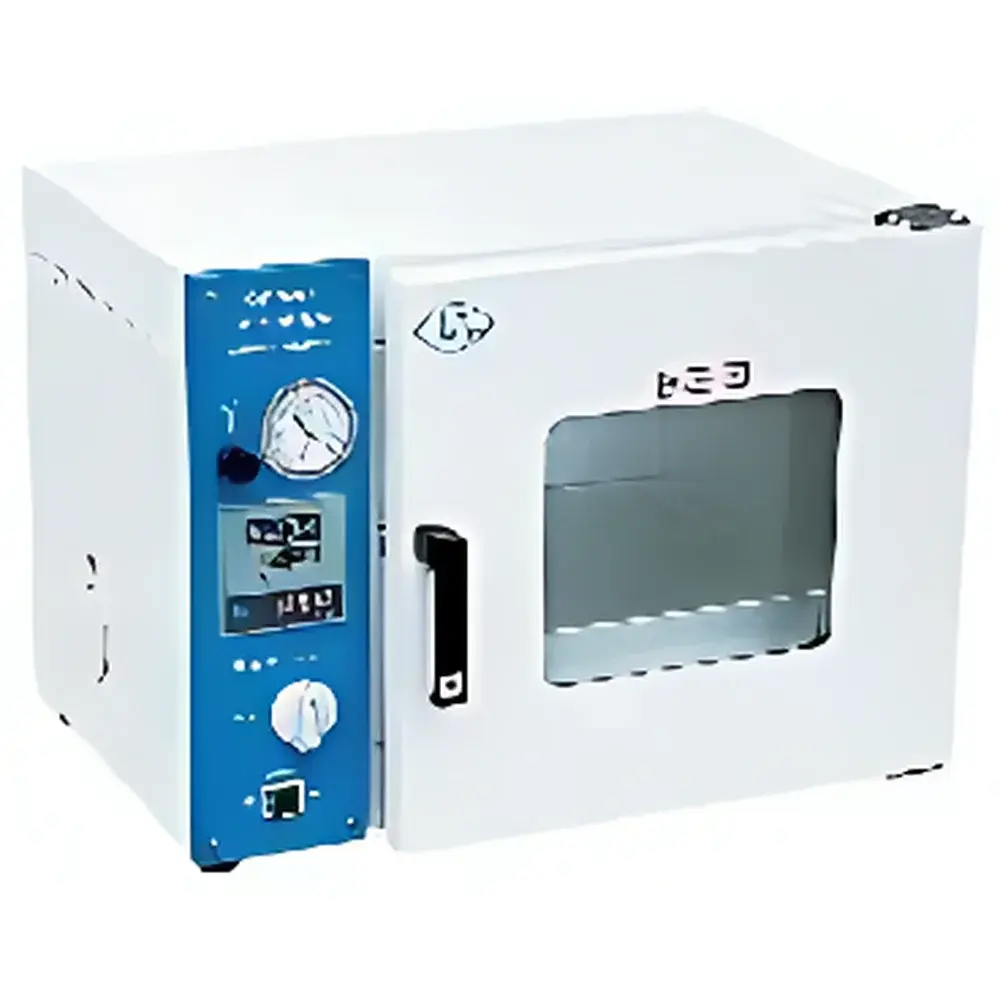
Shanghai LabTech DZF-3B Stainless Steel Vacuum Drying Oven
| Origin | Shanghai |
|---|---|
| Manufacturer Type | Authorized Distributor |
| Origin Category | Domestic (China) |
| Model | DZF-3B |
| Price | USD 2,700 (FOB Shanghai) |
| Voltage/Power | 220 V / 1400 W |
| Chamber Dimensions | 450 × 450 × 450 mm |
| Temperature Range | 50–250 °C |
| Construction | 304 Stainless Steel Interior & Exterior |
| Door | Tempered Bullet-Resistant Glass |
| Sealing | Integrated Molded Silicone Gasket |
| Control System | Intelligent PID Temperature Controller |
| Vacuum Compatibility | Compatible with Standard Two-Stage Rotary Vane Vacuum Pumps (e.g., ≤ 5 Pa ultimate vacuum) |
Overview
The Shanghai LabTech DZF-3B Stainless Steel Vacuum Drying Oven is an engineered solution for controlled thermal processing under reduced-pressure conditions. Designed in accordance with fundamental principles of vacuum thermodynamics, it enables solvent removal, moisture elimination, heat-sensitive material stabilization, and low-oxygen thermal treatment without oxidative degradation. Unlike conventional convection ovens, the DZF-3B operates by evacuating ambient air to lower the boiling point of volatile components—thereby facilitating gentle, uniform drying at sub-atmospheric pressures. Its rigid 304 stainless steel chamber construction ensures long-term resistance to corrosion, thermal cycling fatigue, and chemical exposure typical in pharmaceutical, materials science, and polymer research laboratories. The unit complies with general safety requirements outlined in IEC 61010-1 (Safety Requirements for Electrical Equipment for Measurement, Control, and Laboratory Use) and supports integration into GLP-compliant workflows when paired with validated vacuum gauges and calibrated temperature sensors.
Key Features
- Spacious cubic chamber (450 × 450 × 450 mm) optimized for volumetric efficiency and uniform heat distribution across stacked or irregularly shaped samples.
- Intelligent PID temperature controller with ±1.0 °C accuracy (at setpoint), programmable ramp-soak profiles, and real-time digital display for repeatable thermal protocols.
- Tempered bullet-resistant glass door with multi-point adjustable clamping mechanism—enabling visual monitoring without vacuum interruption or thermal loss.
- Seamless, compression-molded silicone gasket integrated into the door frame, tested to maintain ≤ 5 Pa residual pressure over extended operation cycles (when used with appropriate vacuum pumps).
- Full 304 stainless steel interior and exterior surfaces—including shelves, walls, and door liner—resisting pitting, passivation loss, and cleaning agent erosion during routine decontamination.
- Robust heating system with distributed tubular heaters and forced-air-free radiant design, minimizing hot spots and ensuring thermal homogeneity per ISO 14644-1 Class 8 cleanroom-compatible operation.
Sample Compatibility & Compliance
The DZF-3B accommodates a broad range of sample formats: porous ceramics, lyophilized biologics, thin-film coatings, battery electrode slurries, and moisture-sensitive electronic components. It supports ASTM D2291 (Standard Test Method for Moisture Content of Insulating Materials), ISO 758 (Determination of Water Content—Karl Fischer Titration), and USP (Water for Pharmaceutical Purposes) ancillary drying steps. While the oven itself does not carry CE marking or FDA 510(k) clearance, its mechanical and electrical architecture conforms to EN 61000-6-3 (EMC Emission Standards) and UL 61010-1 recognized construction practices. Users are responsible for validating vacuum integrity, temperature uniformity (per IQ/OQ protocols), and process reproducibility per internal SOPs or regulatory mandates such as EU Annex 15 or FDA Guidance for Industry: Process Validation.
Software & Data Management
The DZF-3B operates via embedded firmware with no proprietary software dependency. All temperature setpoints, dwell times, and alarm thresholds are configured directly on the front-panel interface. Optional RS485 Modbus RTU output (available upon request) enables connection to SCADA systems or centralized lab data loggers for time-stamped temperature/vacuum trend capture. When integrated with third-party vacuum controllers (e.g., Pfeiffer TPG300 series), the system supports audit-trail-capable logging compliant with FDA 21 CFR Part 11 requirements—provided the host software implements electronic signatures, user access controls, and immutable record storage.
Applications
- Pre-weighing desiccation of reference standards prior to gravimetric analysis (e.g., ASTM E2906).
- Drying of nanomaterial dispersions without agglomeration—leveraging reduced surface tension under vacuum.
- Thermal aging studies of encapsulated OLED substrates under inert gas backfill (N₂ or Ar) after vacuum evacuation.
- Post-synthesis solvent removal from MOFs and covalent organic frameworks where atmospheric heating induces structural collapse.
- Stabilization of calibration weights and precision metrology artifacts in humidity-controlled metrology labs.
- Low-temperature sterilization validation support for reusable surgical instruments (as part of multi-stage depyrogenation protocols).
FAQ
What vacuum level can the DZF-3B achieve?
When paired with a standard two-stage rotary vane pump (e.g., 2 L/s displacement), the chamber typically reaches ≤ 5 Pa (0.038 Torr) within 25–35 minutes. Ultimate vacuum depends on pump performance, seal integrity, and chamber load.
Is the temperature uniformity validated per ISO 17025?
The base unit does not include factory-issued uniformity reports. Users must perform in-house mapping using NIST-traceable PT100 probes at 9 points (per ISO/IEC 17025:2017 Clause 7.8.2) during qualification.
Can the DZF-3B be used for oxygen-sensitive annealing?
Yes—after achieving target vacuum, users may backfill with high-purity inert gas (e.g., 99.999% N₂) via optional inlet valve kits. This enables controlled atmosphere thermal treatments.
Does the stainless steel chamber resist hydrochloric acid vapor exposure?
No. 304 stainless steel is not resistant to chloride-containing vapors. For aggressive chemistry applications, electropolished 316L or Hastelloy C-276 lining upgrades are recommended.
What maintenance intervals are recommended for the silicone gasket?
Inspect visually before each use; replace every 18–24 months or immediately if cracking, permanent compression set (>20%), or vacuum hold time degradation exceeds 15% from baseline.
Related Products



