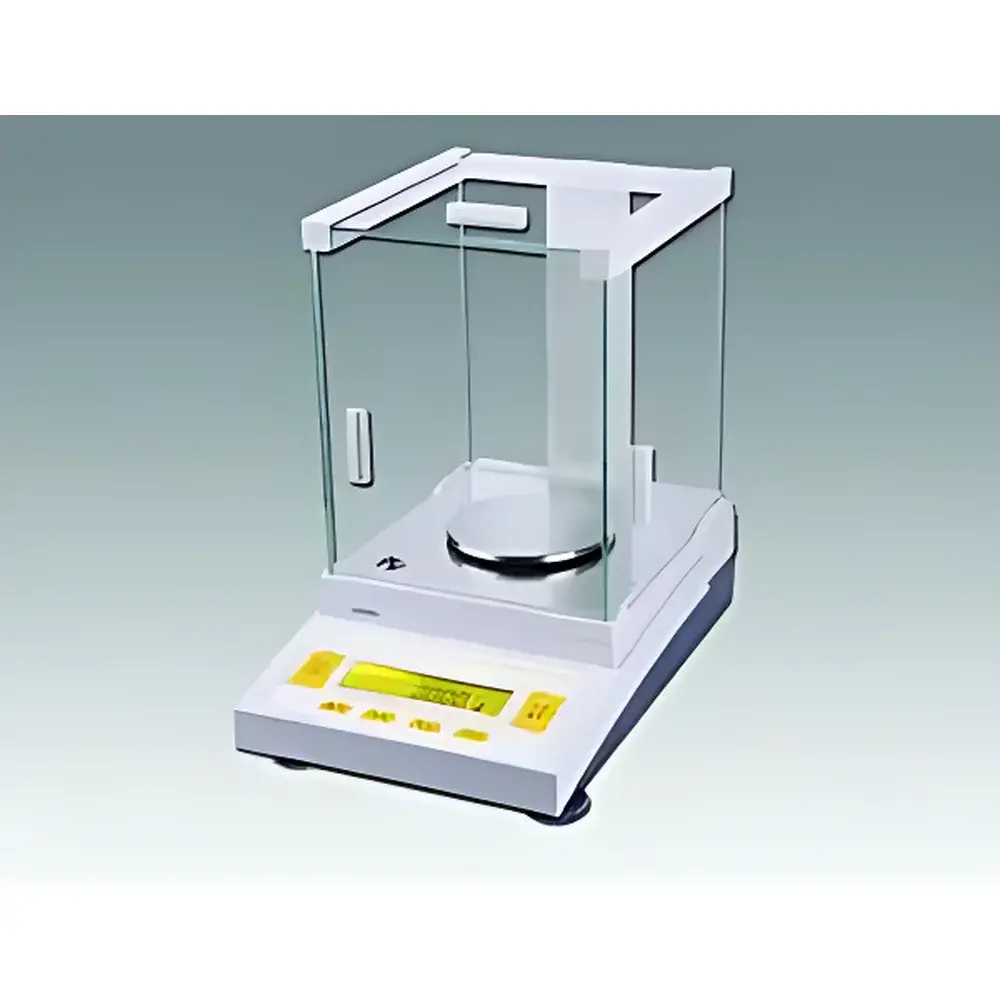
Chu Ding Technology JA2003N Analytical Balance
| Brand | Chu Ding Technology |
|---|---|
| Origin | Shanghai, China |
| Model | JA2003N |
| Capacity | 200 g |
| Readability | 1 mg |
| Repeatability | ≤1 mg |
| Linearity | ±2 mg |
| Dimensions (W×D×H) | 350 × 220 × 340 mm |
| Pan Diameter | Φ90 mm |
| Power | AC adapter or 9 V battery |
| Display | Backlit LCD |
| Interface | RS232 |
| Environmental Compensation | Dynamic temperature compensation |
| Features | Internal calibration, tare, counting mode, unit conversion (g, oz, ct), auto-zero tracking, overload protection & alarm, electromagnetic force sensor, 5-sided glass draft shield, 4-level shock absorption |
Overview
The Chu Ding Technology JA2003N Analytical Balance is a high-precision laboratory balance engineered for routine quantitative mass measurement in quality control, academic research, pharmaceutical formulation, and industrial process verification. It operates on the principle of electromagnetic force compensation (EMFC), where the mass-induced displacement of the weighing pan is counteracted by a precisely regulated electromagnetic field; the resulting current required to restore equilibrium is linearly proportional to the applied load. This architecture eliminates mechanical hysteresis and creep inherent in strain-gauge-based systems, delivering superior long-term stability and reproducibility. With a 200 g maximum capacity and 1 mg readability (0.001 g), the JA2003N meets the performance criteria for Class II analytical balances per OIML R76 and ISO 9001-compliant environments. Its compact footprint (350 × 220 × 340 mm) and integrated five-sided glass draft shield ensure operational reliability in standard laboratory workspaces without requiring dedicated vibration-isolated benches.
Key Features
- Electromagnetic force compensation sensor with zero drift suppression and dynamic temperature compensation for consistent accuracy across ambient fluctuations (15–30 °C)
- Backlit LCD display with high-contrast characters and intuitive icon-driven interface for rapid parameter navigation
- Five-sided transparent glass draft shield providing full visual access while minimizing air-current interference during low-mass measurements
- Four-stage shock absorption system with adjustable stabilization speed—enabling optimization for either rapid throughput or ultra-stable endpoint readings
- Internal calibration function with automatic self-check at power-on and user-triggered recalibration—no external weights required
- Full-range tare capability, programmable auto-zero tracking, overload protection with audible/visual alert, and mechanical overtravel limiters
- RS232 serial interface compliant with standard ASCII command protocols for direct integration into LIMS or custom data acquisition software
Sample Compatibility & Compliance
The JA2003N accommodates a broad range of sample types—including powders, granules, liquids in tared containers, and small solid components—via its stainless-steel weighing pan (Φ90 mm). The draft shield permits safe handling of hygroscopic or volatile substances. While not certified for GMP-regulated production environments, the balance supports GLP-aligned workflows through traceable calibration records, audit-ready operation logs (when paired with compatible software), and compliance with ISO/IEC 17025 documentation requirements for calibration uncertainty estimation. It satisfies functional equivalency to ASTM E898–22 (Standard Guide for Selection and Use of Laboratory Balances) and aligns with USP general chapter recommendations for analytical balance verification when used within defined environmental controls.
Software & Data Management
Data export is enabled via the built-in RS232 port using standard asynchronous serial communication (9600 baud, 8N1). No proprietary drivers are required; output format follows NIST-traceable ASCII conventions (e.g., “S 000.1234 g” for stable reading). When interfaced with validated third-party software (e.g., LabX Lite or custom Python/Excel VBA scripts), the balance supports timestamped batch logging, statistical process control (SPC) charting, and CSV export with metadata fields (operator ID, sample ID, tare status). Though lacking native 21 CFR Part 11 electronic signature support, its deterministic output stream allows integration into validated systems where data integrity is enforced at the host application layer.
Applications
- Pharmaceutical QC: Active ingredient dispensing verification, excipient ratio checks, and tablet weight uniformity testing per USP
- Chemistry labs: Precise reagent preparation, gravimetric titration standardization, and catalyst dosage control
- Materials science: Density determination of composites, ash content analysis, and moisture loss-on-drying (LOD) assays
- Educational settings: Teaching fundamental metrology concepts including repeatability, linearity, and sensitivity error
- Manufacturing QA: Component count-by-weight for fasteners, PCB assemblies, or packaging fill verification
FAQ
What is the recommended calibration frequency for the JA2003N in routine lab use?
Daily verification with a certified 100 g check weight is advised before first use; full internal calibration should be performed after significant ambient temperature shifts (>5 °C) or every 24 hours in continuous operation.
Does the balance support external calibration with traceable weights?
Yes—the device accepts manual external calibration using Class M2 or better weights via the calibration menu, though internal calibration remains the primary method for daily use.
Can the RS232 output be logged directly to a networked database?
Yes, provided the host system implements proper handshaking and parsing logic; raw ASCII output is fully compatible with SQL-based data ingestion pipelines.
Is the JA2003N suitable for weighing volatile solvents?
Only when placed inside the closed draft shield and with minimal lid opening duration; extended exposure may affect thermal equilibrium and introduce buoyancy errors.
What maintenance is required to sustain metrological performance?
Monthly cleaning of the pan and shield interior with lint-free ethanol wipes; annual verification of electromagnetic coil alignment and sensor linearity by an accredited service provider is recommended.