
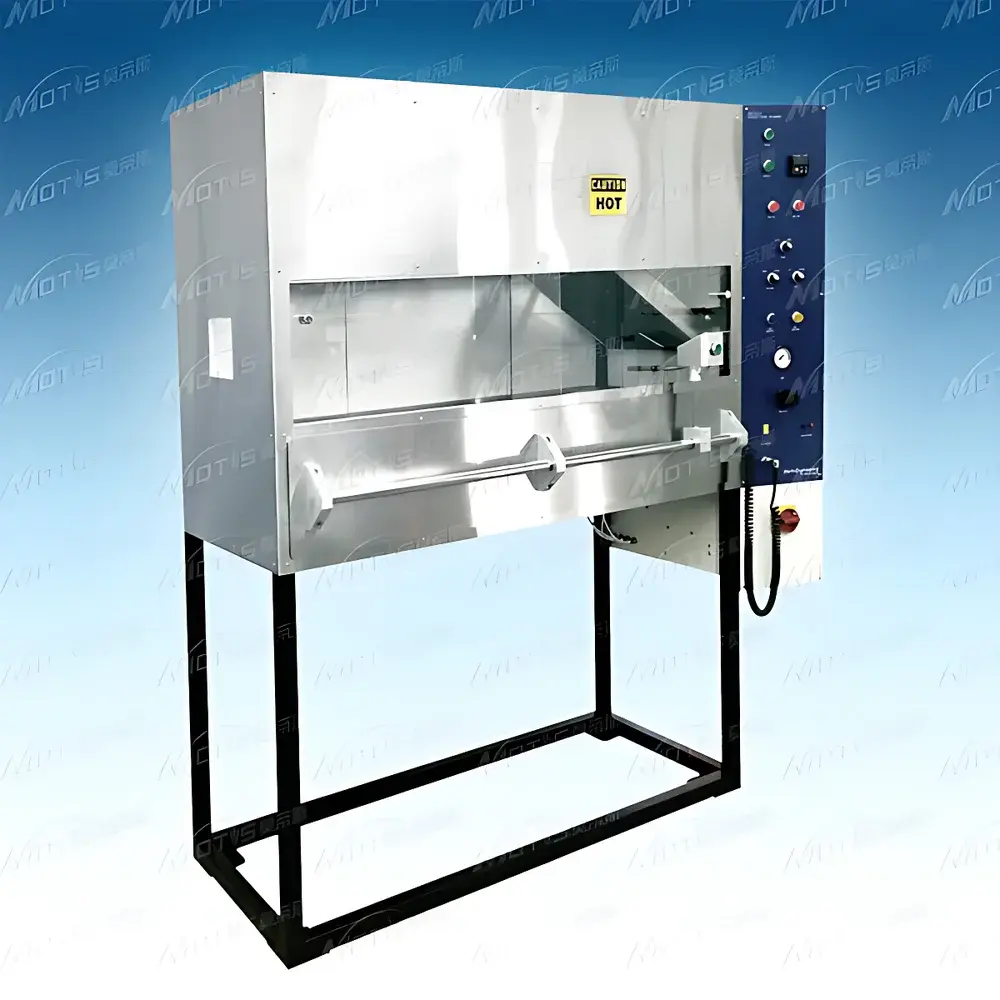
Marlin Engineering ME1300-3 FAA-Approved Radiant Panel Flame Spread Tester for Thermal/Acoustic Insulation Materials
| Brand | Marlin Engineering (MEI) |
|---|---|
| Origin | USA |
| Model | ME1300-3 |
| Compliance | FAR Part 25 Appendix F Part VI, Airbus AITM 2.0053, Boeing BSS 7365, MH/T 6042-2006 |
| Radiation Panel Angle | 30° to horizontal |
| Radiant Heat Source | 400 VAC 3-phase resistive panel with six 76 mm-wide heating strips |
| Max Operating Temperature | ≥704 °C |
| Temperature Control Accuracy | ±0.1 °C (PID) |
| Ignition Source | Propane Wurster burner, 0.15 mm orifice |
| Flame Height Adjustment | ≥51 mm above specimen plane |
| Laser Distance Monitoring System | For real-time flame front tracking |
| Water-Cooled Heat Flux Sensor | ≥60 kW/m² range, integrated recirculating coolant loop |
| Heat Flux Sensor Mounting | 3.2 mm steel bracket with three 25.4 mm-diameter mounting holes (center-to-center spacing: 51 mm |
| Specimen Holder Options | Standard and short hook-and-loop test fixture (dual-position) |
| Data Acquisition | Automated time-stamped logging, stop-on-criterion, timing resolution: 0.1 s |
| Thermal Monitoring | Calibrated thermocouple positioned 279 mm from rear wall, 292 mm from right wall, and 51 mm below radiant panel (accuracy: ±2 °C) |
| Actuation | Pneumatic sliding drawer for specimen insertion/retraction |
Overview
The Marlin Engineering ME1300-3 Radiant Panel Flame Spread Tester is a rigorously engineered combustion test system designed specifically for evaluating the flame propagation behavior of thermal and acoustic insulation materials used in commercial and military aircraft interiors. It operates on the principle of controlled radiant heat exposure followed by piloted ignition—mimicking real-world fire initiation scenarios where insulating blankets, batts, and composite laminates are subjected to intense thermal radiation prior to direct flame contact. The instrument conforms to the physical configuration, operational sequence, and measurement requirements defined in FAR Part 25 Appendix F Part VI—the foundational U.S. Federal Aviation Regulation governing flammability of aircraft interior materials—as well as internationally harmonized standards including Airbus AITM 2.0053 and Boeing BSS 7365. Its design integrates metrological traceability, mechanical repeatability, and environmental isolation to ensure data integrity required for regulatory submissions and airworthiness certification.
Key Features
- High-stability radiant panel assembly featuring six 76 mm-wide resistive heating strips mounted within a rigid structural frame; capable of sustained operation at temperatures ≥704 °C with PID-controlled thermal regulation (±0.1 °C stability).
- Precisely angled radiant panel (30° to horizontal) housed inside a fully enclosed test chamber equipped with an integral draft hood and exhaust chimney to maintain consistent boundary-layer conditions during testing.
- Propane-fueled Wurster-type ignition burner with a 0.15 mm orifice diameter, mounted on a motorized linear stage to ensure reproducible flame positioning ≥51 mm above the specimen surface.
- Laser-based optical monitoring system aligned parallel to the specimen surface, enabling high-resolution tracking of flame front progression along the longitudinal axis with sub-millimeter spatial fidelity.
- Water-cooled calorimetric heat flux sensor rated for incident radiant fluxes up to and exceeding 60 kW/m², supported by a thermally stable 3.2 mm-thick steel mounting bracket with three precisely spaced 25.4 mm-diameter calibration ports (191 ± 3 mm, 242 mm, and 293 mm from radiant surface).
- Pneumatically actuated sliding drawer mechanism for fully automated specimen loading and retrieval—eliminating operator-induced variability and enhancing safety during hot-cycle operations.
- Integrated thermocouple port located at standardized coordinates (279 mm from rear wall, 292 mm from right wall, 51 mm beneath radiant panel) for verification of thermal field uniformity per ASTM E162 and ISO 5657 protocols.
- Time-synchronized data acquisition system with 0.1-second temporal resolution, auto-triggered start/stop logic based on flame arrival at predefined distance thresholds, and native support for CSV export and timestamped event logging.
Sample Compatibility & Compliance
The ME1300-3 accommodates standard-sized specimens (typically 152 mm × 152 mm or 152 mm × 305 mm) cut from flexible insulation blankets, rigid foam panels, fiber-reinforced composites, and hybrid acoustic/thermal barrier laminates. Dual specimen holders—including a standard mount and a shortened fixture optimized for hook-and-loop fastened configurations—enable compliance with both FAR 25.853(a) and specialized OEM test protocols. All hardware, control firmware, and calibration procedures adhere to the technical specifications outlined in FAR Part 25 Appendix F Part VI, ensuring full alignment with FAA Type Certification Basis documentation. The system supports audit-ready reporting compliant with GLP and GMP principles, including electronic signature capability, user access logs, and full audit trail functionality per FDA 21 CFR Part 11 when integrated with validated laboratory information management systems (LIMS).
Software & Data Management
The embedded control software provides real-time visualization of radiant panel temperature, heat flux readings, flame front position (via laser displacement feedback), and elapsed test time. All measurements are time-stamped and stored in a structured binary format with metadata tagging (operator ID, calibration certificate number, specimen lot ID, ambient humidity/temperature). Export modules generate ANSI-compliant reports formatted for submission to aviation authorities—including tabulated flame spread rate (mm/s), afterflame time (s), and char length (mm)—with optional overlays of raw sensor traces. Software architecture supports remote diagnostics, firmware updates via secure HTTPS, and integration with enterprise-grade cybersecurity frameworks (e.g., NIST SP 800-53 controls).
Applications
This tester is deployed primarily in aerospace OEM and Tier-1 supplier laboratories for qualification of insulation systems used in fuselage liners, cargo compartment barriers, engine nacelle wraps, and avionics bay thermal shields. It serves critical roles in material screening during early-stage development, batch release testing against procurement specifications, and root-cause analysis following in-service fire incidents. Secondary applications include R&D validation of intumescent coatings, ceramic fiber hybrids, and bio-based insulation alternatives under accelerated thermal stress conditions. The platform also supports comparative studies across material families (e.g., fiberglass vs. aerogel vs. basalt wool) under identical radiant flux profiles—enabling quantitative ranking of flame resistance performance independent of subjective visual assessment.
FAQ
What regulatory standards does the ME1300-3 directly support?
FAR Part 25 Appendix F Part VI, Airbus AITM 2.0053, Boeing BSS 7365, and MH/T 6042-2006.
Is the radiant panel angle adjustable?
No—the 30° fixed inclination is mandated by FAR 25.853(a) and cannot be modified without invalidating compliance claims.
Can the system be used for non-aircraft materials?
While technically capable of testing other thermal insulation products, its calibration, geometry, and software logic are optimized exclusively for aviation-grade materials per referenced standards.
What maintenance intervals are recommended for the water-cooled heat flux sensor?
Annual recalibration is required; coolant loop filtration and flow-rate verification should be performed quarterly per Marlin Engineering Maintenance Bulletin MB-ME1300-07.
Does the system include NIST-traceable calibration certificates?
Yes—each delivered unit includes factory-issued certificates for radiant panel temperature uniformity, heat flux sensor response, and timing module accuracy, all traceable to NIST SRMs.



