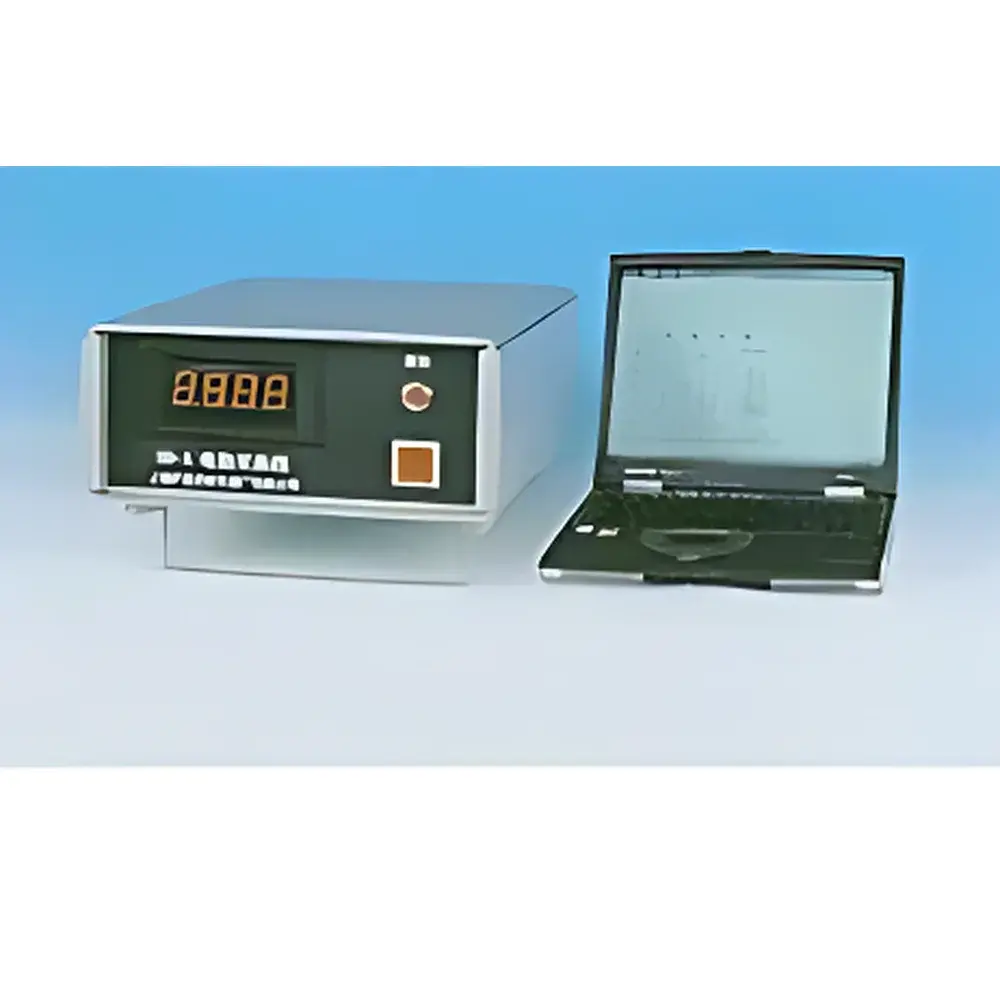
Chu Ding HD-4 Computer-Controlled UV Absorbance Detector for Nucleic Acids and Proteins
| Origin | Shanghai, China |
|---|---|
| Manufacturer Type | Authorized Distributor |
| Regional Origin | Domestic (PRC) |
| Model | HD-4 |
| Price | USD 1,950 (FOB Shanghai) |
| Wavelengths | 254 nm & 280 nm (LED digital display) |
| Optical Path Length | 4 mm |
| Sample Cell Volume | 80 µL |
| Transmittance Range | 0–100% T |
| Absorbance Range | 0–2.0 A |
| Dimensions (W×D×H) | 280 × 210 × 160 mm |
| Interface | RS-232 serial port for PC connectivity |
| Data Output | Real-time A/T values, chromatogram plotting, exportable ASCII/CSV data files |
Overview
The Chu Ding HD-4 Computer-Controlled UV Absorbance Detector is a benchtop analytical instrument engineered for real-time, quantitative detection of nucleic acids and proteins during liquid chromatography (LC) and gel filtration applications. It operates on the principle of ultraviolet absorbance spectroscopy at fixed wavelengths—specifically 254 nm (optimal for nucleic acid quantification via π→π* transitions in purine/pyrimidine bases) and 280 nm (selective for aromatic amino acids—tryptophan, tyrosine—in proteins). The detector integrates a high-stability LED-based optical system with a 4 mm pathlength flow cell, enabling reproducible measurements across low-volume (80 µL) samples under continuous flow conditions. Designed as a modular component within a complete LC separation system—including compatibility with standard analytical columns, peristaltic or syringe-driven constant-flow pumps, and fraction collectors—the HD-4 delivers trace-level sensitivity and baseline stability essential for elution profile monitoring in molecular biology, biopharmaceutical process development, and academic research laboratories.
Key Features
- Fixed-wavelength dual-channel UV detection at 254 nm and 280 nm, calibrated to NIST-traceable standards
- LED digital display for simultaneous transmittance (%T) and absorbance (A) readouts, minimizing photometric drift
- 4 mm optical pathlength quartz flow cell optimized for aqueous mobile phases and low-viscosity biological buffers
- RS-232 serial interface compliant with standard COM port protocols, enabling direct communication with Windows-based acquisition software
- Real-time chromatogram generation, peak integration, and baseline correction algorithms embedded in native acquisition suite
- Export functionality supporting ASCII and CSV formats for downstream analysis in MATLAB, GraphPad Prism, or Python-based pipelines
- Compact footprint (280 × 210 × 160 mm) suitable for shared instrumentation benches and GLP-compliant lab environments
Sample Compatibility & Compliance
The HD-4 accommodates standard UV-transparent solvents including water, Tris-HCl, phosphate-buffered saline (PBS), and low-concentration denaturants (e.g., ≤6 M urea, ≤0.1% SDS) commonly used in protein purification and nucleic acid isolation workflows. It supports flow rates up to 5 mL/min when paired with compatible peristaltic pumps and exhibits minimal carryover (<0.1%) following standard column wash protocols. While not certified to ISO/IEC 17025 or FDA 21 CFR Part 11 out-of-the-box, the instrument’s RS-232 interface and deterministic data logging architecture allow integration into validated systems where electronic records meet ALCOA+ principles (Attributable, Legible, Contemporaneous, Original, Accurate, Complete, Consistent, Enduring, Available). Users deploying the HD-4 in regulated environments must implement complementary audit trail and user access control via third-party LIMS or ELN platforms.
Software & Data Management
The HD-4 operates with proprietary Windows-compatible acquisition software that provides real-time signal visualization, adjustable sampling intervals (10–500 ms), and automatic zero/baseline calibration routines. Chromatographic data are stored in timestamped project folders with metadata (date, operator ID, method name, instrument serial number). The software supports overlay comparison of up to eight runs, manual or auto-threshold peak detection, and calculation of integrated area, retention time, and relative abundance. All raw voltage-to-absorbance conversion coefficients are user-accessible and modifiable per ASTM E275-21 guidelines for spectrophotometric calibration verification. Exported datasets include header rows defining units, scaling factors, and acquisition parameters—ensuring full traceability and interoperability with statistical analysis frameworks.
Applications
- Monitoring elution profiles during size-exclusion chromatography (SEC) of monoclonal antibodies and recombinant proteins
- Quantifying DNA/RNA yield and purity (A260/A280 ratio) post-gel extraction or column purification
- Tracking protein folding/unfolding transitions via 280 nm absorbance shifts in thermal or chemical denaturation assays
- Validating buffer exchange efficiency in desalting steps prior to mass spectrometry analysis
- Supporting teaching laboratories in undergraduate biochemistry courses for hands-on chromatography instruction
- Quality control testing of oligonucleotide synthesis intermediates in contract manufacturing organizations (CMOs)
FAQ
Is the HD-4 compatible with HPLC systems?
Yes—the HD-4 accepts standard 1/16″ OD stainless steel or PEEK tubing connections and functions as a fixed-wavelength UV detector in isocratic or low-pressure gradient LC configurations. It does not support high-pressure operation (>100 psi) or wavelength scanning.
Can absorbance data be synchronized with fraction collector triggers?
Yes—via TTL-level external trigger input, the HD-4 can initiate data capture upon fraction collection command signals from compatible fraction collectors (e.g., Gilson FC204, Bio-Rad Model 2110).
Does the instrument include validation documentation?
No—users must perform IQ/OQ/PQ according to internal SOPs; factory calibration certificates are available upon request with optional NIST-traceable reference standards.
What maintenance is required for long-term stability?
Annual verification of LED intensity output and photodiode linearity using neutral density filters is recommended; flow cell cleaning with 70% ethanol followed by deionized water flush is advised after each use with viscous or particulate-laden samples.