
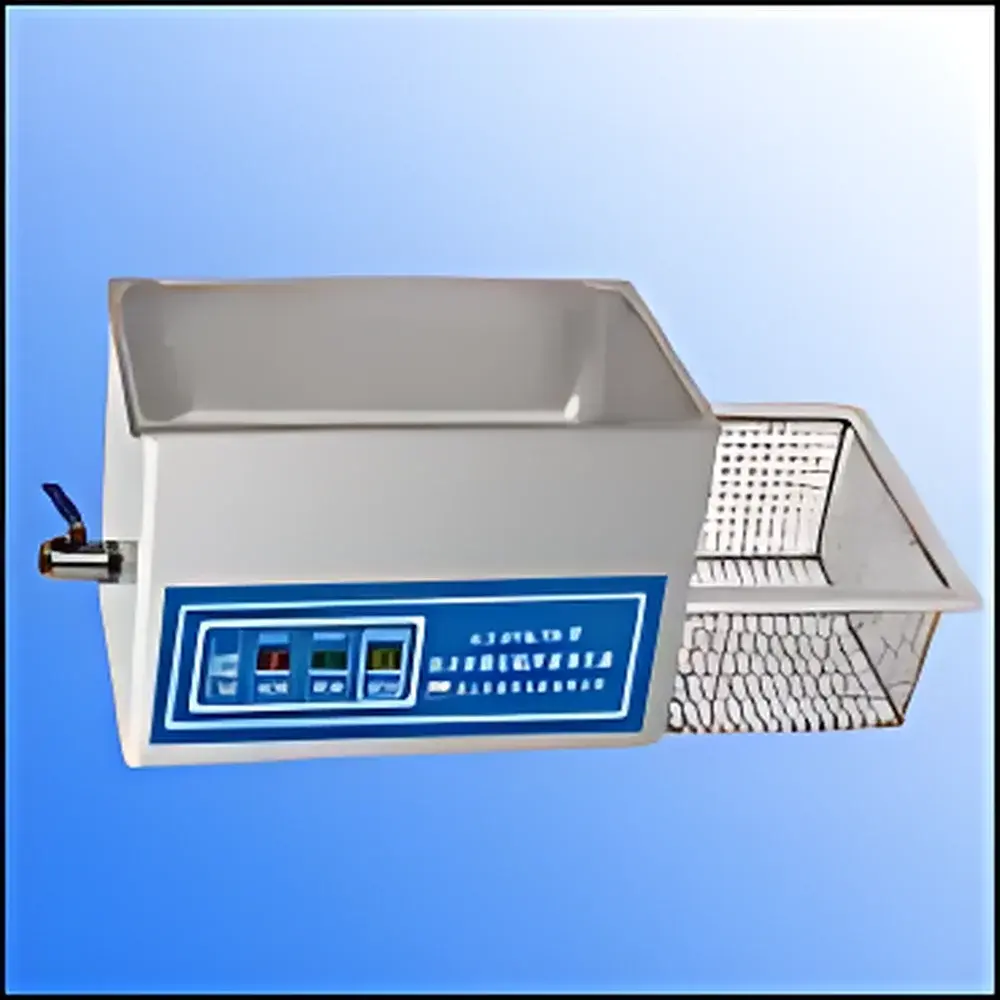
Kunshan KQ-2200DA Desktop Digital Ultrasonic Cleaner
| Origin | Shanghai, China |
|---|---|
| Manufacturer Type | Authorized Distributor |
| Country of Origin | China |
| Model | KQ-2200DA |
| Dimensions (W×D×H) | 260 × 160 × 260 mm |
| Tank Internal Dimensions (W×D×H) | 230 × 140 × 100 mm |
| Tank Capacity | 3 L |
| Ultrasonic Frequency | 40 kHz |
| Ultrasonic Power Output | 100 W |
| Power per Transducer | 80 W |
| Temperature Control Range | Ambient to 80 °C (adjustable) |
| Timer Range | 1–99 min (digital preset & memory) |
| Safety Features | Low-water level detection, over-temperature/over-voltage/over-current protection, auto-shutdown |
| Construction | 304 Stainless Steel Tank |
| Accessories | Removable stainless steel mesh basket (standard on KQ-2200DB/DE |
| Noise Reduction | Optional acoustic lid available (KQ-2200DE variant) |
Overview
The Kunshan KQ-2200DA Desktop Digital Ultrasonic Cleaner is a compact, microprocessor-controlled cleaning system engineered for precision laboratory and light industrial applications. It operates on the principle of high-frequency ultrasonic cavitation—generating microscopic vacuum bubbles in liquid media that collapse violently upon contact with submerged surfaces, delivering mechanical energy sufficient to dislodge particulate contaminants, organic residues, and biofilms without abrasive action. With a fixed operating frequency of 40 kHz and a total ultrasonic output power of 100 W distributed across transducers mounted directly to the tank base, the KQ-2200DA ensures consistent energy distribution and reproducible cleaning performance across its 3-liter stainless steel chamber. Its integrated digital control panel enables precise, repeatable parameter programming—including time, temperature, and power level—with non-volatile memory retention for frequently used protocols. Designed for benchtop use in QC labs, academic research facilities, and R&D environments, the unit meets fundamental functional requirements for solvent-based cleaning, degassing, dispersion, emulsification, and cell lysis preparation.
Key Features
- Microprocessor-based digital interface with real-time display of set and actual temperature, elapsed time, and ultrasonic power level
- Non-volatile memory function retains user-defined cleaning parameters between power cycles
- Comprehensive safety architecture: automatic shutdown triggered by low liquid level, over-temperature (>85 °C), over-voltage (>±10% nominal), or over-current conditions
- 304 stainless steel tank fabricated via deep-drawn stamping—resistant to corrosion, thermal stress, and ultrasonic fatigue
- Dual-stage transducer mounting ensures uniform acoustic field distribution and minimizes standing wave interference
- Adjustable heating system (ambient to 80 °C) with ±2 °C accuracy, enabling temperature-assisted cleaning for viscous or thermally sensitive samples
- Programmable timer (1–99 minutes) with audible end-of-cycle alert and auto-off functionality
Sample Compatibility & Compliance
The KQ-2200DA accommodates a broad range of sample types including glassware (vials, cuvettes, pipette tips), metal components (surgical instruments, optical mounts), ceramic substrates, and polymer-based labware—provided compatibility with aqueous or mild organic solvents (e.g., isopropanol, ethanol, aqueous alkaline detergents) is confirmed. The unit does not incorporate sterilization-grade validation features and is not intended for terminal sterilization per ISO 17665 or EN 285. However, its consistent cavitation performance supports cleaning process validation under ISO 15883-1 (washer-disinfectors) and ASTM F3127 (ultrasonic cleaning verification). While not certified to UL/CSA 61010-1 or IEC 61010-1 out-of-the-box, its electrical design adheres to core safety principles outlined in these standards, including reinforced insulation, grounding continuity, and thermal cutoff integration. For GLP/GMP-regulated environments, users may implement procedural controls—including equipment logbooks, calibration of external thermometers, and periodic verification of cavitation activity using aluminum foil test (ASTM E1753).
Software & Data Management
The KQ-2200DA operates as a standalone embedded system with no external software dependency or data export capability. All operational parameters are configured and monitored locally via the front-panel LCD and membrane keypad. No USB, RS-232, or Ethernet connectivity is provided; therefore, it does not support FDA 21 CFR Part 11-compliant electronic records, audit trails, or remote monitoring. Users requiring traceable process documentation must implement manual logging of batch-specific settings (time, temperature, power), operator ID, and lot numbers of cleaned items. For laboratories integrating ultrasonic cleaning into validated workflows, this model serves best as a pre-qualified auxiliary tool—where critical process parameters are fixed, and cleaning efficacy is verified independently via residue testing (e.g., TOC, HPLC, visual inspection) rather than instrument-generated data logs.
Applications
- Routine cleaning of analytical glassware prior to HPLC, GC, or spectrophotometric analysis
- Removal of polishing compounds and oils from precision optics and metrology components
- Preparation of nanoparticle dispersions and colloidal suspensions in materials science research
- Cell disruption for preliminary extraction of intracellular proteins in molecular biology workflows
- Degassing of solvents and resin mixtures prior to casting or chromatographic column packing
- Supporting ASTM D2624 (jet fuel conductivity), ASTM D4176 (diesel cleanliness), and ISO 4406 (fluid particle contamination) sample preparation protocols
FAQ
Is the KQ-2200DA suitable for cleaning delicate MEMS devices or semiconductor wafers?
The 40 kHz frequency and fixed 100 W output may induce excessive cavitation intensity for sub-micron surface features. For such applications, lower-frequency (25–33 kHz) or swept-frequency systems with power modulation are recommended.
Does the unit include a heater with PID temperature control?
Yes—it features proportional-integral temperature regulation with ±2 °C stability at setpoint, though no external probe calibration port is provided.
Can the stainless steel tank be replaced or repaired if damaged?
The tank is integral to the chassis and not field-replaceable; structural damage typically necessitates full unit replacement per manufacturer service policy.
What is the expected service life of the ultrasonic transducers?
Under normal operation (≤4 hrs/day, deionized or low-conductivity water), transducers maintain >90% nominal output for ≥5,000 operating hours before measurable degradation occurs.
Is third-party calibration available for time, temperature, or power output?
No NIST-traceable calibration certificates are offered by the manufacturer; users must engage accredited metrology labs for periodic verification using calibrated thermistors, timers, and RF power meters.



