
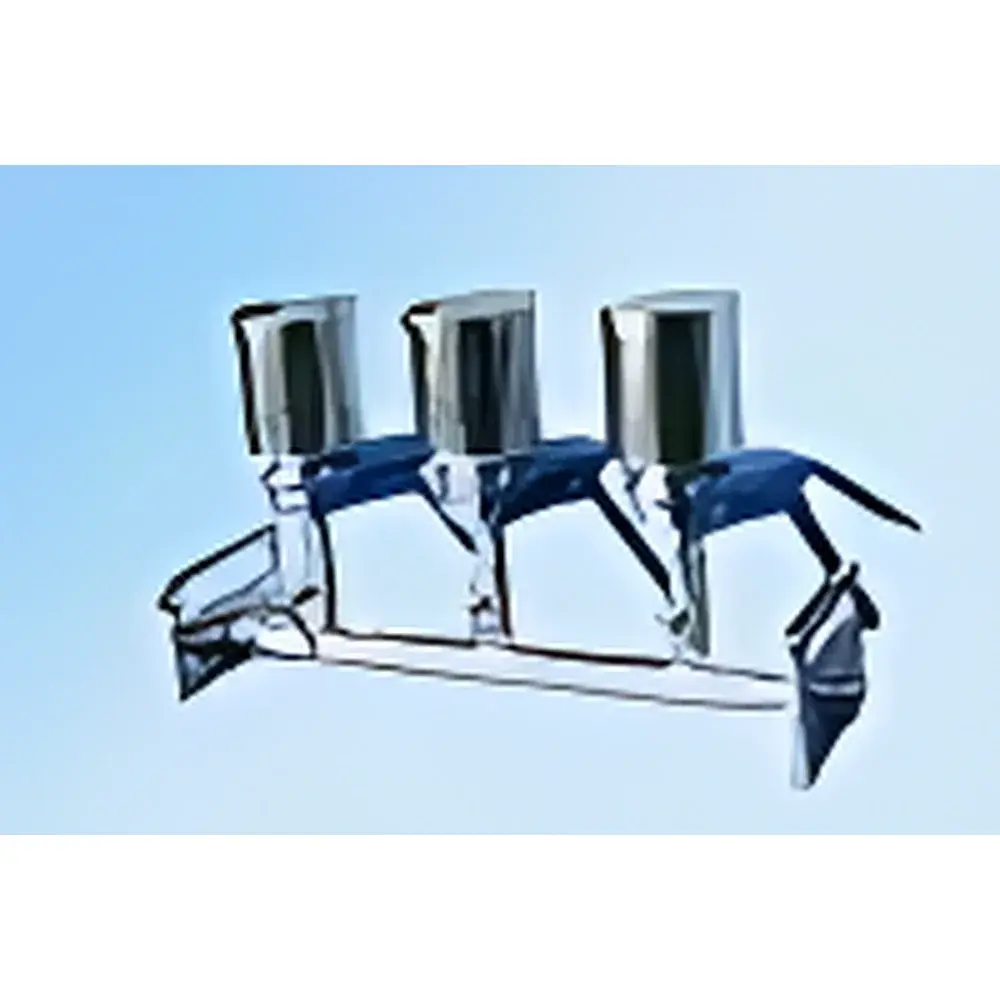
Chu Ding HSF-G3 Triple-Station Stainless Steel Solution Filtration System (Microbial Testing Filtration Assembly)
| Brand | Chu Ding Technology |
|---|---|
| Origin | Shanghai, China |
| Manufacturer Type | Authorized Distributor |
| Origin Category | Domestic (China-made) |
| Model | HSF-G3 |
| Price | USD 1,240 (FOB Shanghai) |
Overview
The Chu Ding HSF-G3 Triple-Station Stainless Steel Solution Filtration System is a precision-engineered, gravity- and vacuum-assisted multi-sample filtration platform designed for microbiological testing, particulate analysis, and routine solution clarification in regulated laboratory environments. Unlike traditional single-vessel glass fritted funnels—prone to breakage, thermal shock, and limited throughput—the HSF-G3 implements a robust Couette-style parallel filtration architecture based on controlled vacuum-driven flow through standardized membrane supports. Its core function is to enable simultaneous, independent filtration of up to three liquid samples under identical pressure differentials and dwell times, thereby minimizing inter-sample variability and enhancing analytical reproducibility. The system complies with fundamental operational principles outlined in ISO 7218:2017 (Microbiology of food and animal feeding stuffs) and ASTM D5907 (Standard Test Methods for Particulates in Water), serving as a foundational tool for membrane filtration-based quantification of viable microorganisms (e.g., total coliforms, E. coli, Pseudomonas), suspended solids, chlorophyll-a, or precipitated analytes prior to spectrophotometric, chromatographic, or culture-based downstream analysis.
Key Features
- Triple-station modular design with independent stainless steel filter heads, each equipped with a dedicated 316L stainless steel ball valve for precise flow control and cross-contamination prevention.
- Full-body construction from electropolished 316L sanitary-grade stainless steel—resistant to pitting corrosion in acidic (pH ≥ 1.0), alkaline (pH ≤ 13.5), and oxidizing environments; compatible with autoclaving at 121 °C for 30 minutes per cycle without dimensional drift or surface degradation.
- Integrated aluminum alloy clamping mechanism ensures uniform sealing force across all filter membranes (diameter: 47 mm standard), eliminating leakage and ensuring consistent filtration integrity across replicates.
- Modular vacuum interface: 1/4″ NPT female port compatible with standard lab vacuum pumps (recommended ultimate vacuum ≤ 80 kPa); optional inline vacuum regulator available for fine-tuned pressure control.
- Scalable configuration: Base unit supports 3 stations; additional filter head assemblies (HSF-G3-EXT kits) allow expansion to 6 stations while retaining shared vacuum manifold and structural rigidity.
Sample Compatibility & Compliance
The HSF-G3 accommodates a broad spectrum of aqueous and mildly organic solvent-based samples—including nutrient broths, environmental water matrices (surface, wastewater, seawater), pharmaceutical rinse solutions, and botanical extracts—provided membrane compatibility is verified. Users select appropriate microporous membranes (e.g., mixed cellulose ester [MCE], polyethersulfone [PES], or polycarbonate [PC]) based on target analyte size (0.22 µm for sterility, 0.45 µm for general microbial enumeration, 1.2 µm for sediment analysis). All wetted components meet USP Class VI biocompatibility requirements. The system supports GLP/GMP-aligned workflows via documented cleaning validation protocols and is routinely employed in laboratories adhering to FDA 21 CFR Part 11–compliant data governance frameworks when paired with validated electronic lab notebooks (ELNs).
Software & Data Management
As a hardware-only filtration platform, the HSF-G3 does not incorporate embedded firmware or proprietary software. However, it integrates seamlessly into digital laboratory ecosystems: vacuum pump operation may be logged via external pressure transducers connected to SCADA or LabArchives; filtration start/stop timestamps, membrane lot numbers, and sample IDs are recorded manually or via barcode-scanned entry into LIMS platforms such as Thermo Fisher SampleManager or LabVantage. Full audit trails—including operator ID, sterilization batch logs, and maintenance records—are maintained per ISO/IEC 17025:2017 clause 7.9 (Handling of nonconforming work) and support regulatory inspections.
Applications
- Membrane filtration-based microbial enumeration per APHA Standard Methods 9222 B/D and ISO 9308-1 for drinking water and recreational waters.
- Pre-concentration of low-biomass environmental samples prior to qPCR or metagenomic sequencing.
- Removal of particulates from HPLC mobile phases or calibration standards to prevent column fouling.
- Clarification of cell culture supernatants or fermentation broths in bioprocess development labs.
- Quantitative recovery of algae or phytoplankton cells for pigment extraction and spectrophotometric analysis (e.g., chlorophyll-a determination at 664 nm).
FAQ
Can the HSF-G3 be used with aggressive solvents such as acetone or chloroform?
No. While 316L stainless steel resists many aqueous reagents, prolonged exposure to halogenated hydrocarbons or strong ketones may compromise elastomeric seals (if present in optional accessories) and is not validated. Consult the membrane manufacturer’s chemical compatibility chart before use.
Is the system supplied with filters or vacuum pump?
No. The HSF-G3 includes only the stainless steel filtration assembly (filter cups, heads,支架, ball valves, clamps, and base manifold). Filters and vacuum source must be selected and procured separately based on application requirements.
What is the maximum operating temperature for continuous filtration?
The unit is rated for continuous operation at ambient temperatures up to 60 °C. Autoclaving is permitted only during sterilization cycles—not during active filtration.
How is calibration performed?
The HSF-G3 requires no periodic metrological calibration. Performance verification is conducted via challenge tests using standardized latex microsphere suspensions (e.g., 3.0 µm NIST-traceable particles) to confirm retention efficiency and flow uniformity across all three stations.
Related Products



