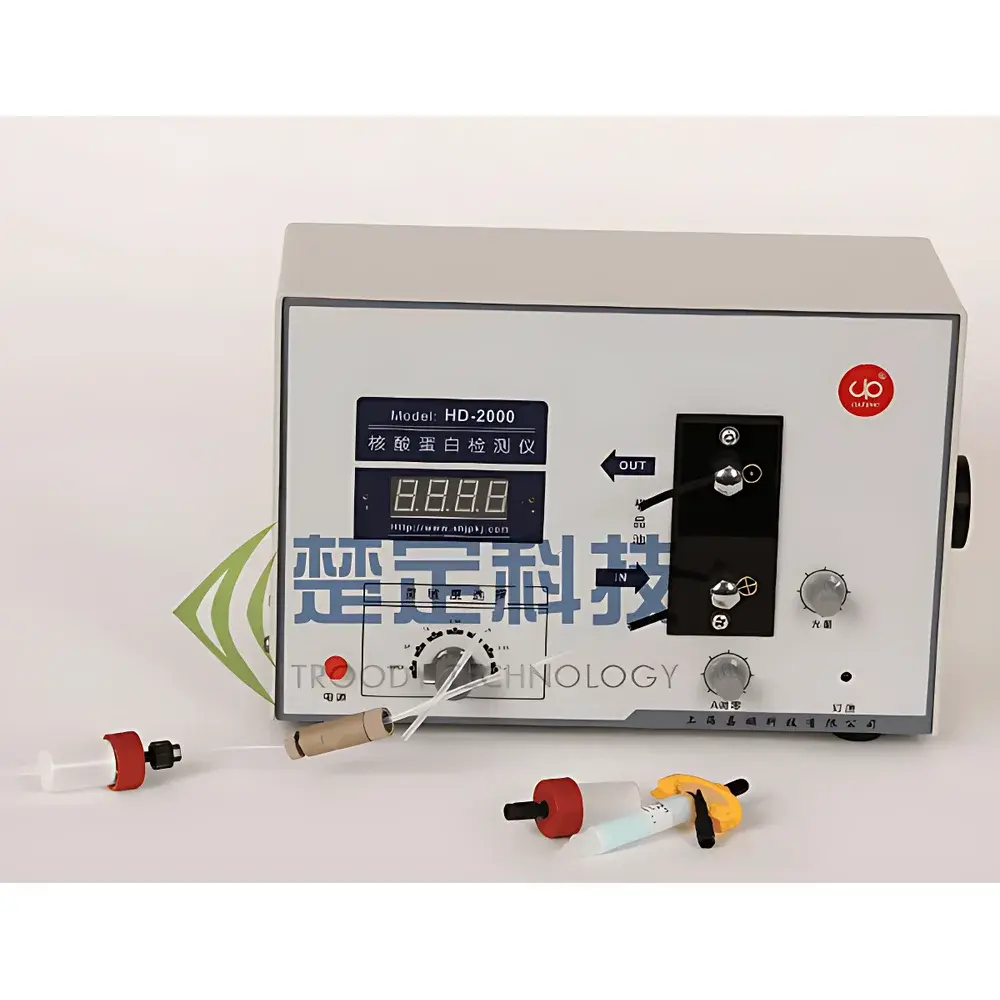
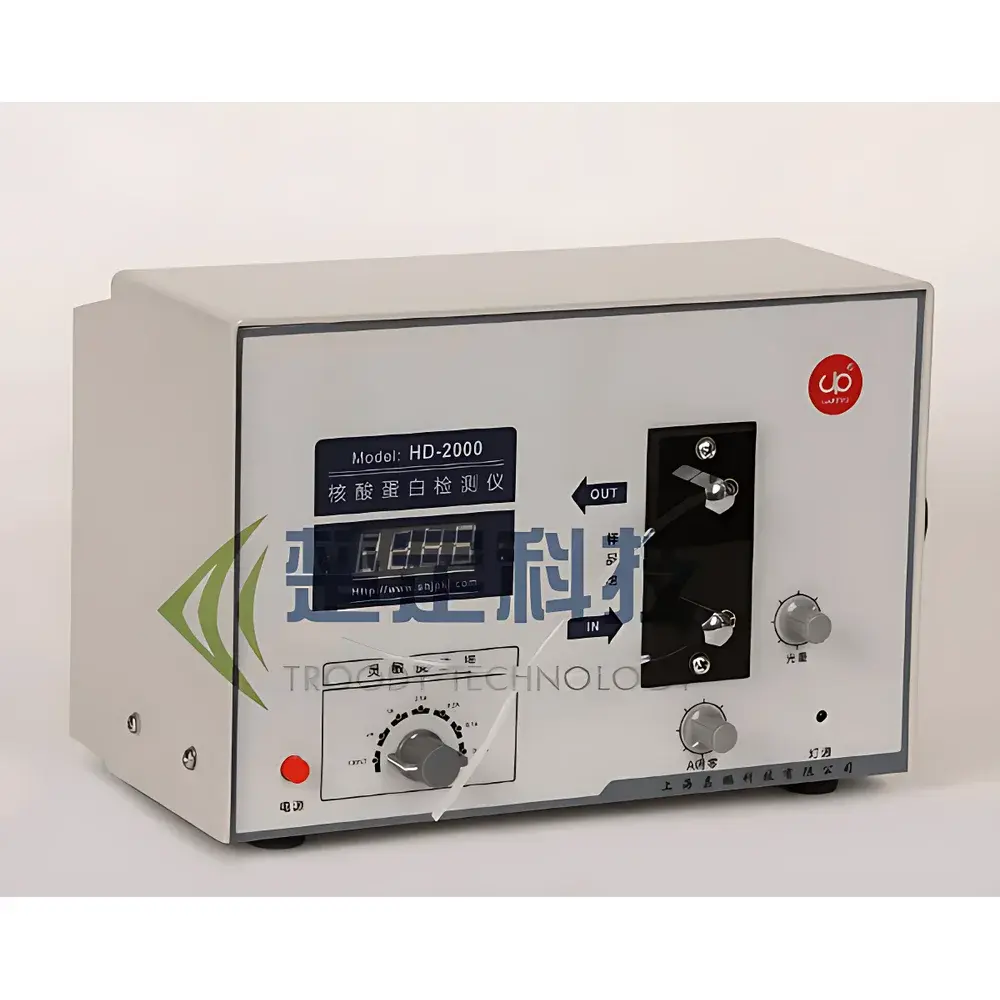
Chu Ding HD-2000 UV Detector / Nucleic Acid & Protein Analyzer
| Brand | Chu Ding |
|---|---|
| Model | HD-2000 |
| Detection Principle | Dual-wavelength UV absorbance (220, 254, 280, 340 nm) |
| Optical Path Length | 3 mm |
| Sample Cell Volume | 100 µL |
| Transmittance Range | 0–100% T |
| Absorbance Range | 0–0.2 A |
| Display | LED digital (T/A dual-mode) |
| Output Signals | 10 mV recorder output |
| UV Lamp Power | 6 W |
| UV Filter Dimensions | 200 × 80 mm |
| Input Voltage | 220 V AC |
| Dimensions (W×D×H) | 285 × 165 × 190 mm |
| Instrument Type | Benchtop |
| Origin | Shanghai, China |
| Compliance | Designed for GLP-compliant chromatographic workflows per ISO 17025 and USP <857> UV-Vis detection guidelines |
Overview
The Chu Ding HD-2000 UV Detector / Nucleic Acid & Protein Analyzer is a benchtop ultraviolet absorbance detector engineered for integration into low-pressure liquid chromatography (LPLC) and fast protein liquid chromatography (FPLC) systems. It operates on the principle of Beer–Lambert law-based UV-Vis photometry, measuring sample absorbance at four fixed wavelengths—220 nm (peptide bond), 254 nm (nucleic acids), 280 nm (aromatic amino acids), and 340 nm (background reference)—enabling simultaneous quantification and qualitative assessment of nucleic acids, proteins, and other UV-absorbing biomolecules during column elution. Its 3 mm optical path length and 100 µL flow cell provide optimal sensitivity and minimal band broadening for analytical-scale separations. The instrument is designed for continuous operation in academic laboratories, pharmaceutical QC labs, and biotechnology R&D environments where reproducible, trace-level detection of macromolecules is required under ambient or controlled temperature conditions.
Key Features
- Fixed-wavelength UV detection at 220, 254, 280, and 340 nm—optimized for nucleic acid (A260/A280 ratio), protein (A280), and impurity profiling
- High-stability optical architecture featuring imported IP28 photomultiplier tube (PMT) with low dark current and enhanced signal-to-noise ratio
- Dual-mode LED digital display showing both transmittance (%T) and absorbance (A) in real time, facilitating rapid method validation and calibration verification
- 10 mV analog output compatible with strip-chart recorders, integrators, and legacy chromatography data systems
- Optional RS232 serial interface for connection to external PCs or data loggers—supports ASCII-formatted absorbance stream transmission for post-run analysis
- Benchtop form factor (285 × 165 × 190 mm) with integrated 6 W UV lamp and precision-matched 200 × 80 mm bandpass filter assembly
- Robust mechanical design with EMI-shielded electronics and thermal stabilization circuitry to minimize baseline drift over extended runs (>8 h)
Sample Compatibility & Compliance
The HD-2000 is validated for use with standard aqueous and organic-aqueous mobile phases common in ion-exchange, size-exclusion, and reversed-phase chromatography of biological macromolecules. It accommodates standard 1/16″ OD PEEK or stainless-steel tubing connections and interfaces directly with peristaltic pumps, fraction collectors, and preparative columns (e.g., HiTrap, Econo-Pac). All optical and electronic components meet IEC 61010-1 safety standards for laboratory electrical equipment. While not FDA 21 CFR Part 11–certified as a standalone system, its analog/digital outputs support audit-trail-capable data acquisition when paired with compliant software (e.g., Chromeleon, Empower, or custom LabVIEW applications). The detector conforms to measurement principles outlined in ISO 17025 (clause 5.4.2, calibration of UV-Vis detectors) and USP General Chapter “Ultraviolet-Visible Spectrophotometry” for quantitative chromatographic detection.
Software & Data Management
The HD-2000 operates as a hardware detector without embedded firmware-based data processing. Instead, it delivers raw analog voltage signals (proportional to absorbance) and optional ASCII-formatted serial data streams. When connected via RS232, it supports baud rates up to 9600 bps and transmits time-stamped absorbance values at user-defined intervals (e.g., 0.1–2 s resolution). This architecture ensures compatibility with third-party chromatography data systems (CDS) that accept external analog inputs or serial telemetry. Laboratories implementing GxP workflows may configure external CDS platforms to enforce electronic signatures, version-controlled method files, and automated report generation—leveraging the HD-2000’s deterministic signal output as a traceable physical measurement layer. No proprietary drivers or closed-format binaries are required.
Applications
- Real-time monitoring of protein elution profiles during affinity and ion-exchange chromatography
- Quantitative determination of dsDNA concentration using A260 with correction for A230/A280 contaminants
- Monitoring of oligonucleotide synthesis purity and coupling efficiency in desalting steps
- Enzyme assay development requiring continuous UV absorbance tracking of cofactor (e.g., NADH at 340 nm) depletion
- Quality control of purified antibodies, recombinant enzymes, and plasmid preparations prior to formulation
- Educational use in undergraduate biochemistry labs for teaching chromatographic theory and detector calibration protocols
FAQ
What wavelength options are available, and how are they selected?
The HD-2000 provides fixed-wavelength detection at 220 nm, 254 nm, 280 nm, and 340 nm. Wavelength selection is manual via front-panel toggle switch; no software control or scanning capability is included.
Is the flow cell removable or replaceable?
Yes—the 3 mm pathlength, 100 µL quartz flow cell is field-replaceable using standard 10-32 threaded fittings and requires no optical realignment upon reinstallation.
Can this detector be used with HPLC systems?
It is rated for low-pressure applications (<5 bar); direct integration with high-pressure HPLC systems (≥200 bar) is not recommended without an external pressure regulator and pulse damper.
Does the instrument include calibration certification?
No factory calibration certificate is supplied; users are advised to perform initial verification using NIST-traceable neutral density filters or potassium dichromate solutions per USP .
What maintenance is required for long-term stability?
Annual PM includes UV lamp replacement (6 W, 254 nm dominant), PMT gain verification using reference standards, and cleaning of filter surfaces with spectroscopic-grade methanol and lint-free wipes.