
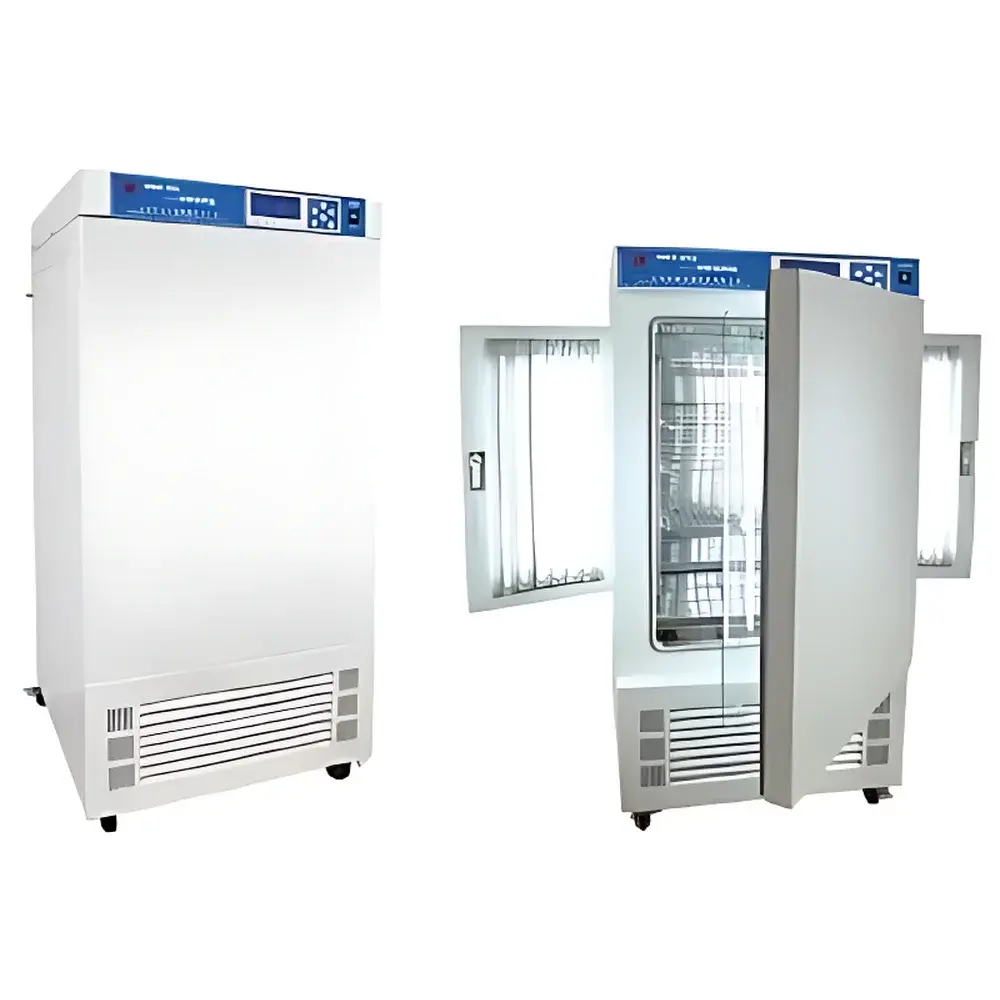
Chu Ding Technology HGZ-400 Plant Growth Chamber with LCD Display and Eco-Friendly Non-CFC Refrigeration
| Brand | Chu Ding Technology |
|---|---|
| Origin | Shanghai, China |
| Manufacturer Type | Authorized Distributor |
| Product Category | Domestic |
| Model | HGZ-400 |
| Power Supply | AC 220 V, 50 Hz |
| Temperature Range (with light) | 10–50 °C |
| Temperature Range (without light) | 4–50 °C |
| Temperature Uniformity | ±1 °C |
| Temperature Resolution | 0.1 °C |
| Illumination Intensity | 0–25,000 lx, 6-step adjustable |
| Light Source | T4 fluorescent tubes, triple-sided illumination |
| Internal Volume | 400 L |
| Internal Dimensions (W×D×H) | 680 × 550 × 1050 mm |
| External Dimensions (W×D×H) | 880 × 780 × 1810 mm |
| Input Power | 2500 W |
| Standard Shelves | 3 pcs |
| Operating Environment | 5–30 °C |
| Continuous Operation | ≥360 h |
| Safety | Dual-compressor auto-switching, over-temperature cut-off with audible/visual alarm |
| Control System | Microprocessor-based PID control, 99-cycle programmable sequence (30 segments/cycle, up to 99 h 59 min/segment) |
| Data Interface (optional) | USB or RS485 for printer/computer connectivity |
| Interior Material | Mirror-finish stainless steel, rounded corners |
| Insulation | Double-door structure with high-efficiency thermal barrier |
| Refrigerant | R134a / R406A (non-ozone-depleting, low-GWP) |
Overview
The Chu Ding Technology HGZ-400 Plant Growth Chamber is a precision-engineered environmental simulation system designed for reproducible, long-term studies in plant physiology, seed germination, tissue culture, entomology, and small-animal husbandry. It operates on a dual-mode thermoregulatory principle—integrating microprocessor-controlled heating, eco-friendly vapor-compression cooling, and programmable photoperiodic lighting—to emulate diurnal climatic cycles with high fidelity. Unlike generic incubators, the HGZ-400 employs a dedicated air circulation architecture based on JAKEL tube-flow centrifugal fans and an optimized internal duct layout, ensuring uniform temperature distribution (±1 °C) and consistent photon flux across the entire 400 L working chamber. Its non-CFC refrigeration system—utilizing R134a and R406A blends—complies with Montreal Protocol requirements and supports ISO 14001-aligned laboratory sustainability protocols without compromising thermal response time or stability.
Key Features
- Triple-sided T4 fluorescent illumination system delivering up to 25,000 lx at the shelf plane, with six discrete intensity levels and independent day/night photoperiod programming
- Dual redundant compressor assembly with automatic load-balancing switching—engineered to sustain uninterrupted operation for ≥360 hours under continuous duty cycle conditions
- Mirror-finish 304 stainless-steel interior with radius-corner geometry, facilitating ISO 5 cleanroom-compatible decontamination and minimizing microbial retention
- Double-glazed, vacuum-insulated observation door with low-emissivity coating—maintaining thermal integrity during visual monitoring (no measurable temperature perturbation upon opening)
- PID-based digital temperature controller with 0.1 °C resolution, supporting complex multi-segment scheduling (99 cycles × 30 segments × 99 h 59 min maximum duration per segment)
- RS485/USB communication interface (optional) enabling integration into centralized lab data networks, GLP-compliant audit trails, and automated CSV export of time-stamped temperature/light logs
- Over-temperature safety interlock with dual-stage threshold detection (warning + hard cutoff), coupled with audible buzzer and LED fault indicator per IEC 61000-4-2 ESD immunity standards
Sample Compatibility & Compliance
The HGZ-400 accommodates standard botanical growth vessels—including Petri dishes (up to 150 mm), Magenta boxes, hydroponic trays, and ventilated rodent cages (up to 30 cm width)—across three independently height-adjustable stainless-steel shelves. Its airflow design prevents laminar stagnation zones, ensuring uniform CO2 dispersion and moisture homogeneity—critical for Arabidopsis thaliana phenotyping, Brassica seedling assays, and Drosophila melanogaster developmental staging. The chamber meets ASTM E1802-20 (Standard Practice for Environmental Chambers Used in Biological Testing) for temperature uniformity validation and conforms to ISO 17025 calibration traceability requirements when paired with external NIST-traceable reference sensors. All electrical components comply with CE EN 61010-1:2019 for laboratory equipment safety, and refrigerant handling adheres to EPA SNAP Program guidelines for low-global-warming-potential alternatives.
Software & Data Management
While the HGZ-400 operates autonomously via its embedded 4.3″ TFT-LCD interface, optional firmware upgrades enable bidirectional serial communication via Modbus RTU over RS485 or mass-storage mode over USB. When connected to a host PC running compliant data acquisition software (e.g., LabVIEW™ or custom Python-based PySerial scripts), users can configure remote parameter sets, initiate real-time telemetry streaming, and generate timestamped .csv reports compliant with 21 CFR Part 11 Annex 11 electronic record requirements—including user authentication logs, change history, and digital signature fields. Optional thermal mapping packages support IQ/OQ documentation for GxP-regulated facilities, with built-in validation templates aligned to WHO TRS 986 Annex 6 and EU GMP Annex 15.
Applications
- Controlled-environment phenotyping of crop mutants under defined photothermal regimes (e.g., vernalization studies in wheat, photoperiod-sensitive flowering in rice)
- Standardized seed viability testing per ISTA Rules (International Seed Testing Association), including accelerated aging and cold germination protocols
- In vitro propagation of orchids and medicinal herbs requiring precise light-quality modulation (PAR spectrum control via selectable lamp ballasts)
- Longitudinal behavioral assays in Drosophila and zebrafish larvae, where circadian entrainment depends on stable light-dark transitions
- Pre-clinical toxicology screening using plant-based bioindicators (e.g., Lemna minor growth inhibition assays per OECD 221)
- QC/QA stability chambers for pharmaceutical excipients sensitive to photodegradation (ICH Q1B Option 2)
FAQ
Does the HGZ-400 support dynamic light-spectrum tuning (e.g., red/blue ratio adjustment)?
No—the system uses fixed-color-temperature T4 fluorescent lamps optimized for broad PAR (400–700 nm) output. Spectral customization requires third-party LED retrofit kits, not covered under standard warranty.
Can the unit maintain humidity control?
Humidity is not actively regulated; ambient RH drifts within 40–75% under typical lab conditions (20–25 °C, 50% RH). For hygroscopic experiments, external humidification/dehumidification modules must be integrated via auxiliary ports.
Is factory calibration certificate included with shipment?
Yes—a UKAS-accredited temperature uniformity report (per ASTM E1802) and illuminance verification (using calibrated photometer traceable to NPL) are supplied digitally with each unit.
What maintenance intervals are recommended for compressor longevity?
Compressor oil inspection every 18 months; condenser coil cleaning quarterly; door gasket integrity check semiannually. Full preventive maintenance service is available through Chu Ding’s authorized APAC service network.
Can the HGZ-400 be validated for ISO 17025 accredited testing labs?
Yes—its modular sensor architecture, deterministic control firmware, and documented uncertainty budgets (±0.3 °C k=2 for temperature, ±3% for irradiance) meet ILAC-G8:2021 requirements for measurement capability statements.
Related Products




