
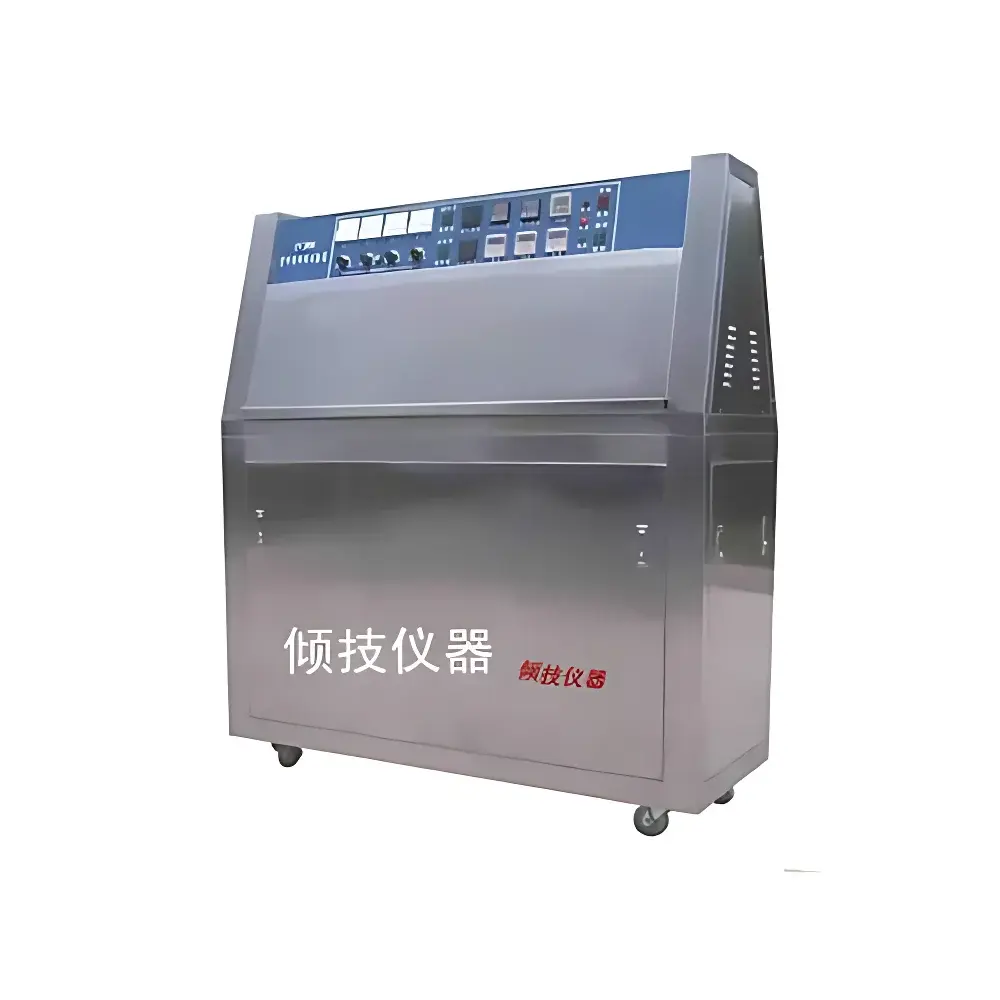
Qinji QUV1003 UV Aging Test Chamber for Geotextiles
| Brand | Qinji |
|---|---|
| Origin | Shanghai, China |
| Model | QUV1003 (Spray-Type) |
| Temperature Range | RT+10°C to 70°C |
| Temperature Uniformity | ±3°C |
| Humidity Range | ≥75% RH |
| Illumination Temperatures | 50°C / 60°C / 70°C (60°C recommended) |
| Condensation Temperature | 50°C (±3°C) |
| Cycle Options | 4h UV / 4h Condensation or 8h UV / 4h Condensation |
| UV Lamp Type | UV-B (280–315 nm) |
| Lamp Center-to-Center Spacing | 65–70 mm |
| Specimen-to-Lamp Distance | 55 mm |
| Standard Specimen Size | 75 × 150 mm |
| Water Consumption | 8 L/day (deionized or distilled water required) |
| Interior Dimensions (D×W×H) | 450 × 1165 × 500 mm |
| External Dimensions (D×W×H) | 600 × 1325 × 1480 mm |
Overview
The Qinji QUV1003 UV Aging Test Chamber is a purpose-engineered environmental test system designed to accelerate the photodegradation and moisture-induced aging of geosynthetic materials—particularly geotextiles—under controlled ultraviolet radiation, thermal cycling, and condensation exposure. Based on the fundamental principles of xenon-arc and fluorescent UV accelerated weathering, this chamber employs calibrated UV-B lamps (280–315 nm) to replicate the most damaging portion of terrestrial solar UV spectrum. Unlike broad-spectrum irradiation systems, the QUV1003 focuses on photochemical degradation pathways associated with polymer chain scission, carbonyl formation, and hydrolytic cleavage—key mechanisms responsible for tensile strength loss, surface embrittlement, color fading, and delamination in polypropylene (PP), polyester (PET), and polyethylene (PE) geotextiles. Its operational architecture complies with the core experimental framework defined in GB/T 14522–1993, which aligns closely with international standards such as ISO 4892-3 (Plastics — Methods of exposure to laboratory light sources — Part 3: Fluorescent UV lamps) and ASTM G154 (Standard Practice for Operating Fluorescent Ultraviolet (UV) Lamp Apparatus for Exposure of Nonmetallic Materials).
Key Features
- UV-B fluorescent lamp array with spectral output centered at 313 nm, delivering reproducible irradiance profiles across the 280–315 nm band critical for simulating high-altitude or low-ozone-layer UV stress;
- Integrated spray function enabling cyclic wetting during UV exposure—mimicking dew formation, rainfall, and surface runoff effects that synergistically accelerate hydrolysis in synthetic polymers;
- Precisely regulated condensation cycle via bottom-mounted water reservoir and heated chamber floor, maintaining saturated humidity conditions at 50°C to induce interfacial moisture accumulation within fiber bundles;
- Independent control of UV irradiance intensity, black-panel temperature, and condensation duration—supporting customizable test protocols per project-specific service life modeling;
- Stainless steel 304 interior chamber with corrosion-resistant hardware, optimized airflow design to minimize thermal gradients (±3°C uniformity), and quartz glass UV-transmissive viewing window;
- Programmable controller supporting up to 99 cycles with user-defined sequence logic—including dual-phase operation (e.g., 8 h UV + 4 h condensation) and multi-step ramp profiles.
Sample Compatibility & Compliance
The QUV1003 accommodates standard geotextile specimens sized 75 × 150 mm, mounted vertically on stainless steel racks ensuring consistent 55 mm spacing from lamp centers. It supports woven, nonwoven, and knitted geotextiles used in landfill liners, road subbases, erosion control blankets, and drainage composites. Test methodologies conducted using this chamber are directly traceable to GB/T 14522–1993, and its operational parameters satisfy prerequisite conditions for data submission under ISO 10318 (Geosynthetics — Vocabulary) and ASTM D4354 (Practice for Sampling of Geosynthetics). While not certified to IEC 61000 or UL standards, the system’s thermal management, electrical insulation, and lamp safety interlocks meet CE-level functional safety expectations for Class II laboratory equipment. Documentation packages include calibration certificates for black-panel thermometers and UV radiometers (NIST-traceable upon request).
Software & Data Management
The embedded microprocessor-based controller logs real-time temperature, UV irradiance (via integrated sensor), and cycle phase status at 1-minute intervals. Data export is supported via USB interface in CSV format, compatible with Excel, MATLAB, and LIMS platforms. Although no proprietary PC software is bundled, raw log files contain timestamped metadata sufficient for GLP-compliant audit trails—including operator ID fields, test start/stop confirmation, and deviation alerts (e.g., temperature excursion > ±3°C for >2 min). For regulated environments, optional RS-485 Modbus RTU integration enables connection to centralized SCADA or MES systems, supporting 21 CFR Part 11–compliant electronic signatures when paired with validated third-party software.
Applications
- Evaluation of UV stabilization efficacy in PP and PET geotextiles containing HALS (hindered amine light stabilizers) or UV absorbers;
- Comparative lifetime prediction of geotextiles deployed in arid vs. humid climatic zones using accelerated condensation-UV synergy protocols;
- Quality assurance testing of incoming geosynthetic rolls prior to civil engineering installation;
- Supporting technical dossiers for CE marking under EN 13249 (Geotextiles and geotextile-related products — Characteristics required for use in filtration applications);
- Research into moisture-mediated photolysis kinetics in biodegradable geotextiles (e.g., polylactic acid blends) under controlled RH and spectral input.
FAQ
What UV spectral range does the QUV1003 replicate, and why is UV-B emphasized for geotextile testing?
The chamber uses fluorescent UV-B lamps emitting between 280–315 nm—a range proven to drive photo-oxidative degradation in polyolefins more aggressively than UV-A. This spectral focus aligns with GB/T 14522–1993 and enables accelerated detection of embrittlement onset before macroscopic failure occurs.
Is distilled water mandatory for the spray and condensation functions?
Yes. Conductivity must remain below 5 µS/cm to prevent mineral deposition on lamps and specimen surfaces, which would attenuate UV transmission and introduce uncontrolled variables in reflectance and absorption behavior.
Can the QUV1003 be validated for ISO/IEC 17025 accredited laboratories?
The base configuration supports validation per ISO/IEC 17025 Annex A.3 (Equipment verification), provided users perform periodic irradiance mapping, temperature uniformity surveys, and black-panel thermometer calibration using accredited external providers.
Does the system support continuous monitoring during unattended operation?
Yes—internal data logging continues autonomously for up to 30 days. Optional Ethernet module (sold separately) enables remote status polling and alarm notification via SMTP or SNMP protocols.
What maintenance intervals are recommended for long-term reliability?
UV lamps require replacement every 1,600 hours of operation; stainless steel chamber surfaces should be wiped weekly with deionized water; condensation reservoir must be drained and refilled daily to prevent biofilm formation.



