
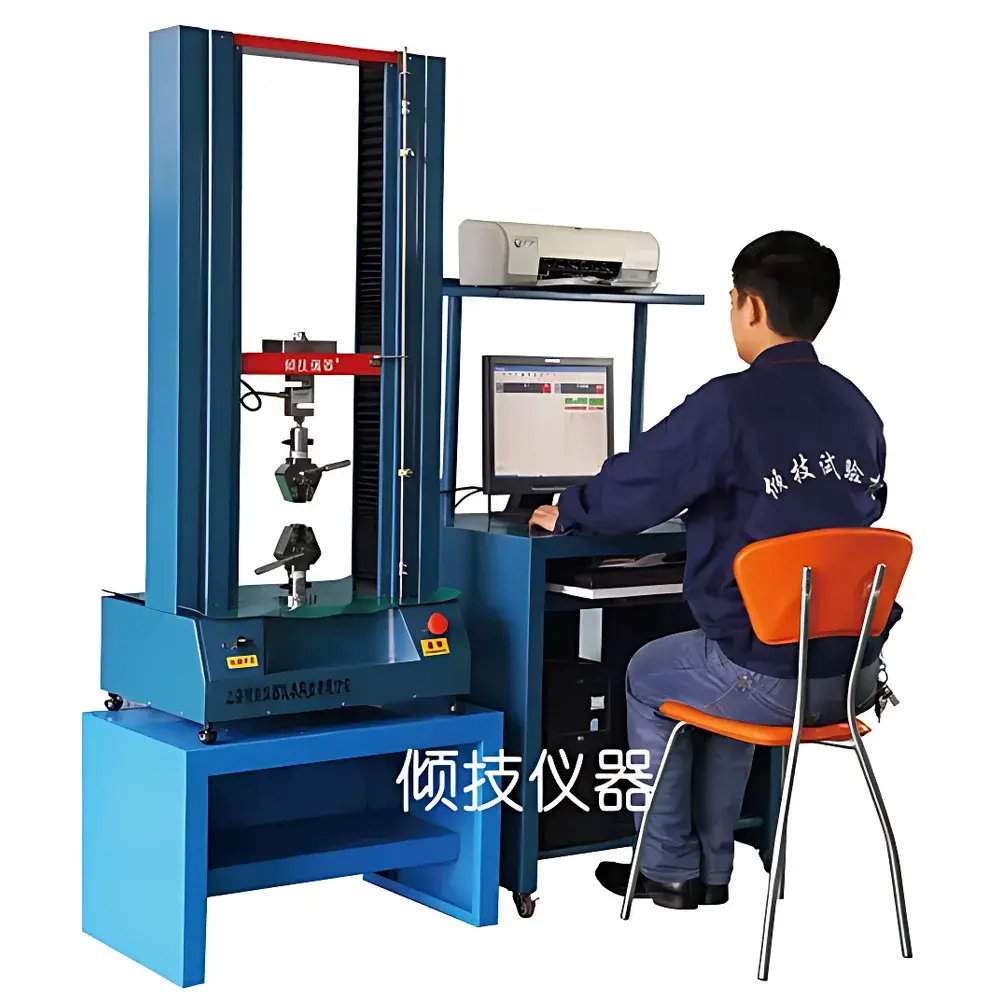
QJ211S2 Fabric Seam Slippage Tester – High-Precision Universal Tensile Testing System for Woven Textiles
| Key | Origin: Shanghai, China |
|---|---|
| Manufacturer Type | Authorized Distributor |
| Origin Category | Domestic (China) |
| Model | QJ211S2 |
| Pricing | Available Upon Request |
| Max Load Capacity | 10 kN |
| Force Accuracy Class | 0.5 |
| Effective Test Width | 320 mm |
| Effective Stroke | 500 mm (optional 800 mm) |
| Speed Range | 0.01–300 mm/min |
| Speed Accuracy | ±0.5% of indicated value |
| Force Resolution | 500,000 counts (full-scale, no range switching) |
| Displacement & Strain Accuracy | ±0.5% of indicated value |
| Sensor | U.S.-sourced high-precision load cell |
| Controller | Panasonic full-digital AC servo system |
| Control Mode | Full-closed-loop digital control supporting constant-load, constant-strain, and constant-displacement testing |
| Safety Protection | Software diagnostics, electronic travel limits, overload protection (110% FS), automatic return post-test |
| Fixture Customization | Application-specific clamping solutions available |
| Power | 2–5 kW motor |
| Net Weight | ~145 kg |
Overview
The QJ211S2 Fabric Seam Slippage Tester is a specialized universal tensile testing system engineered for precise mechanical evaluation of woven textile seam integrity under standardized conditions. It operates on the fundamental principle of uniaxial tensile loading applied to a pre-seamed fabric specimen—typically folded and stitched along its width—with controlled separation of the seam interface at a defined rate. The instrument quantifies either the force required to produce a specified seam opening (constant-gap method) or the displacement achieved under a prescribed load (constant-force method), in strict accordance with international test standards including ISO 13936-1, ASTM D434, and GB/T 13772.1. Designed exclusively for woven fabrics—where interlacing geometry permits measurable slippage between warp and weft yarns—the system also supports complementary seam strength measurement, tear resistance (ASTM D2261), strip tensile (ISO 13934-1), and peel adhesion testing across diverse flexible materials such as nonwovens, coated fabrics, laminates, leather, rubber sheets, and thin polymer films.
Key Features
- High-fidelity force measurement with 0.5-class accuracy and 500,000-count resolution across the full 10 kN range—no manual range switching required.
- Wide-speed capability (0.01–300 mm/min) with ±0.5% speed fidelity, enabling compliance with low-rate creep protocols and high-speed seam burst simulations.
- Dual-mode seam slippage testing: configurable for either fixed-gap (e.g., 6 mm opening per ISO 13936-1) or fixed-load (e.g., 100 N per ASTM D434) evaluation sequences.
- Full-closed-loop digital control architecture integrating Panasonic AC servo drive and real-time feedback from U.S.-certified load cells and linear displacement transducers.
- Robust mechanical frame with precision-ground crosshead guidance, adjustable sample grip alignment, and dual-speed manual/electronic crosshead positioning for rapid setup and repeatability.
- Comprehensive safety suite: electronic end-stop limits, software-based overload detection (triggered at 110% of rated capacity), automatic emergency halt, and programmable return-to-home function.
Sample Compatibility & Compliance
The QJ211S2 accommodates specimens conforming to standard dimensions defined in ISO 13936-1 (100 mm × 250 mm), ASTM D434 (50 mm × 200 mm), and GB/T 13772.1 (100 mm × 250 mm). Its 320 mm effective test width and 500 mm (extendable to 800 mm) vertical stroke support both narrow-strip and full-width seam configurations. Clamping systems are customizable—including pneumatic, wedge-action, and serrated jaw options—to prevent slippage or premature failure of delicate or highly extensible substrates. All test routines adhere to GLP-aligned data integrity requirements: timestamped force/displacement traces, audit-trail-enabled parameter logging, and export-ready CSV/Excel outputs compatible with FDA 21 CFR Part 11-compliant LIMS integration when paired with validated software modules.
Software & Data Management
The embedded test control software provides intuitive workflow navigation, multi-step program sequencing, and real-time graphical monitoring of load vs. displacement, stress vs. strain, and seam gap evolution curves. Users define test parameters—including target load, displacement threshold, dwell time, and pass/fail criteria—via ISO/ASTM template presets or fully custom profiles. Raw data streams are stored with metadata (operator ID, calibration date, environmental conditions), and all modifications to test settings are logged with user attribution and timestamps. Export formats include ASCII, PDF reports with embedded charts, and XML for traceable archival. Optional validation packages support IQ/OQ documentation and periodic performance verification against certified reference standards.
Applications
- Seam slippage resistance assessment of apparel, upholstery, technical workwear, and military-grade woven textiles.
- Comparative evaluation of sewing thread type, stitch density, needle size, and seam construction (e.g., flat-felled vs. French seams).
- Quality assurance in textile finishing plants, garment manufacturing QA labs, and third-party certification bodies (e.g., SGS, Bureau Veritas, Intertek).
- Material development R&D for high-performance composites, geotextiles, filtration media, and medical barrier fabrics.
- Cross-material mechanical benchmarking: tensile modulus, breaking strength, elongation at break, and peel adhesion of laminated or bonded structures.
FAQ
What standards does the QJ211S2 support for seam slippage testing?
It complies with ISO 13936-1, ASTM D434, BS EN 13936-1, and GB/T 13772.1 for seam slippage; ISO 13934-1 and ASTM D5034 for tensile strength; ISO 13937-1 for tear resistance.
Can the system test non-woven or knitted fabrics?
While optimized for woven constructions where yarn slippage is mechanistically relevant, it may be used for comparative analysis of nonwovens or knits—but results must be interpreted with caution due to differing failure modes and lack of standardized seam slippage protocols for those structures.
Is calibration traceable to national metrology institutes?
Yes—load cell calibration certificates are provided with NIST-traceable documentation, and annual recalibration services include uncertainty budgets aligned with ISO/IEC 17025 requirements.
Does the system support automated reporting for regulatory submissions?
When configured with validated software and electronic signature modules, it meets audit readiness criteria for ISO 9001, ISO 17025, and FDA-regulated environments requiring 21 CFR Part 11 compliance.
What maintenance is required to ensure long-term accuracy?
Routine checks include sensor zero-balance verification, crosshead lubrication every 6 months, and annual full-system calibration; all consumables (grips, jaw inserts) are field-replaceable with documented torque specifications.



