
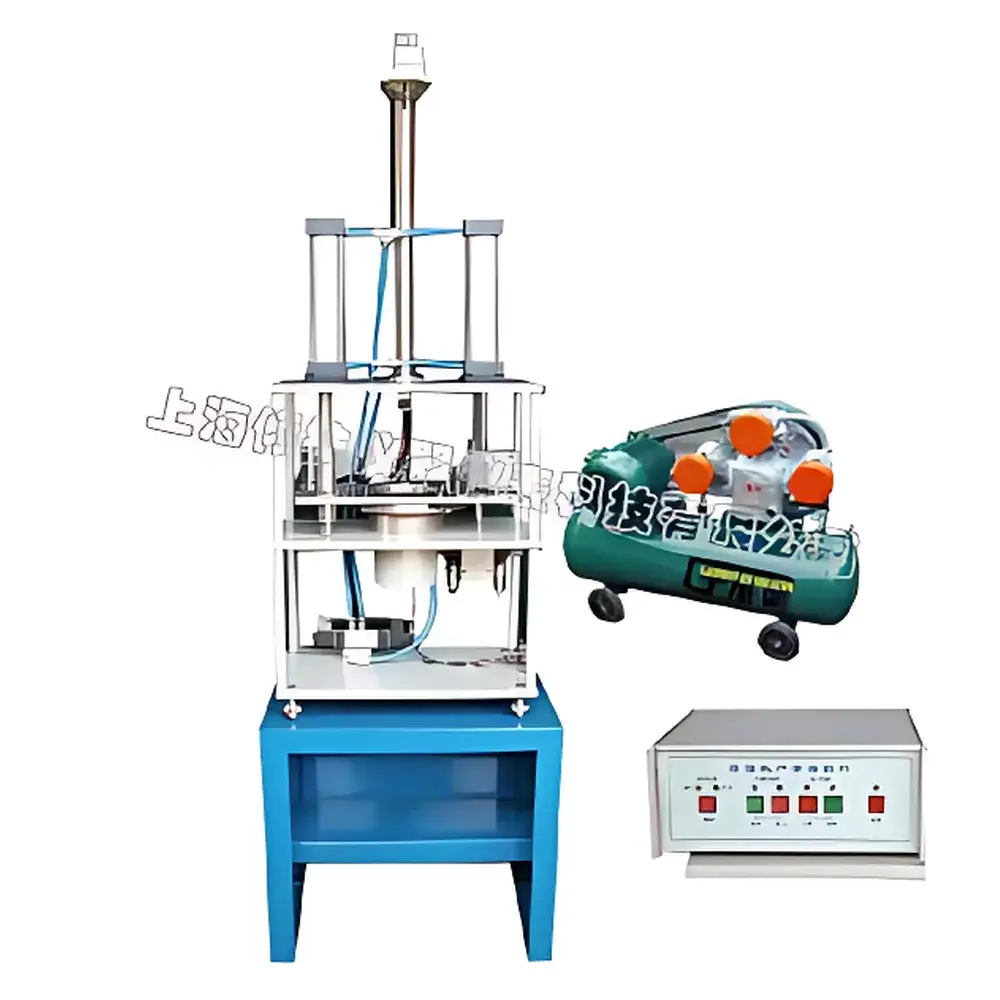
Qinji QJLB Free-Fall Dart Impact Tester
| Brand | Qinji |
|---|---|
| Origin | Shanghai, China |
| Manufacturer Type | Authorized Distributor |
| Country of Origin | China |
| Model | QJLB |
| Price | USD 1,700 (FOB Shanghai) |
| Instrument Category | Other Impact Testing Machines |
| Compliance | ISO 7765-1985, GB/T 9639-1988, ZBN 72026-1990 |
| Sample Type | Plastic Films & Sheets, Thin Metallic Coatings |
Overview
The Qinji QJLB Free-Fall Dart Impact Tester is a precision mechanical impact testing system engineered for quantitative evaluation of impact resistance in thin, flexible planar materials. It operates on the principle of free-fall impact: a standardized dart (with defined geometry and mass) is released from a controlled height onto a horizontally clamped specimen. The test determines the critical impact energy—expressed as the mass (in grams) of the dart required to produce 50% failure probability (i.e., the “50% tear mass”) under specified drop height conditions. This probabilistic endpoint is statistically derived using the up-and-down method or staircase procedure per ISO 7765-1985 and GB/T 9639-1988. Unlike pendulum-based Charpy or Izod testers, the QJLB employs gravity-driven kinetic energy delivery, eliminating rotational inertia and damping artifacts—making it particularly suitable for low-stiffness, high-ductility substrates such as polyethylene films, BOPP laminates, metallized PET, and polymer-coated steel sheets.
Key Features
- Robust cast-iron base and vertical guide column ensure dimensional stability and repeatable dart trajectory alignment during repeated drop cycles.
- Adjustable release mechanism with positive mechanical latch guarantees consistent initial potential energy across tests, minimizing operator-induced variability.
- Standardized dart configuration compliant with ISO 7765: includes hemispherical tip (R = 1.6 mm), stainless-steel construction, and mass range covering 50 g to 2,000 g (darts sold separately per application requirements).
- Specimen clamping system designed for uniform radial tension across circular test areas (typically Ø 150 mm), preventing edge slippage and ensuring valid stress-state representation.
- No electronic actuation or motorized lift—mechanical simplicity enhances long-term reliability, reduces calibration drift, and supports GLP-compliant manual operation logs.
Sample Compatibility & Compliance
The QJLB is validated for use with plastic films ≥ 25 µm and ≤ 250 µm thick, including LDPE, HDPE, PP, PET, PVC, and coextruded barrier structures. It also accommodates coated metallic substrates where coating thickness does not exceed 50 µm and substrate flexural rigidity remains below 1.5 N·mm². All mechanical dimensions, drop height tolerance (±1 mm), dart geometry tolerances, and clamping force specifications conform to ISO 7765-1985 Annex A and GB/T 9639-1988 Clause 4. The instrument satisfies the metrological requirements of China’s professional standard ZBN 72026-1990 for drop-weight impact testers, including structural rigidity verification and repeatability limits (< ±3% CV for replicate 50% mass determinations). While not inherently 21 CFR Part 11–compliant (as it lacks digital data capture), its mechanical design permits integration with external force-sensing platforms or high-speed imaging systems for audit-trail-capable workflows.
Software & Data Management
The QJLB operates as a standalone mechanical tester without embedded firmware or onboard software. Data acquisition and statistical analysis are performed externally using validated spreadsheet templates or laboratory information management systems (LIMS). Users typically record drop height, dart mass, pass/fail outcomes, and environmental conditions (temperature, RH per ISO 291) manually or via barcode-scanned test IDs. For regulated environments, laboratories may deploy third-party software (e.g., LabWare LIMS or custom Python scripts) to implement ALCOA+ principles: attributable, legible, contemporaneous, original, accurate, complete, consistent, enduring, and available records. Calibration certificates for darts and height gauges must be maintained per ISO/IEC 17025 requirements, with traceability to national standards (e.g., CNAS-accredited labs).
Applications
- Quality control of blown and cast polyolefin films in packaging production lines.
- Development screening of impact-modified polymer blends for agricultural mulch and medical pouch applications.
- Comparative assessment of coating adhesion integrity on pre-painted steel coils (ASTM D2794 referenced for failure mode correlation).
- Educational demonstration of energy absorption mechanisms in viscoelastic thin films (used in university polymer engineering labs).
- Regulatory submission support for ISO 10993-1 biocompatibility assessments requiring mechanical durability evidence.
FAQ
What standards does the QJLB comply with?
ISO 7765-1985, GB/T 9639-1988, and ZBN 72026-1990.
Is the instrument supplied with calibration darts?
No—standardized darts (50 g, 100 g, 250 g, 500 g, 1000 g) are ordered separately and require periodic recalibration per ISO 9513.
Can the QJLB test rigid plastics or injection-molded parts?
No—it is specifically designed for thin, flexible planar specimens; rigid or curved samples fall outside its validated scope.
What maintenance is required annually?
Visual inspection of guide column wear, lubrication of release mechanism, verification of clamp torque consistency, and re-certification of dart masses.
Does Qinji provide installation support outside China?
Yes—remote commissioning guidance is included; on-site technical support is available under separate service agreement.



