
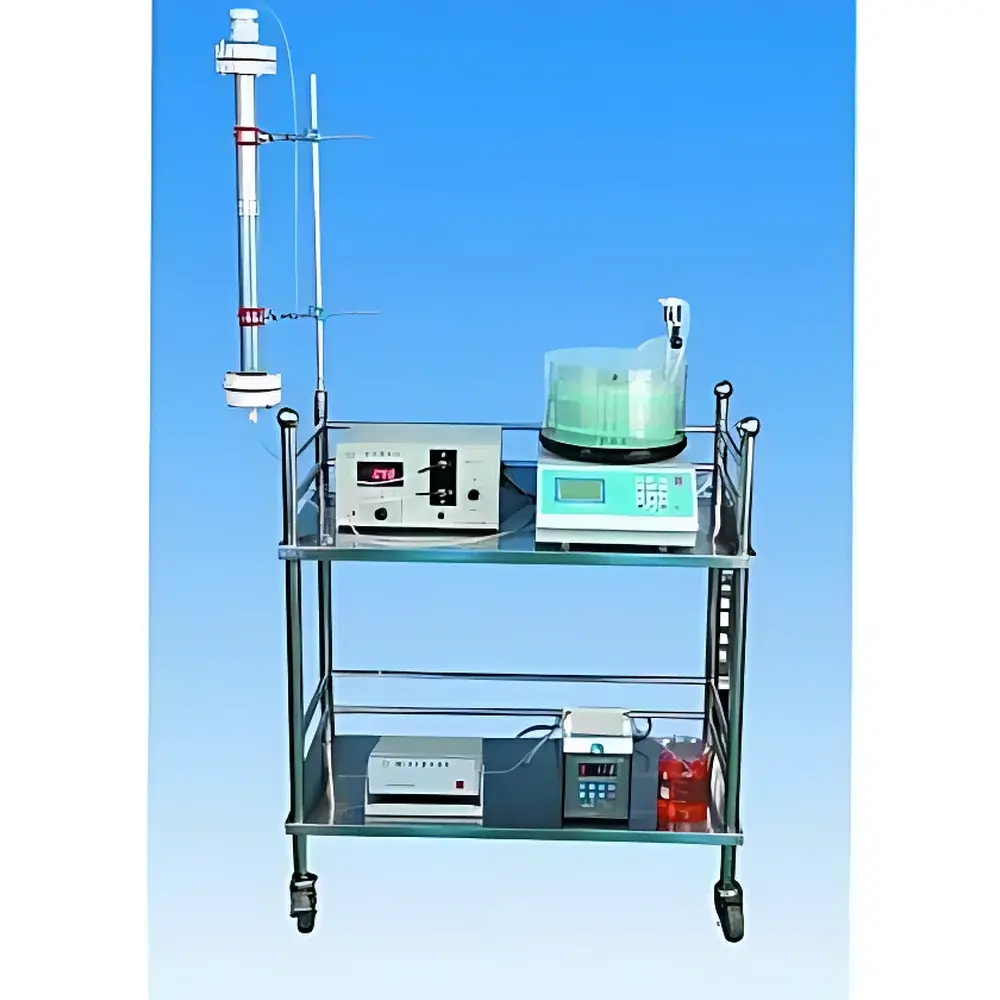
MC99-3 Auto Liquid Chromatography Fraction Collector System (Premium Modular Configuration)
| Origin | Shanghai, China |
|---|---|
| Manufacturer Type | Authorized Distributor |
| Origin Category | Domestic (PRC) |
| Model | MC99-3 |
| Price | USD 4,280 (FOB Shanghai) |
| UV Wavelengths | 220, 254, 280, 340 nm |
| Fraction Collection Capacity | 100 × 12 mL tubes |
| Timing Range | 1 s – 9999 min |
| Droplet Counting Range | 1–9999 drops |
| Peak Detection Range | 0–100 mV |
| Gradient Volume | 1000 mL (linear profile only) |
| Pump Flow Rate | 1–80 mL/min |
| Peristaltic Pump Speed | 0.1–100 rpm |
| Column Set | Φ1.0×40 cm, Φ1.6×50 cm, Φ2.5×60 cm |
| System Weight | 32 kg |
Overview
The MC99-3 Auto Liquid Chromatography Fraction Collector System (Premium Modular Configuration) is a benchtop, modular chromatographic separation platform engineered for reproducible nucleic acid and protein purification workflows in academic, clinical, and industrial life science laboratories. It operates on classical UV absorbance-based detection principles—utilizing fixed-wavelength ultraviolet photometry at 220 nm (peptide bond), 254 nm (nucleic acid backbone), 280 nm (aromatic amino acids), and 340 nm (background reference or turbidity correction)—to monitor eluent composition in real time during column-based separations. The system integrates four core functional modules: a dual-channel UV detector with analog output, a digitally controlled peristaltic pump, a microprocessor-driven fraction collector with programmable timing/droplet/peak-triggered collection modes, and a passive gradient mixer enabling linear two-solvent blending. Designed for compatibility with standard glass or PEEK-packed analytical and preparative columns (up to Φ2.5 cm × 60 cm), the MC99-3 supports both analytical-scale monitoring and milligram-level purification of biomolecules without requiring high-pressure instrumentation.
Key Features
- Quad-wavelength UV detection (220/254/280/340 nm) with analog voltage output (0–100 mV) for integration with external chart recorders or data acquisition systems
- Programmable fraction collection via three independent triggering modes: time-based (1 s–9999 min), droplet-counting (1–9999 drops), and peak-threshold detection (0–100 mV analog input)
- Digital peristaltic pump with adjustable speed range (0.1–100 rpm), delivering stable flow rates from 1 to 80 mL/min across variable tubing inner diameters
- Modular architecture allowing field-reconfigurable component arrangement—detector, pump, mixer, and collector operate as interoperable units with standardized fluidic interfaces
- Included column set comprising three standard glass chromatography columns (Φ1.0×40 cm, Φ1.6×50 cm, Φ2.5×60 cm), optimized for gel filtration, ion exchange, and hydrophobic interaction chromatography
- Linear gradient generation capability up to 1000 mL total volume using dual-solvent reservoirs and a passive mixing chamber; no active gradient programming required
Sample Compatibility & Compliance
The MC99-3 is validated for use with aqueous and mild organic solvent-based mobile phases commonly employed in low-pressure liquid chromatography (LPLC), including Tris-HCl, phosphate buffers, NaCl gradients, ethanol/water mixtures, and acetonitrile/water solutions (≤30% v/v). It accommodates purified DNA fragments (50 bp–20 kb), plasmid preparations, recombinant proteins (10–200 kDa), antibodies, and viral capsid proteins. While not designed for GMP manufacturing environments, the system supports GLP-aligned documentation practices: all collection events—including timestamp, trigger mode, elapsed time, and detector signal threshold—are logged to non-volatile memory. Optional integration with third-party software enables export of CSV-formatted acquisition logs compliant with FDA 21 CFR Part 11 requirements when deployed with validated electronic signature protocols.
Software & Data Management
The MC99-3 does not include embedded firmware-based data visualization but provides analog and digital I/O interfaces (RS-232, 0–5 V TTL, and 4–20 mA current loop) compatible with industry-standard data acquisition platforms such as LabVIEW, MATLAB Data Acquisition Toolbox, or open-source tools like Python’s PySerial and NumPy. When paired with optional PC-based analysis software (sold separately), users gain access to real-time chromatogram plotting, baseline correction, peak integration, retention time alignment, and export to PDF, PNG, or Excel formats. All raw signal traces and collection metadata are stored in timestamped binary files (.BIN) with checksum validation to ensure data integrity during long-duration runs (>24 h).
Applications
- Purification of PCR-amplified DNA fragments prior to Sanger sequencing or NGS library preparation
- Desalting and buffer exchange of enzymatically digested proteins prior to mass spectrometry analysis
- Isolation of His-tagged recombinant proteins from Ni-NTA column eluates
- Fractionation of plant or microbial extracts for natural product screening (e.g., flavonoids, alkaloids)
- Removal of endotoxins from plasmid preps using size-exclusion chromatography
- Quality control of oligonucleotide synthesis batches via UV spectral profiling
FAQ
Does the MC99-3 support gradient programming beyond linear profiles?
No—the system implements only passive linear gradients via mechanical mixing; exponential, concave, or step gradients require external programmable pumps.
Can the UV detector be calibrated traceably to NIST standards?
Yes—each unit ships with a factory calibration certificate referencing traceable quartz filters at 254 nm and 280 nm; users may perform field verification using potassium dichromate solutions per ASTM E275.
Is the fraction collector compatible with 15-mL conical tubes or 96-well plates?
The standard carousel accepts only 12-mL round-bottom glass or polypropylene tubes; adapters for alternative tube formats or microplate racks are available as optional accessories.
What maintenance is required for long-term reliability?
Biannual inspection of pump tubing compression, UV lamp intensity verification (lamp lifetime ≈ 2,000 h), and cleaning of flow cell windows with ethanol followed by deionized water rinse.
Does the system meet CE or UL safety certification requirements?
The MC99-3 complies with IEC 61010-1:2010 for laboratory electrical equipment and carries the CE marking for EMC Directive 2014/30/EU and Low Voltage Directive 2014/35/EU.




