
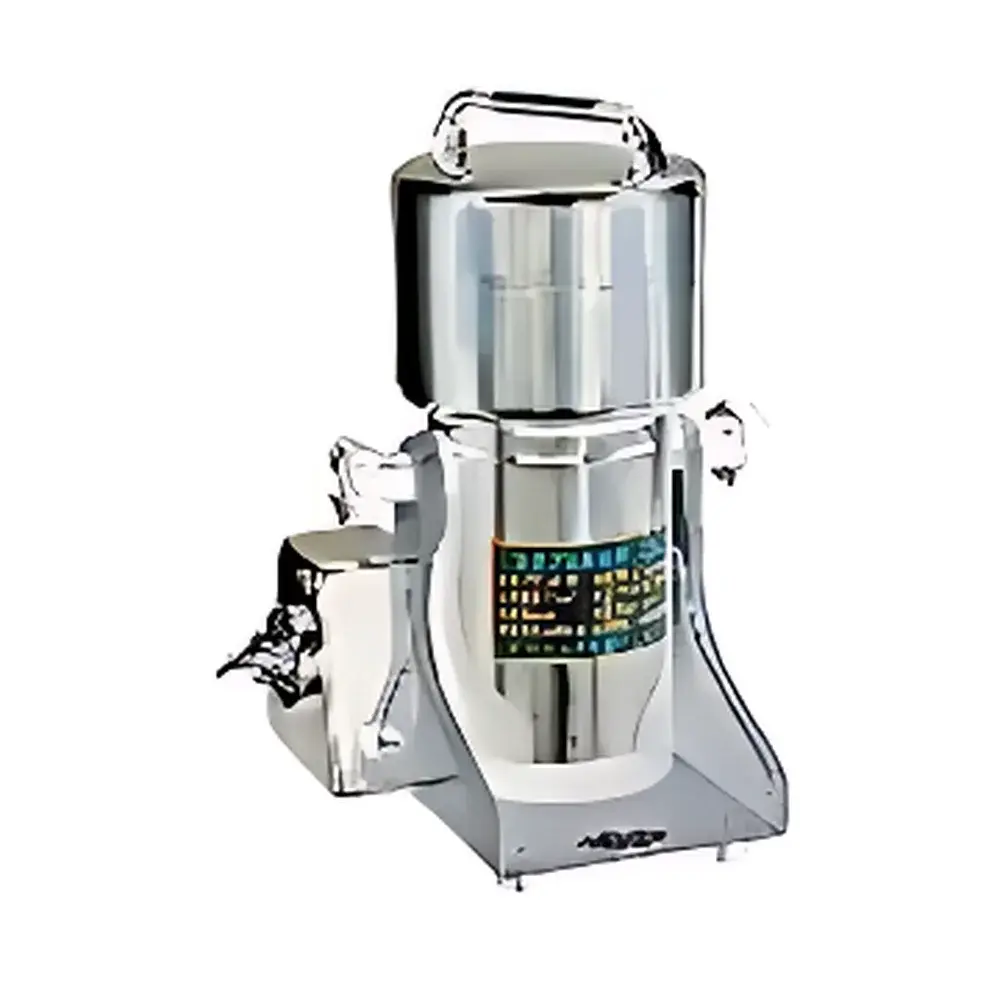
FW Series Laboratory Sample Milling Grinder (FW-135 / FW-177 / F120 Models)
| Origin | Shanghai, China |
|---|---|
| Manufacturer Type | Authorized Distributor |
| Origin Category | Domestic (China) |
| Model Numbers | FW-135, FW-177, F120 |
| Motor Power | 200 W (FW-135), 460 W (FW-177), 180 W (F120) |
| Voltage | 220 V AC |
| Rotational Speed | 10,000 rpm (FW-135), 24,000 rpm (FW-177), 1,400 rpm (F120) |
| Overall Dimensions | φ130×250 mm (FW-135), φ140×290 mm (FW-177), 300×185×300 mm (F120) |
| Particle Size Range | 60–200 µm |
| Construction | Stainless Steel Grinding Chamber |
| Application-Specific Design | Adjustable Clearance for Fibrous & Oily Samples (F102/F120 variant) |
Overview
The FW Series Laboratory Sample Milling Grinder is a precision-engineered benchtop grinding system designed for consistent, reproducible size reduction of heterogeneous solid samples in analytical and quality control laboratories. Built upon a robust mechanical architecture, the series employs high-speed rotor-stator impact milling (FW-135/FW-177) and adjustable shear-cutting mechanisms (F120 variant) to achieve controlled particle size distribution across diverse biological and mineral matrices. Unlike general-purpose blenders or homogenizers, the FW series is explicitly optimized for sample preparation prior to downstream analysis—including moisture determination (AOAC 925.09), proximate analysis (ASTM D5142), protein quantification (Kjeldahl digestion prep), and lipid extraction (Soxhlet or ASE). Its stainless steel grinding chamber ensures chemical inertness, minimal sample retention, and compliance with GLP-aligned cleaning validation protocols.
Key Features
- Stainless steel grinding chamber and contact parts—resistant to corrosion, non-reactive with organic solvents and acidic/basic extracts, and compliant with ISO 8573-1 purity class requirements for cleanroom-compatible sample handling.
- Model-specific motor configurations: FW-135 (200 W, 10,000 rpm) for moderate-volume herbal powders; FW-177 (460 W, 24,000 rpm) for high-throughput, fine-grinding applications requiring sub-200 µm output; F120 (180 W, 1,400 rpm) with adjustable rotor–stator clearance for fibrous, oily, or elastic tissues (e.g., plant stems, animal skin, dried roots).
- Compact footprint and low-vibration design—enables stable operation on standard laboratory countertops without anchoring; noise emission <72 dB(A) at 1 m distance, meeting OSHA 29 CFR 1910.95 workplace exposure limits.
- Tool-free disassembly for rapid cleaning and cross-contamination prevention—grinding assemblies conform to USP environmental monitoring guidelines for non-sterile pharmaceutical labs.
- Thermal management via passive convection cooling—prevents thermal degradation of thermolabile phytochemicals (e.g., volatile oils, flavonoids) during extended operation.
Sample Compatibility & Compliance
The FW series accommodates a broad spectrum of dry or low-moisture (<12% w/w) solid samples: botanical materials (dried leaves, rhizomes, seeds), cereal grains (wheat, rice, soybeans), soil aggregates, coal fines, geological core fragments, and pharmaceutical excipients. It is routinely deployed in accordance with ASTM D7506 (standard test method for particle size analysis of pulverized coal), ISO 11277 (soil particle-size distribution), and Chinese Pharmacopoeia (ChP) General Chapter 0211 (herbal drug comminution). While not certified for GMP manufacturing environments, its construction and documentation support audit readiness under FDA 21 CFR Part 11 (for electronic records generated during sample prep logs) and EU Annex 11 (data integrity principles).
Software & Data Management
The FW Series operates as a standalone mechanical instrument with no embedded firmware or digital interface. All operational parameters—including run time, motor speed (fixed per model), and maintenance intervals—are recorded manually or integrated into LIMS via external barcode-scanned sample tags. For traceability, users are advised to document batch-specific grinding conditions (e.g., “FW-177, 3 × 45 s pulses, ambient temp 22°C”) in electronic lab notebooks compliant with ALCOA+ principles (Attributable, Legible, Contemporaneous, Original, Accurate, Complete, Consistent, Enduring, Available).
Applications
- Preparation of homogeneous subsamples for elemental analysis (ICP-OES, XRF) of mineral-rich herbs and soils.
- Generation of uniform particle size distributions required for NIR calibration models in botanical QC.
- Routine comminution of grain samples prior to near-infrared spectroscopy (NIRS) for moisture, protein, and oil content prediction (AOAC 984.27).
- Fragmentation of fibrous medicinal plants (e.g., Angelica sinensis, Rehmannia glutinosa) where conventional mills yield inconsistent particle morphology.
- Supporting pharmacopeial testing workflows including ChP 2020 General Chapter 0211 and USP Disintegration, where defined particle size is prerequisite for dissolution assay validity.
FAQ
Is the FW-177 suitable for cryogenic grinding?
No—the unit lacks liquid nitrogen ports or insulated chambers; it is rated for ambient-temperature operation only.
Can I validate the particle size output for regulatory submissions?
Yes—particle size distribution must be verified externally using laser diffraction (ISO 13320) or sieve analysis (ISO 9276-1); the grinder itself provides no real-time sizing feedback.
What maintenance intervals are recommended for sustained accuracy?
Inspect rotor/stator wear every 200 operating hours; replace stainless steel blades when edge radius exceeds 50 µm (measured via optical profilometry).
Does the F120 model meet FDA requirements for food-grade processing?
It complies with FDA 21 CFR 170–199 for material contact surfaces (304 stainless steel), but final suitability depends on facility-level HACCP validation.
Are spare parts available internationally?
Yes—rotor assemblies, stator plates, and chamber gaskets are stocked globally through authorized distribution partners with documented lot traceability.



