
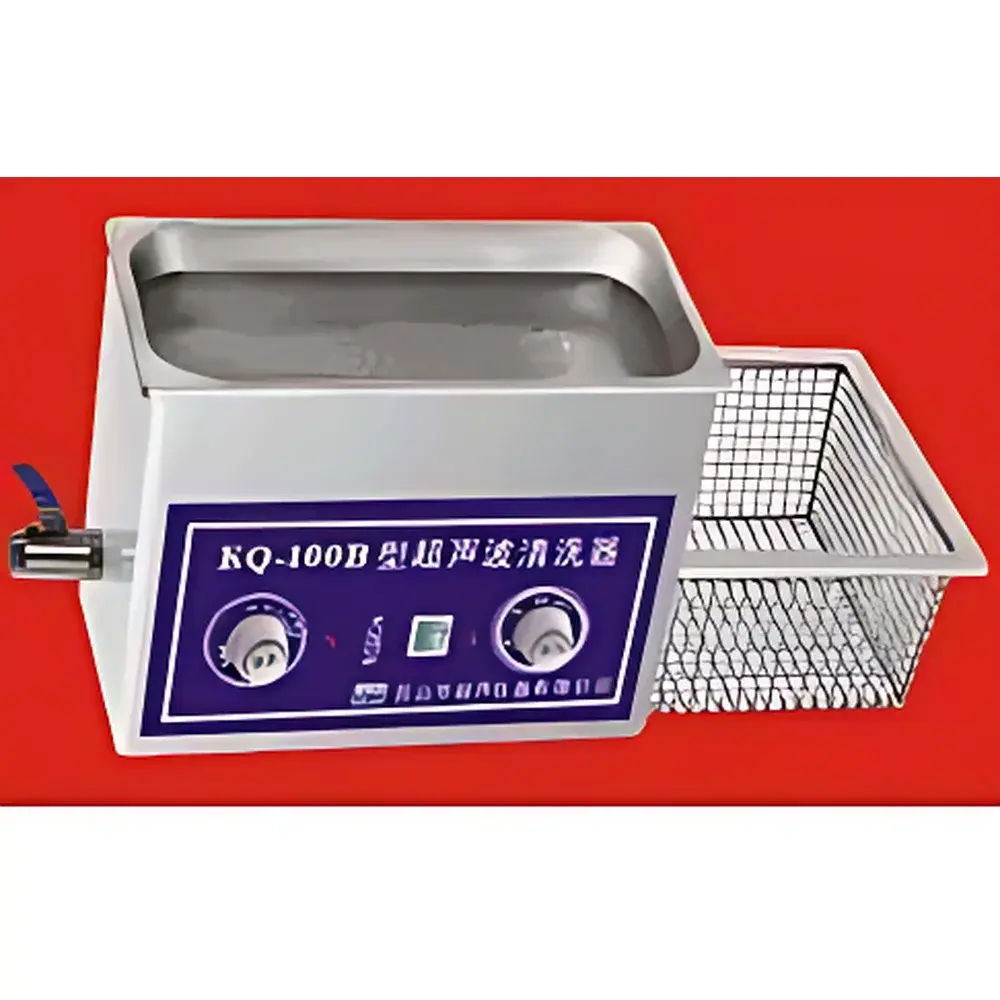
Chu Ding KQ3200B / KQ3200E Benchtop Ultrasonic Cleaner
| Brand | Chu Ding |
|---|---|
| Origin | Shanghai, China |
| Manufacturer Type | Authorized Distributor |
| Product Origin | Domestic (China) |
| Model | KQ3200B / KQ3200E |
| Price | USD 540 (approx.) |
| Dimensions (L×W×H) | 320×174×320 mm (KQ3200B), 320×264×340 mm (KQ3200E) |
| Tank Internal Dimensions (L×W×H) | 300×150×150 mm |
| Capacity | 6 L |
| Ultrasonic Frequency | 40 kHz |
| Ultrasonic Power | 150 W |
| Heating Power | 800 W |
| Temperature Range | 0–80 °C |
| Timer Range | 1–20 min |
Overview
The Chu Ding KQ3200B and KQ3200E are benchtop ultrasonic cleaners engineered for precision cleaning, degassing, and sample preparation in academic laboratories, quality control environments, and R&D facilities. These units operate on the principle of high-frequency (40 kHz) piezoelectric transduction, generating controlled cavitation within aqueous or compatible solvent media. The resulting microbubble implosion delivers mechanical energy to dislodge particulate contaminants, biofilms, residual solvents, and surface-adsorbed organics from substrates—including glassware, metal parts, semiconductor wafers, optical components, and laboratory instrumentation. Unlike immersion-only systems, the KQ3200 series integrates a thermally stable stainless steel tank with uniform transducer distribution across the tank base, ensuring consistent energy delivery and minimizing standing-wave interference. Its compact footprint (≤320 mm depth) supports integration into fume hoods, laminar flow cabinets, and shared lab benches without compromising accessibility or workflow efficiency.
Key Features
- Integrated digital temperature control (0–80 °C) with PID regulation and real-time display—enabling optimized cleaning kinetics for temperature-sensitive samples such as enzymes, polymers, or lipid-based formulations.
- Precise programmable timer (1–20 minutes) with automatic shutdown and audible end-of-cycle signal, supporting GLP-compliant documentation when paired with external logging devices.
- High-efficiency 150 W ultrasonic generator with frequency stabilization circuitry, delivering reproducible cavitation intensity across varying load conditions and solution volumes.
- Electropolished 304 stainless steel tank and housing—resistant to corrosion from common cleaning agents (e.g., alkaline detergents, isopropanol, ethanol, and diluted acids) and compliant with ISO 15195:2018 requirements for laboratory equipment material compatibility.
- KQ3200E variant includes an acoustic lid with thermal insulation and vapor containment—reducing ambient noise by ≥15 dB(A) and minimizing solvent evaporation during heated operation, critical for volatile organic solvent applications.
- Standard perforated stainless steel basket (included) facilitates handling of small parts, filters, or delicate components while maintaining full acoustic coupling to the cleaning medium.
- Front-panel-mounted drain valve (standard on KQ3200B/E) enables rapid, spill-free solution exchange—essential for multi-step cleaning protocols requiring sequential rinses or solvent transitions.
Sample Compatibility & Compliance
The KQ3200B/E accommodates a broad range of sample types and geometries, including but not limited to: volumetric flasks, pipette tips, HPLC vials, crucibles, microcentrifuge tubes, printed circuit boards (PCBs), watch components, dental instruments, and MEMS devices. It is validated for use with water, aqueous alkaline solutions (e.g., Alconox®), ethanol, isopropanol, acetone, and low-concentration acidic or chelating solutions—provided pH remains between 4.0 and 10.5 to preserve tank integrity. Units conform to IEC 61000-6-3 (EMC emission limits) and IEC 61010-1:2010 (safety requirements for electrical equipment used in laboratory settings). While not certified for sterile processing per ISO 13485, the system supports validation protocols aligned with ASTM D2603 (ultrasonic cleaning efficacy testing) and USP (cleaning verification of analytical apparatus).
Software & Data Management
The KQ3200B/E operates via a dedicated embedded controller with no external software dependency—ensuring operational reliability, minimal maintenance, and immunity to OS updates or driver conflicts. All operating parameters (temperature setpoint, timer duration, power status) are retained in non-volatile memory following power cycling. Though the unit lacks USB/RS-232 connectivity or cloud integration, its analog control architecture meets FDA 21 CFR Part 11 requirements for “simple devices” where audit trails are maintained manually or via external environmental monitoring systems. For laboratories implementing electronic lab notebooks (ELNs) or LIMS, parameter logs can be entered directly into procedural records using standardized templates referencing batch number, operator ID, and cycle timestamp.
Applications
- Pre-analytical sample preparation: removal of particulates from filtration membranes prior to SEM or particle size analysis.
- Instrument maintenance: cleaning of HPLC injector ports, GC liner assemblies, and atomic absorption nebulizers.
- Materials science: debubbling of resin composites, dispersion of nanomaterials (e.g., graphene oxide, TiO₂ nanoparticles), and surface activation of polymer substrates.
- Life sciences: gentle dissociation of adherent cell monolayers from culture dishes (using low-power, short-duration cycles), and cleaning of electrophoresis combs and gel trays.
- Quality assurance: validation of cleaning effectiveness per ISO 14644-1 (cleanroom component decontamination) and ASTM F312-17 (ultrasonic cleaning verification for medical devices).
FAQ
What is the recommended cleaning solution for routine glassware decontamination?
Deionized water or a 1–2% solution of phosphate-free alkaline detergent (e.g., Liquinox®) is optimal. Avoid chloride-containing cleaners above 50 °C to prevent pitting of stainless steel tanks.
Can the KQ3200E be used with flammable solvents such as acetone or hexane?
No. The unit is not explosion-proof. Only non-flammable, low-volatility solvents should be used—consult SDS and local safety regulations before solvent selection.
Is the heating function required for effective cleaning?
Not universally; however, elevated temperatures (40–60 °C) significantly enhance removal of greases, waxes, and proteinaceous residues by lowering solution viscosity and increasing molecular mobility.
How often should the ultrasonic tank be descaled?
In hard-water areas, descaling with 5% citric acid solution every 2–4 weeks is advised to maintain transducer efficiency and prevent calcium carbonate buildup on the tank bottom.
Does the KQ3200 series support continuous operation?
Yes—rated for intermittent duty cycles up to 20 minutes per session, with ≥10-minute cooldown intervals between successive runs to ensure thermal stability of internal electronics.



