
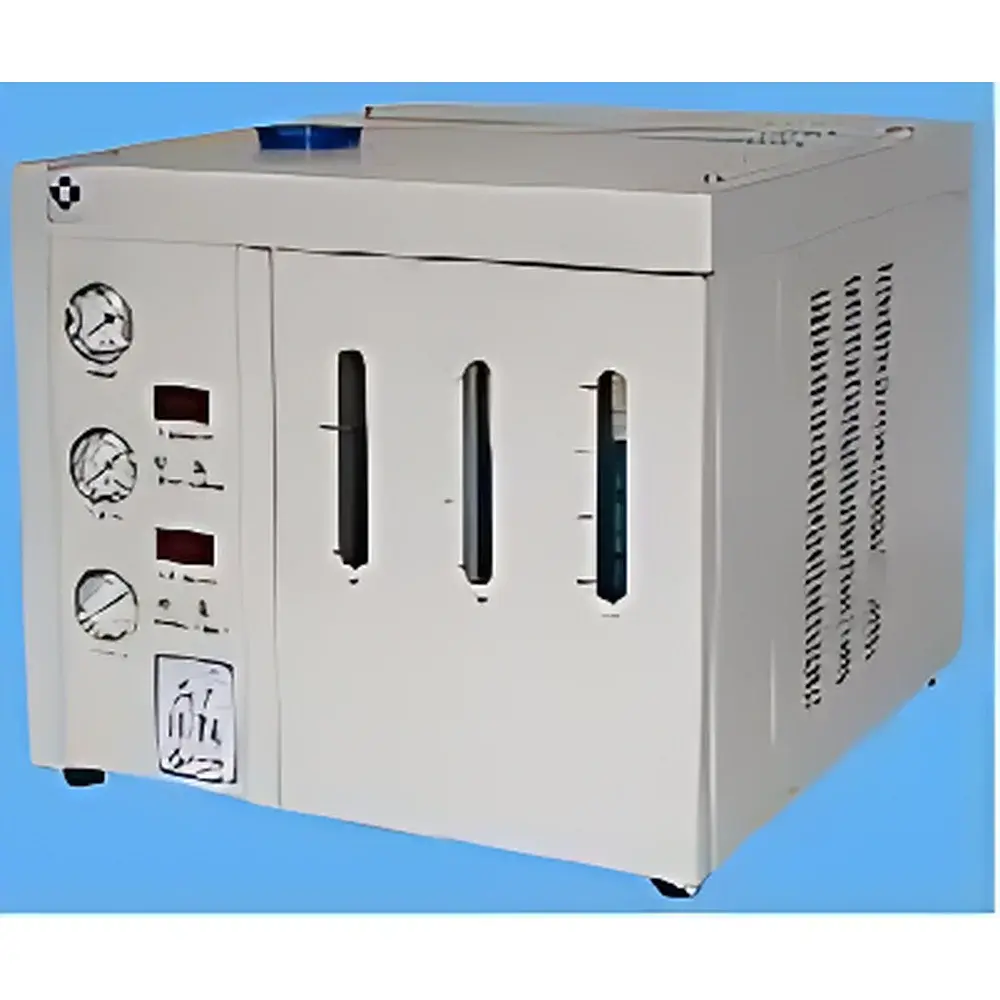
Chu Ding Technology XYT-300 / XYT-500 / XYT-300G / XYT-500G Nitrogen-Hydrogen-Air Integrated Gas Generator
| Brand | Chu Ding Technology |
|---|---|
| Origin | Shanghai, China |
| Model | XYT-300 / XYT-500 / XYT-300G / XYT-500G |
| Nitrogen Purity | O₂ < 3 ppm, Dew Point < −70 °C |
| Nitrogen Flow | 0–500 mL/min |
| Nitrogen Pressure | 0–0.5 MPa (factory-set at 0.4 MPa) |
| Hydrogen Purity | 99.999% |
| Hydrogen Flow | 0–500 mL/min |
| Hydrogen Pressure | 0–0.4 MPa (factory-set at 0.3 MPa) |
| Air Flow | 0–5000 mL/min |
| Air Pressure | 0–0.5 MPa (factory-set at 0.4 MPa) |
| Dimensions | 460 × 440 × 370 mm |
| Max Power Consumption | 450 W |
Overview
The Chu Ding Technology XYT-300 / XYT-500 / XYT-300G / XYT-500G is an integrated laboratory gas generator engineered to simultaneously supply high-purity nitrogen, hydrogen, and compressed air from a single compact unit. Designed for analytical instrumentation requiring stable, on-demand gas streams—including gas chromatography (GC), GC–MS, flame ionization detectors (FID), thermal conductivity detectors (TCD), and nitrogen purge applications—the system eliminates reliance on high-pressure gas cylinders while maintaining strict purity and pressure stability. Nitrogen is generated via pressure swing adsorption (PSA) using carbon molecular sieve (CMS) technology; hydrogen is produced by alkaline electrolysis of deionized water; and compressed air is delivered via either a standard oil-free scroll compressor (XYT-300/XYT-500) or a premium imported oil-free piston compressor (XYT-300G/XYT-500G), ensuring zero hydrocarbon contamination critical for sensitive detector operation. All three gas streams operate independently yet share intelligent control logic, enabling selective activation, real-time flow tracking, and automatic pressure regulation.
Key Features
- Triple-gas integration in one chassis: independent nitrogen, hydrogen, and air generation modules with synchronized safety interlocks.
- Stainless steel nitrogen and hydrogen storage tanks—rated for 1.0 MPa working pressure—designed to meet ISO 10297 and PED 2014/68/EU structural integrity requirements for low-pressure gas reservoirs.
- Hydrogen module incorporates automatic anti-alkaline backflow protection and closed-loop flow tracking to maintain stoichiometric consistency across varying instrument demand.
- Nitrogen module features dual-tower PSA architecture with auto-regeneration cycles, achieving O₂ < 3 ppm and dew point ≤ −70 °C (measured per ISO 8573-1 Class 2:2:2).
- Air module includes precision pressure stabilization, automatic condensate drainage, and integrated particulate/moisture filtration compliant with ISO 8573-1 Class 3:4:3 specifications.
- G-series models (XYT-300G/XYT-500G) integrate certified imported oil-free compressors—CE-marked and tested per ISO 8573-1 Annex B—to guarantee hydrocarbon-free air output (< 0.01 mg/m³ total oil content), essential for FID baseline stability.
- Front-panel digital interface with real-time display of individual gas pressures, flow rates, system status, and maintenance alerts.
Sample Compatibility & Compliance
The XYT series supports all standard GC inlet types (split/splitless, PTV, cool-on-column) and detector configurations requiring ultra-high-purity carrier and fuel gases. Nitrogen meets ASTM D6866-22 specifications for inert carrier gas in trace organic analysis; hydrogen complies with ISO 8573-1:2010 Class 1.2 for gaseous hydrogen used in analytical instrumentation; compressed air satisfies USP requirements for instrumental air in pharmaceutical QC labs. The system’s electrical design conforms to IEC 61010-1:2010 for laboratory equipment safety, and its enclosure meets IP20 ingress protection rating. Optional audit trail logging and user-access control firmware upgrades support GLP/GMP environments requiring 21 CFR Part 11–compliant data integrity.
Software & Data Management
While the base configuration operates via embedded microcontroller with tactile keypad and LED display, optional RS-232/USB communication ports enable integration with lab information management systems (LIMS) or building automation platforms. Firmware supports configurable alarm thresholds (e.g., low water level, high temperature, pressure deviation > ±5%), event timestamping, and 30-day operational history storage. Remote monitoring capability allows technicians to verify gas availability prior to instrument startup—reducing unplanned downtime during overnight GC runs. All firmware updates are delivered via signed binary packages to ensure code authenticity and version traceability.
Applications
- Carrier gas supply for capillary GC and GC–MS systems requiring consistent 0.3–0.5 MPa nitrogen at ≤500 mL/min.
- Fuel gas source for FID, NPD, and FPD detectors demanding 99.999% H₂ at regulated 0–500 mL/min flow.
- Make-up and combustion air for detectors, including TCD reference arms and FID air-assisted flames.
- Blanketing and purging in sample preparation hoods, glove boxes, and inert-atmosphere reactors.
- Replacement for cylinder-based gas logistics in multi-instrument labs—reducing cylinder handling, rental fees, and regulatory documentation overhead.
FAQ
What is the difference between XYT-300/XYT-500 and XYT-300G/XYT-500G models?
The “G” suffix denotes integration of an imported oil-free air compressor, certified to deliver hydrocarbon-free air meeting ISO 8573-1 Class 1 for critical detector applications.
Can nitrogen and hydrogen be used simultaneously without cross-contamination?
Yes. Physically isolated gas paths, dedicated CMS beds, and non-return valves prevent intermixing; each stream undergoes independent purity verification before delivery.
Is deionized water required for hydrogen generation?
Yes. Conductivity must remain below 1 µS/cm; built-in resistivity sensor triggers audible/visual alerts if feedwater quality degrades.
What maintenance intervals are recommended?
CMS replacement every 24 months (under continuous operation); alkaline electrolyte replenishment every 6 months; air filter element replacement every 12 months.
Does the unit support remote diagnostics or service access?
Standard models include local diagnostic codes; optional Ethernet module enables secure remote technician access via TLS-encrypted SSH tunnel.



