
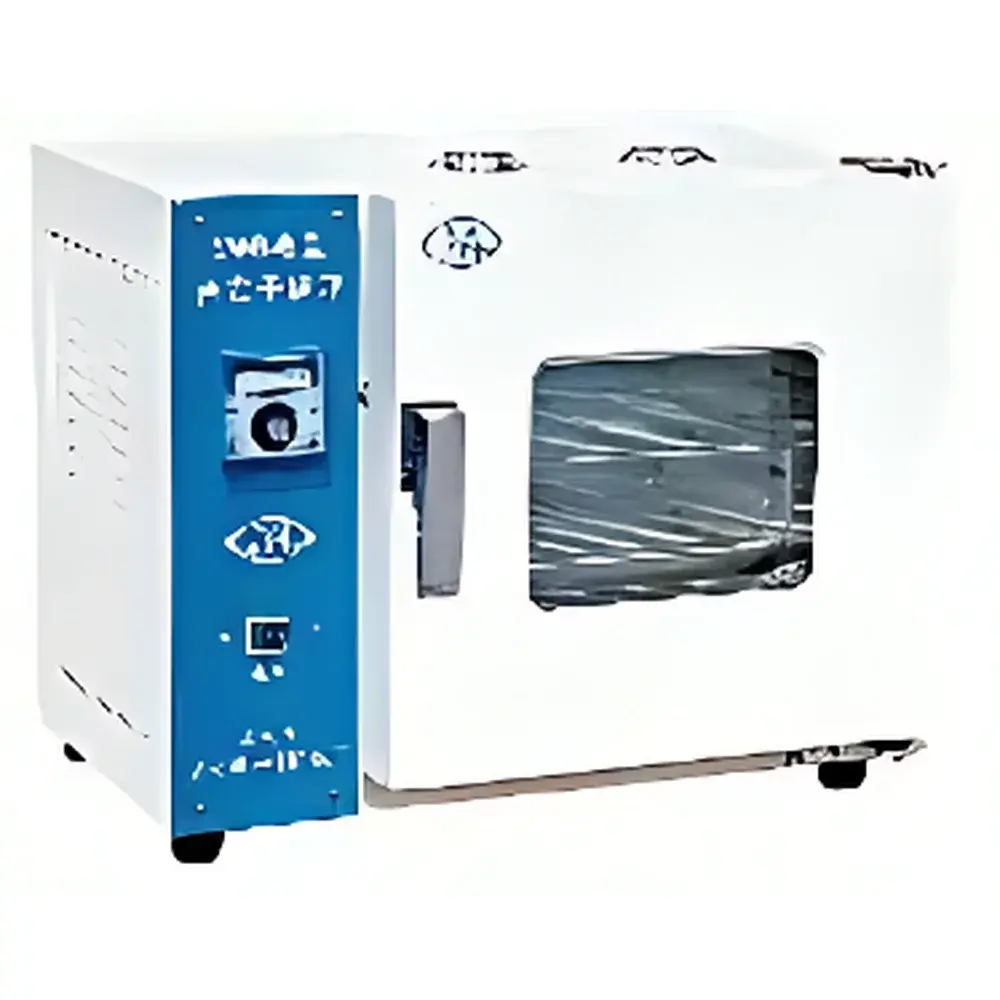
Shanghai LabTech 202-0ES / 202-1ES / 202-2ES / 202-3ES Electrically Heated Constant-Temperature Drying Oven
| Origin | Shanghai, China |
|---|---|
| Power Supply | 220 V AC |
| Heating Power | 1.6–4.0 kW |
| Internal Chamber Dimensions (W×D×H) | 350×350×350 mm to 500×600×750 mm |
| External Dimensions (W×D×H) | 515×640×555 mm to 665×890×955 mm |
| Temperature Range | Ambient +10 °C to 300 °C |
| Temperature Uniformity | ±2.5 °C (at 100 °C) |
| Temperature Control Accuracy | ±1.0 °C |
| Compliance | GB/T 5170.2–2017, ISO 17025 (when used in accredited labs), GLP-ready architecture |
Overview
The Shanghai LabTech 202-0ES, 202-1ES, 202-2ES, and 202-3ES series are benchtop-to-floor-standing electrically heated constant-temperature drying ovens engineered for precision thermal processing in regulated laboratory and industrial quality control environments. These ovens operate on resistive heating principles, utilizing nickel-chromium alloy heating elements mounted on the chamber walls and/or bottom to ensure uniform convective heat distribution. Air circulation is facilitated by a rear-mounted axial fan with adjustable speed—enabling consistent temperature homogeneity across the working chamber. Designed to meet fundamental thermal stability requirements for drying, baking, sterilization, polymer curing, and moisture content determination, each model complies with national standard GB/T 5170.2–2017 for environmental testing equipment performance verification. The ovens are suitable for use in ISO/IEC 17025-accredited laboratories when integrated into documented SOPs and routine calibration protocols.
Key Features
- Electrostatically coated steel exterior housing—resistant to chipping, corrosion, and chemical splashes under routine lab handling conditions
- Tempered double-layer observation window integrated into the door assembly—provides real-time visual monitoring without compromising thermal integrity or safety interlock functionality
- Modular temperature control system supporting interchangeable digital PID controllers—including optional RS-485 communication interface for external data logging and centralized HVAC integration
- Independent over-temperature protection circuit with mechanical cut-off switch—meets IEC 61000-4-2 ESD immunity and Class II electrical safety requirements
- Insulated chamber construction using high-density ceramic fiber board (≥1200 °C rated)—minimizes thermal loss and improves energy efficiency during extended operation cycles
- Removable, stainless-steel interior shelves (standard: 2 pcs; optional: up to 4) with reinforced support rails—designed for load capacities up to 15 kg per shelf
Sample Compatibility & Compliance
The 202-ES series accommodates a broad range of sample formats—from Petri dishes and weighing boats to glassware, metal trays, and polymer substrates—within defined chamber volume envelopes. All models maintain stable setpoint control across their full operating range (ambient +10 °C to 300 °C), validated per GB/T 5170.2–2017 methodology at key reference points (e.g., 50 °C, 100 °C, 150 °C). Temperature uniformity is specified as ±2.5 °C (measured at nine points within the working zone at 100 °C), supporting applications requiring adherence to USP , ASTM E145, and ISO 12100 safety guidelines. While not intrinsically certified for hazardous area use, the ovens may be deployed in non-classified zones under GMP Annex 15 and FDA 21 CFR Part 211-compliant facilities when paired with qualified calibration procedures and preventive maintenance logs.
Software & Data Management
These ovens do not include embedded touchscreen HMI or proprietary software suites. Instead, they feature analog/digital hybrid control architecture compatible with third-party data acquisition systems via 4–20 mA or 0–5 V analog outputs (optional configuration). When equipped with the RS-485 port option, users may integrate the oven into LabVantage, Thermo Fisher SampleManager, or custom SCADA platforms using Modbus RTU protocol. Audit trail capability is achieved through external recording devices compliant with FDA 21 CFR Part 11—requiring electronic signatures, time-stamped event logging, and user-access-level permissions. Calibration certificates traceable to NIM (National Institute of Metrology, China) are available upon request for IQ/OQ/PQ validation packages.
Applications
- Moisture loss-on-drying (LOD) analysis per USP and Ph. Eur. 2.2.32 for pharmaceutical excipients and APIs
- Residual solvent removal from coated films and thin-film battery electrodes in R&D settings
- Pre-conditioning of filter media and desiccant materials prior to gravimetric testing
- Baking of printed circuit boards (PCBs) and solder paste reflow simulation in electronics QA labs
- Heat stabilization of reference standards and calibration weights in metrology labs
- Drying of soil, sediment, and botanical samples for elemental analysis (ICP-OES/MS)
FAQ
What is the maximum recommended continuous operating temperature?
The ovens are rated for continuous operation up to 300 °C. Prolonged use above 250 °C requires periodic verification of door gasket integrity and thermocouple drift.
Are internal temperature sensors calibrated and traceable?
Standard units include a factory-calibrated PT100 sensor with ±0.5 °C accuracy at 100 °C. NIST-traceable calibration certificates are available as an add-on service.
Can these ovens be used for sterilization of medical devices?
They meet dry-heat sterilization parameters (160 °C for 120 min or 170 °C for 60 min) per ISO 15883-5 but require additional validation (BI testing, load mapping) for regulatory submission.
Is airflow adjustable independently of temperature setpoint?
Yes—the fan speed is manually adjustable via potentiometer on the rear panel, allowing optimization for low-mass vs. high-thermal-inertia loads.
Do the 202-ES models support programmable ramp-soak profiles?
Not natively. Profile-based operation requires external controller integration via analog or Modbus interface.
Related Products



