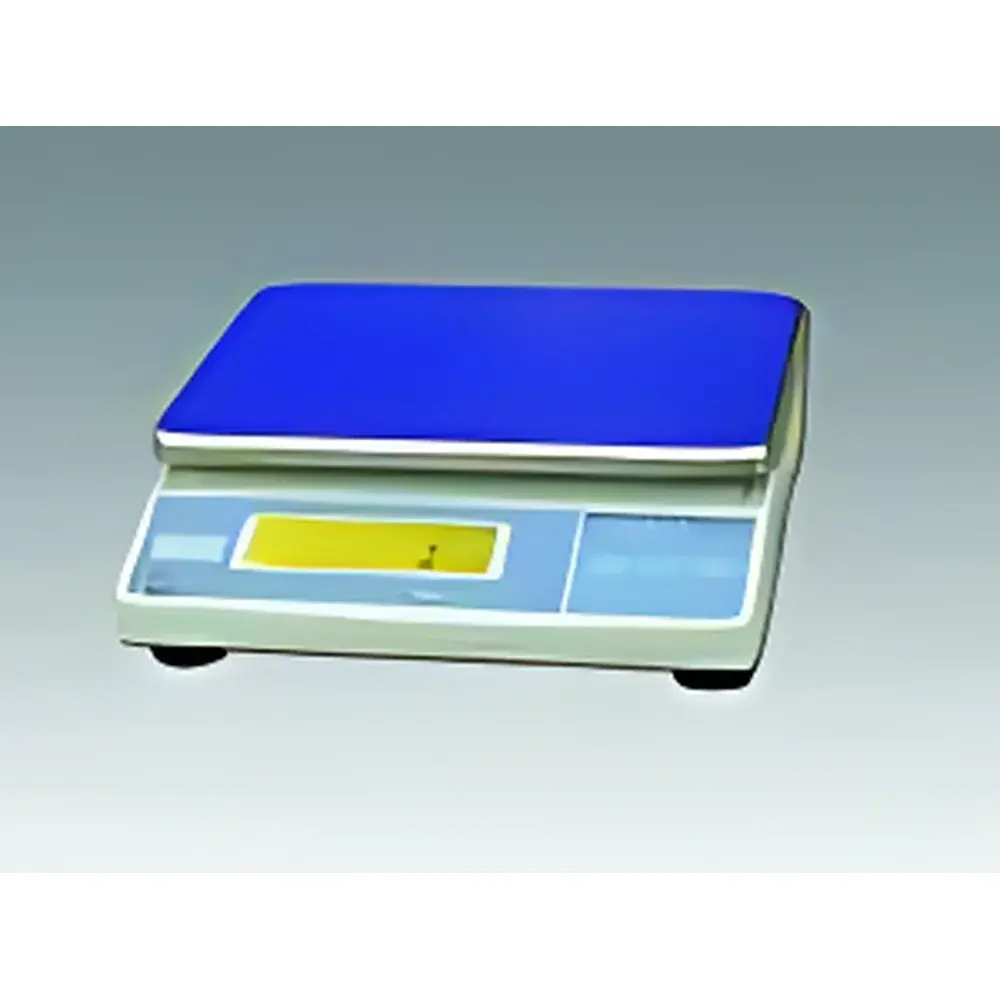
YP20K-1 Electronic Balance
| Origin | Shanghai, China |
|---|---|
| Manufacturer Type | Distributor |
| Origin Category | Domestic (China) |
| Model | YP20K-1 |
| Price | USD 605 (approx.) |
| Capacity | 20 kg |
| Readability | 0.1 g |
| Repeatability | ±0.1 g |
| Linearity | ±0.2 g |
| Dimensions (W×D×H) | 310 × 285 × 100 mm |
| Pan Size | 238 × 286 mm |
| Power | AC adapter or 9 V DC battery |
| Display | Backlit LCD |
| Interface | RS232 |
| Features | Auto-calibration, full-range tare, piece counting, unit conversion, level indicator, one-key function activation |
Overview
The YP20K-1 Electronic Balance is a high-stability, dual-power laboratory and industrial balance engineered for reliable mass measurement in environments where portability, operational flexibility, and regulatory traceability are essential. Designed around a precision electromagnetic force compensation sensor architecture—distinct from traditional strain-gauge systems—the YP20K-1 eliminates common drift sources such as creep, temperature-induced hysteresis, and nonlinearity over time. Its microcontroller-based signal processing ensures consistent response across the full 20 kg capacity with 0.1 g resolution, delivering repeatable results under varying ambient conditions. The balance operates on either AC mains power or a standard 9 V alkaline battery, enabling deployment in field laboratories, quality control stations, educational facilities, and production floors without fixed infrastructure dependency. Its robust metal-and-plastic hybrid housing, stainless steel weighing pan (238 × 286 mm), and integrated leveling bubble support stable operation on non-ideal surfaces—a critical requirement for GLP-compliant routine weighing tasks.
Key Features
- High-resolution measurement: 20 kg maximum capacity with 0.1 g readability and ≤ ±0.1 g repeatability per ISO 7500-1 Class III verification requirements
- Dual power mode: Simultaneous compatibility with AC adapter and 9 V DC battery—enabling uninterrupted operation during power outages or mobile use
- Backlit LCD display: High-contrast, wide-angle screen with automatic brightness control for legibility under low-light or glare-prone conditions
- One-touch functional interface: Dedicated keys for tare, unit conversion (g, oz, ct, etc.), piece counting, and auto-calibration—no menu navigation required
- Integrated RS232 serial port: Enables direct data export to PCs, LIMS, or statistical process control (SPC) software; supports ASCII protocol for seamless integration into validated workflows
- Mechanical stability aids: Built-in spirit level and adjustable feet ensure proper horizontal alignment prior to calibration or critical weighing
Sample Compatibility & Compliance
The YP20K-1 accommodates bulk solids, packaged goods, labware, and intermediate containers up to 20 kg, with its large stainless steel pan optimized for uniform load distribution and corrosion resistance. It meets OIML R76-1 (2006) and JJG 1036–2008 metrological verification standards for non-automatic weighing instruments. While not certified for legal-for-trade applications in the EU (EC Type Approval) or USA (NTEP), it conforms to general-purpose laboratory performance criteria outlined in ASTM E1153 and ISO/IEC 17025 clause 6.4.1 for equipment suitability. Its design supports basic GLP documentation needs through timestamped RS232 output and manual calibration log recording—though it does not provide electronic audit trails or 21 CFR Part 11-compliant user authentication.
Software & Data Management
Data acquisition is performed via standard RS232 serial communication at 9600 baud, 8N1 configuration. The balance outputs weight values in ASCII format, including unit suffixes and status flags (e.g., “TARE”, “STAB”, “OVER”). No proprietary software is bundled; however, raw output is compatible with Microsoft Excel (via terminal emulation), LabArchives, OpenLab CDS, and custom Python/Node-RED scripts using pySerial or similar libraries. Users may configure data logging intervals, prefix identifiers, and delimiter formats externally. Calibration history must be manually recorded, as internal memory retains only the most recent calibration event—not historical metadata such as date, operator ID, or reference standard traceability.
Applications
The YP20K-1 serves as a primary or secondary mass comparator in academic teaching labs, vocational training centers, incoming inspection stations, agricultural commodity grading, and pharmaceutical excipient dispensing (non-GMP). Its counting function enables rapid inventory reconciliation of uniform parts (e.g., screws, tablets, capsules) with configurable sample size input. In food processing QA, it supports batch formulation checks and packaging net-weight verification. Its compact footprint (310 × 285 mm base) and low height (100 mm) allow integration beneath fume hoods or into modular workbenches. The absence of internal draft shields limits use in high-precision analytical workflows requiring sub-milligram resolution—but aligns with ISO 17025 Clause 6.4.2’s principle of “fitness for intended purpose.”
FAQ
Does the YP20K-1 support internal calibration with motorized weights?
No—it performs single-point external calibration using certified reference masses; no internal calibration mechanism is present.
Is the RS232 interface optically isolated?
No—electrical isolation is not implemented; users deploying in electrically noisy industrial settings should use shielded cables and ground-loop mitigation practices.
Can the balance store multiple calibration points for linearity verification?
No—calibration is performed at full capacity only; linearity verification requires external test weights at multiple load points and manual comparison.
What is the warm-up time required before first use?
Minimum 30 minutes at stable ambient temperature (20 ± 5 °C) is recommended to achieve thermal equilibrium of the load cell and electronics.
Is the battery life specified under continuous operation?
Approximately 40 hours under typical intermittent use (5–10 weighings/hour); runtime decreases significantly during continuous display backlight use or frequent RS232 transmission.