
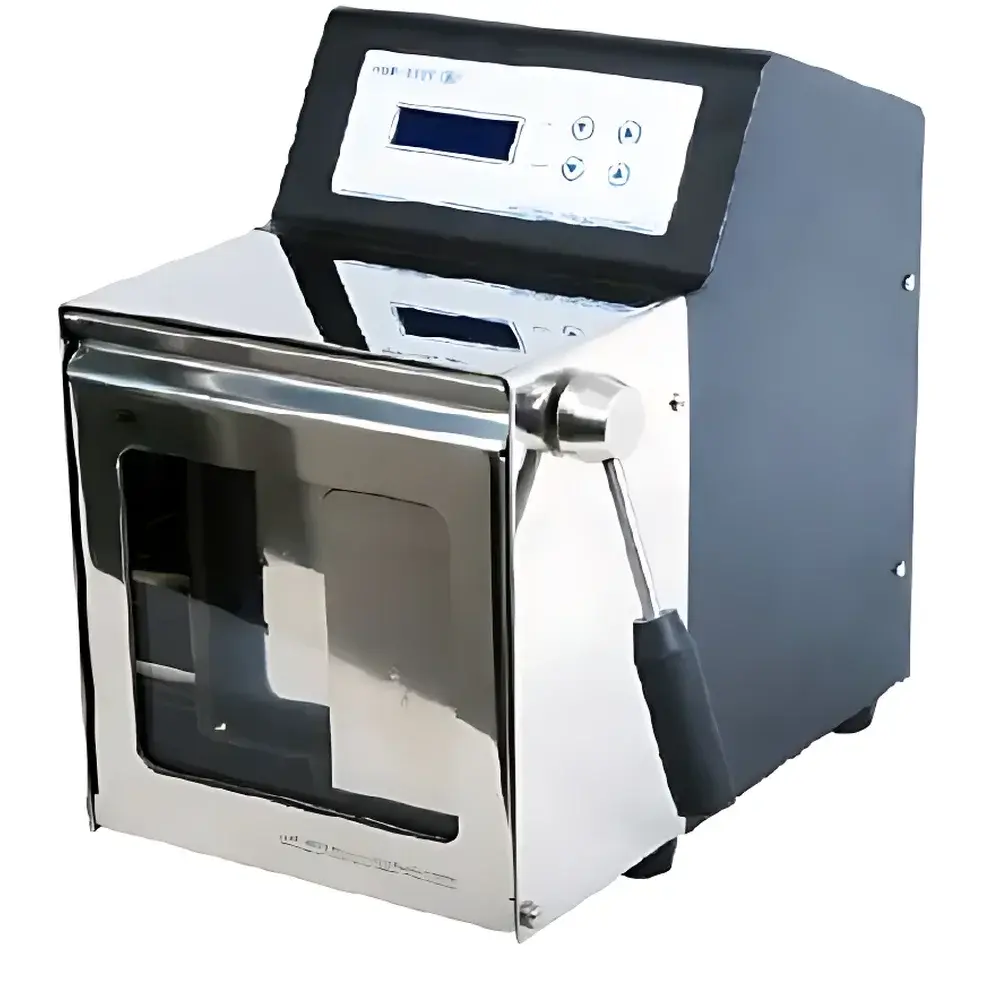
Chu Ding Technology HBM-400F Pulsed-Action Homogenizer (Sterile Stomacher)
| Brand | Chu Ding Technology |
|---|---|
| Origin | Shanghai, China |
| Manufacturer Type | Authorized Distributor |
| Country of Origin | China |
| Model | HBM-400F |
| Instrument Type | Pulsed-Action (Stomacher-Style) |
| Dimensions (W×D×H) | 450 × 270 × 290 mm |
| Sample Volume Range | 30–400 mL |
| Control Interface | Digital Display |
| Time Settings | 10, 30, 60, 90, 120, 180, 600 s or Continuous Mode (8 selectable intervals) |
| Pulsing Frequency | 6–9 pulses/sec (customizable range: 3–12 pulses/sec) |
| Power Input | 220 V / 50 Hz |
| Rated Power | 200 W |
| Net Weight | 16.5 kg |
| Sterile Bag Dimensions | 30 × 17 cm |
Overview
The Chu Ding Technology HBM-400F Pulsed-Action Homogenizer is a laboratory-grade sterile stomacher designed for reproducible mechanical homogenization of solid and semi-solid biological samples in compliance with standardized microbiological preparation protocols. Operating on the principle of controlled reciprocal pulsation—where a motor-driven stainless-steel paddle applies rhythmic, calibrated impacts to a sealed sterile sample bag—the instrument achieves efficient release of microorganisms from food matrices, environmental swabs, clinical specimens, and agricultural products without cross-contamination or thermal degradation. Unlike rotor-stator or ultrasonic homogenizers, the HBM-400F eliminates direct contact between sample and instrument components, ensuring full containment within single-use, certified low-binding polyethylene filtration bags. This design supports ISO 6887-1, FDA Bacteriological Analytical Manual (BAM), and USP guidelines for microbial enumeration, making it suitable for GLP-compliant laboratories engaged in food safety testing, environmental monitoring, and academic research.
Key Features
- Digitally controlled pulsing interface with eight preset time intervals (10–600 s) plus continuous mode for method flexibility and protocol alignment.
- Adjustable pulsing frequency (6–9 pulses/sec standard; optional 3–12 pulses/sec range) enables optimization for diverse sample viscosities and particle sizes—including leafy greens, seafood tissue, soil suspensions, and dairy products.
- Integrated digital gap indicator displays real-time clearance between the oscillating plate and stationary anvil, ensuring consistent mechanical energy delivery across batch runs.
- Full-access front door with tempered glass viewing window allows real-time process monitoring while maintaining operator safety and workflow transparency.
- Automatic Hall-effect safety interlock halts pulsation immediately upon door opening—preventing accidental finger entrapment and meeting IEC 61000-6-2 EMC and EN 61010-1 safety requirements.
- Removable stainless-steel drip tray captures incidental bag leakage, minimizing contamination risk and simplifying decontamination between runs.
- Tool-free interchangeable micro-pulsing plate assembly (optional accessory) supports low-volume homogenization down to 30 mL with enhanced shear localization.
- Non-contact architecture ensures zero sample residue on internal surfaces—eliminating mandatory post-run cleaning cycles when bags remain intact.
Sample Compatibility & Compliance
The HBM-400F accommodates a broad spectrum of sample types, including but not limited to raw meat, poultry carcass rinses, fresh produce, ready-to-eat meals, activated sludge, and clinical swab eluates. Its operation conforms to internationally recognized homogenization standards: ISO 6887-1:2017 (microbiological examination of food and animal feeding stuffs), AOAC Official Method 990.12 (stomacher-based pathogen recovery), and FDA BAM Chapter 3 (enumeration of aerobic plate count). All compatible sterile filter bags are gamma-irradiated (25 kGy), DNase/RNase-free, and certified for endotoxin levels <0.03 EU/mL. The unit’s construction meets IP20 ingress protection rating and complies with CE marking requirements under the Low Voltage Directive (2014/35/EU) and EMC Directive (2014/30/EU).
Software & Data Management
While the HBM-400F operates as a standalone hardware platform with no embedded software stack, its digital control panel logs all user-selected parameters—including time, frequency, and run count—in non-volatile memory for traceability. Each operational cycle generates a timestamped parameter record accessible via front-panel review, supporting audit readiness in regulated environments. For laboratories requiring electronic records per FDA 21 CFR Part 11, the device integrates seamlessly with LIMS or ELN systems via optional RS-232 or USB-to-serial adapters (sold separately), enabling automated parameter export and electronic signature workflows. All firmware updates are delivered through secure offline channels to maintain system integrity and regulatory compliance.
Applications
This homogenizer serves as a core sample preparation tool in accredited food testing laboratories performing Salmonella, Listeria monocytogenes, E. coli O157:H7, and Campylobacter isolation assays. It is routinely deployed in university microbiology teaching labs for hands-on enumeration exercises, environmental health departments conducting water and soil pathogen surveillance, and QC units validating shelf-life stability of RTE foods. Additional use cases include pesticide residue extraction support (prior to GC-MS analysis), mycotoxin matrix disruption, and pre-sequencing DNA/RNA homogenization for metagenomic profiling—provided compatible low-nuclease bags are selected.
FAQ
What sterile bag specifications are required for the HBM-400F?
Standardized 30 × 17 cm polyethylene filtration bags with 100 µm pore size and integrated pour spout are recommended. Bags must be gamma-sterilized and certified for microbiological testing.
Can the HBM-400F be used for quantitative microbial recovery validation?
Yes—its pulse consistency, mechanical reproducibility, and adherence to ISO 6887-1 make it suitable for recovery rate studies when paired with validated bag lots and reference strains.
Is routine calibration required?
No scheduled calibration is mandated; however, users should perform periodic verification of time accuracy (±0.5 s) and pulse frequency (±0.2 pulses/sec) using external timing instrumentation as part of preventive maintenance.
Does the unit support GMP documentation requirements?
It supports GMP-aligned operation through parameter logging, safety interlocks, and compatibility with electronic record systems—though formal qualification (IQ/OQ/PQ) must be conducted by the end-user lab per internal SOPs.
What maintenance is recommended for long-term reliability?
Monthly inspection of door seal integrity, quarterly lubrication of drive shaft bearings, and annual verification of Hall sensor response are advised. No consumables beyond sterile bags are required.



