
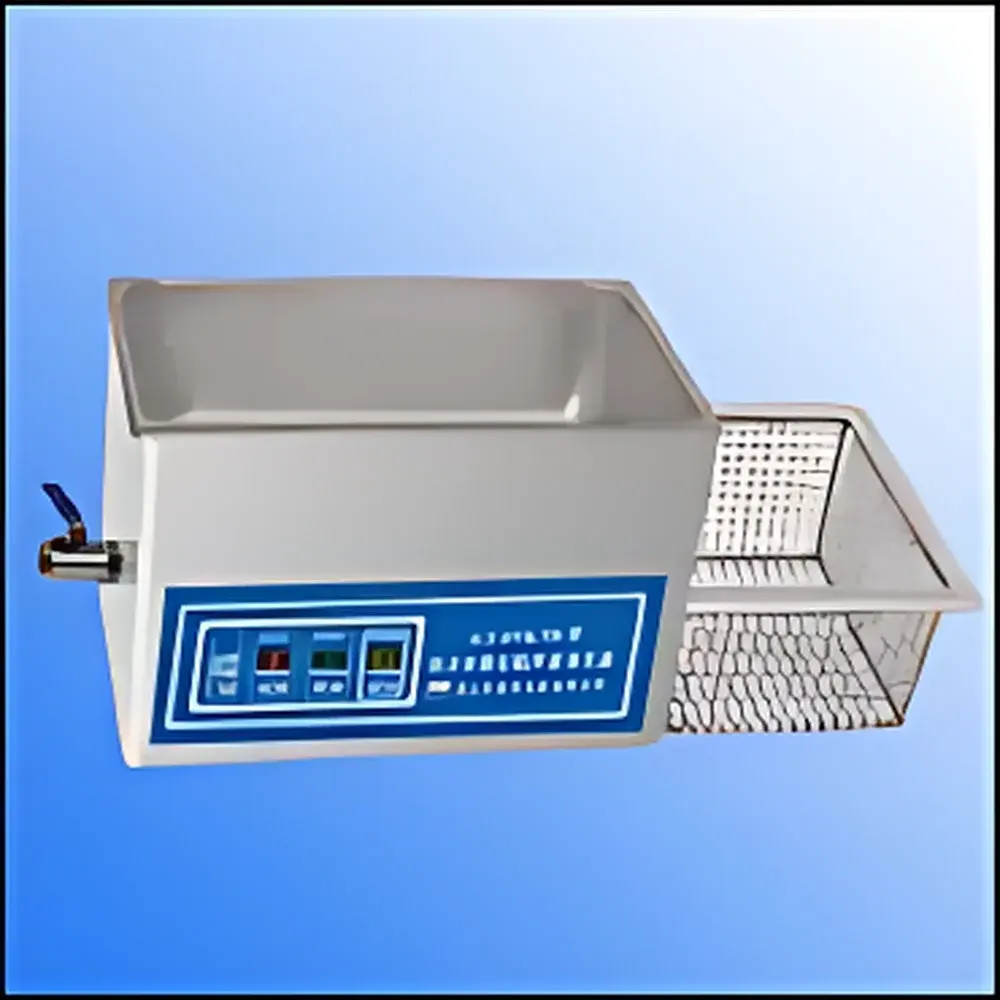
Kunshan KQ-600KDE / KQ-600KDV / KQ-600KDB / KQ-800KDB / KQ-800KDE / KQ-800KDV High-Power Digital Ultrasonic Cleaner
| Origin | Shanghai, China |
|---|---|
| Manufacturer Type | Authorized Distributor |
| Product Origin | Domestic (China) |
| Models | KQ-600KDE, KQ-600KDV, KQ-600KDB, KQ-800KDB, KQ-800KDE, KQ-800KDV |
| Ultrasonic Frequency | 40 kHz |
| Ultrasonic Power Output | 600 W (KQ-600 series) / 800 W (KQ-800 series) |
| Heating Power | 600 W (KQ-600) / 1000 W (KQ-800) |
| Temperature Range | 20–80 °C |
| Timer Range | 1–480 min |
| Tank Material | 304 Stainless Steel (inner tank) |
| Optional Features | Acoustic Lid (E-series), Drain Valve (B/D/V-series), Vapor Recovery System (V-series) |
Overview
The Kunshan KQ-600KDE, KQ-600KDV, KQ-600KDB, KQ-800KDB, KQ-800KDE, and KQ-800KDV series are high-power, digitally controlled ultrasonic cleaners engineered for precision cleaning, degassing, dispersion, emulsification, and cell disruption in laboratory, academic, and light industrial environments. These units operate on the principle of piezoelectric ultrasonics: high-frequency (40 kHz) electrical signals drive transducers bonded to the stainless steel tank base, generating cavitation bubbles in the cleaning solution. Upon collapse, these micro-bubbles release localized energy—up to several thousand Kelvin and hundreds of atmospheres—mechanically dislodging particulate, organic, and oily contaminants from surfaces, crevices, and porous substrates with high reproducibility. Unlike mechanical scrubbing or solvent-intensive methods, ultrasonic cleaning delivers uniform, non-abrasive treatment without compromising sample integrity or operator safety.
Key Features
- Integrated digital control system with real-time display of elapsed time, set time, bath temperature, and actual temperature—retains user-defined parameters across power cycles.
- High-efficiency piezoelectric transducers delivering consistent 40 kHz output; each transducer rated at 100 W nominal acoustic power, enabling scalable cleaning intensity across models (600 W total for KQ-600 series; 800 W for KQ-800 series).
- Electropolished 304 stainless steel inner tank—deep-drawn and seam-welded for corrosion resistance, structural rigidity, and long-term compatibility with aqueous, mild alkaline, and low-concentration detergent solutions.
- Dual-safety thermal regulation: independent over-temperature cutoff (±2 °C accuracy) plus real-time monitoring of line voltage and current draw, with visual fault indication for sustained operational reliability.
- Modular rack design: stainless steel mesh baskets (argon-welded, 0.5 mm wire diameter, 2 mm aperture) standard on all models except KQ-100 variants; V-series models include integrated vapor condensation and recovery to minimize solvent loss and improve lab air quality.
- Configurable physical options: E-series units feature a hinged acoustic lid with silicone gasket for noise attenuation (<65 dB(A) at 1 m); D- and V-series incorporate bottom-mounted drain valves with PTFE-sealed ball valves; B-series omit both lid and drain for simplified benchtop integration.
Sample Compatibility & Compliance
These cleaners accommodate a broad range of sample types—including glassware (vials, cuvettes, pipettes), metal components (surgical instruments, calibration standards), ceramic substrates, semiconductor wafers, and biological specimens (tissue sections, cultured cells)—provided immersion-compatible solvents are selected per material compatibility guidelines. The 40 kHz frequency balances penetration depth and cavitation intensity, making it suitable for delicate optics and robust industrial parts alike. Units comply with IEC 61000-6-3 (EMC emission limits) and IEC 61000-6-2 (immunity to electrostatic discharge and fast transients). While not certified to ISO 13485 or FDA 21 CFR Part 11 out-of-the-box, the digital interface supports audit-ready operation when paired with validated SOPs and external data logging systems compliant with GLP/GMP documentation requirements.
Software & Data Management
The KQ-series employs embedded firmware—not PC-hosted software—ensuring deterministic timing and thermal control without dependency on external operating systems. All parameter settings (time, temperature, power enable/disable) are stored in non-volatile memory and recalled at startup. For laboratories requiring traceability, optional RS-232 or USB-to-serial adapters (sold separately) allow connection to LIMS or custom scripts for timestamped event logging—including start/stop commands, temperature excursions, and fault codes. No proprietary drivers or cloud services are required; raw ASCII data streams conform to standard MODBUS RTU framing for integration into SCADA or MES platforms.
Applications
- Laboratory Glassware Cleaning: Removal of residual proteins, lipids, and trace metals from volumetric flasks, HPLC vials, and NMR tubes prior to analytical use.
- Electronics & Precision Manufacturing: Debris removal from MEMS devices, solder paste residues, and flux contaminants from PCB assemblies without mechanical stress.
- Pharmaceutical R&D: Solvent-based cleaning of tablet punches, capsule fillers, and dissolution apparatus components under cGMP-aligned procedures.
- Materials Science: Dispersion of nanomaterials (e.g., graphene oxide, TiO₂ nanoparticles) in aqueous or organic media; deagglomeration prior to DLS or SEM analysis.
- Life Sciences: Gentle lysis of adherent mammalian cells, homogenization of tissue lysates, and preparation of subcellular fractions where enzymatic or mechanical shear must be minimized.
FAQ
What is the difference between the “B”, “D”, and “V” suffixes in model numbers?
The suffix denotes mechanical configuration: “B” = basic (no lid, no drain), “D” = drain valve equipped, “V” = vapor recovery system + drain + lid.
Can these units operate continuously for extended periods?
Yes—rated for continuous duty at nominal load; internal thermal management and transducer cooling ensure stable performance over multi-hour cycles when operated within ambient temperatures ≤35 °C.
Is the 40 kHz frequency adjustable?
No—the transducers are fixed-frequency resonant devices optimized for broad-spectrum cavitation efficiency; variable-frequency operation is not supported in this product line.
What maintenance is required to sustain optimal ultrasonic output?
Monthly inspection of tank integrity, quarterly descaling with 5% citric acid solution (if using hard water), and annual verification of transducer bond integrity via impedance sweep testing using a network analyzer.
Are replacement tanks or custom racks available?
Yes—original-equipment stainless steel tanks and laser-cut mesh racks are available as spare parts; custom dimensions require minimum order quantities and engineering review for acoustic coupling validation.



