
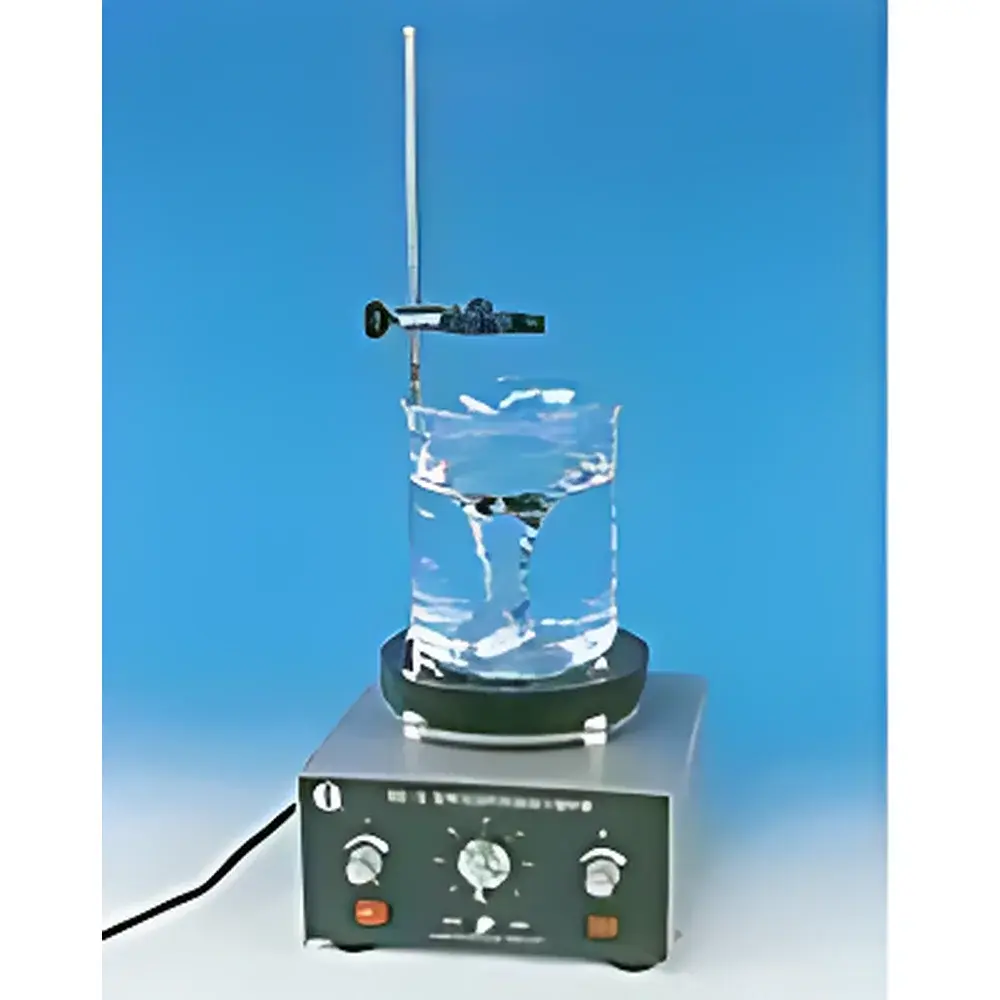
Lab Companion 90-1 Constant-Temperature Magnetic Stirrer | 90-2 Timer-Controlled Constant-Temperature Magnetic Stirrer | 90-3 Bidirectional Constant-Temperature Magnetic Stirrer
| Origin | Shanghai, China |
|---|---|
| Manufacturer Type | Authorized Distributor |
| Regional Origin | Domestic (PRC) |
| Model | 90-1 / 90-2 / 90-3 |
| Price | USD 99 (FOB Shanghai) |
| Stirring Capacity | 20–3000 mL |
| Speed Range | 0–1250 rpm (infinitely variable) |
| Temperature Control Range | Ambient to 150 °C |
| Heating Power | 0–350 W |
| Timer Range (90-2 & 90-3) | 0–120 min |
| Bidirectional Operation | 90-3 only |
| Display | Digital LED for speed, temperature, and timer |
| Housing Material | Die-cast aluminum alloy |
| Stir Bar Compatibility | Standard PTFE-coated or ceramic magnetic stir bars |
| Motor Type | Brushless DC motor with high-torque neodymium magnets |
Overview
The Lab Companion 90-Series Constant-Temperature Magnetic Stirrers are engineered for precision thermal and mechanical control in routine laboratory workflows. Designed around the fundamental principle of contactless magnetic coupling—where a rotating permanent magnet beneath the heating plate induces synchronous rotation of a submerged magnetic stir bar—the series delivers reliable agitation across wide viscosity and volume ranges. Unlike mechanical overhead stirrers, this design eliminates shaft seals, reduces contamination risk, and ensures maintenance-free operation. The 90-1 model provides analog-digital hybrid control of both heating and stirring; the 90-2 adds programmable time-based shut-off for unattended operation; and the 90-3 introduces bidirectional alternation (clockwise/counterclockwise switching at user-defined intervals), enhancing homogenization efficiency in suspensions, precipitates, or heterogeneous reaction mixtures. All units feature a sealed die-cast aluminum housing rated for continuous duty at elevated temperatures, conforming to IEC 61010-1 safety standards for laboratory electrical equipment.
Key Features
- Brushless DC motor with rare-earth neodymium magnets ensuring consistent torque delivery up to 1250 rpm, even at low speeds and high viscosities (e.g., glycerol, polymer solutions, or cell culture media)
- Digital LED display showing real-time values for stirring speed (rpm), setpoint and actual plate temperature (°C), and elapsed or remaining timer duration (min)
- Infinitely variable speed control with <±2% speed stability under load, calibrated against NIST-traceable tachometric reference
- Precise temperature regulation via PID algorithm with ±1.5 °C accuracy across 25–150 °C range; integrated overtemperature cutoff (160 °C hardware limit) prevents thermal runaway
- Adjustable heating power (0–350 W) enables fine-grained energy modulation—critical for temperature-sensitive protocols such as enzyme kinetics or protein denaturation studies
- Bidirectional mode (90-3 only): programmable reversal interval (1–120 sec) and dwell time supports de-agglomeration of particulates and improved mass transfer in solid-liquid systems
- Stainless steel–coated stir bars (included) resist corrosion from acids, bases, and organic solvents—compatible with ASTM D2624 (hydrocarbon blending) and USP compounding environments
Sample Compatibility & Compliance
These stirrers accommodate standard round-bottom flasks (25–2000 mL), beakers (50–3000 mL), and jacketed reactors up to 100 mm base diameter. The uniform heating surface (Ø130 mm) ensures radial temperature deviation <±3 °C at 100 °C. Units comply with CE marking requirements (EMC Directive 2014/30/EU and LVD Directive 2014/35/EU), meet RoHS 2011/65/EU restrictions on hazardous substances, and support GLP-compliant documentation through manual log entries of setpoints and durations. While not intrinsically safe for Class I Div 1 environments, they are routinely deployed in ISO 17025-accredited testing labs for sample preparation prior to HPLC, titration, or gravimetric analysis.
Software & Data Management
The 90-Series operates as a standalone instrument with no proprietary software dependency. All operational parameters are entered and monitored via front-panel membrane switches and the integrated LED display. For laboratories requiring audit trails, users may manually record setpoints, start/stop times, and observed outcomes in bound lab notebooks or LIMS-integrated electronic records. The timer function satisfies basic 21 CFR Part 11 “electronic signature” prerequisites when paired with procedural controls (e.g., dual-operator verification logs). No firmware updates or cloud connectivity are provided—ensuring deterministic behavior and eliminating cybersecurity exposure vectors common in IoT-enabled lab devices.
Applications
- Chemical synthesis: homogeneous mixing during reflux, esterification, or condensation reactions under controlled thermal profiles
- Environmental testing: extraction of heavy metals from soil leachates (EPA Method 3050B) and pH adjustment of aqueous samples
- Pharmaceutical QC: dissolution medium conditioning per USP , buffer equilibration for HPLC mobile phases
- Food & beverage R&D: viscosity stabilization trials, emulsion formation (e.g., mayonnaise analogs), and thermal holding of sensory test samples
- Academic instruction: undergraduate physical chemistry labs demonstrating Arrhenius kinetics, calorimetry pre-equilibration, or colloidal dispersion stability
FAQ
What is the maximum recommended vessel thickness for optimal magnetic coupling?
Glassware up to 10 mm wall thickness (e.g., thick-walled Pyrex® boiling flasks) maintains effective coupling; borosilicate glass >12 mm or metal jackets require external mechanical stirring.
Can the unit maintain temperature stability during rapid addition of cold reagents?
Yes—the PID controller responds within ≤90 seconds to a 10 mL room-temperature injection into 500 mL of 80 °C solution, recovering setpoint within ±2 °C.
Is calibration certification available for regulatory submissions?
Factory calibration reports (speed and temperature) are supplied with each unit; third-party ISO/IEC 17025 calibration services can be arranged through authorized metrology partners.
Does bidirectional mode affect stir bar lifespan?
No—reversal frequency has no measurable impact on PTFE-coated stir bar wear under normal use; typical service life exceeds 2000 hours.
Are replacement heating plates available as spare parts?
Yes—aluminum heating assemblies (P/N LC-HP-90) are stocked globally and field-replaceable without soldering or firmware reset.
Related Products



