
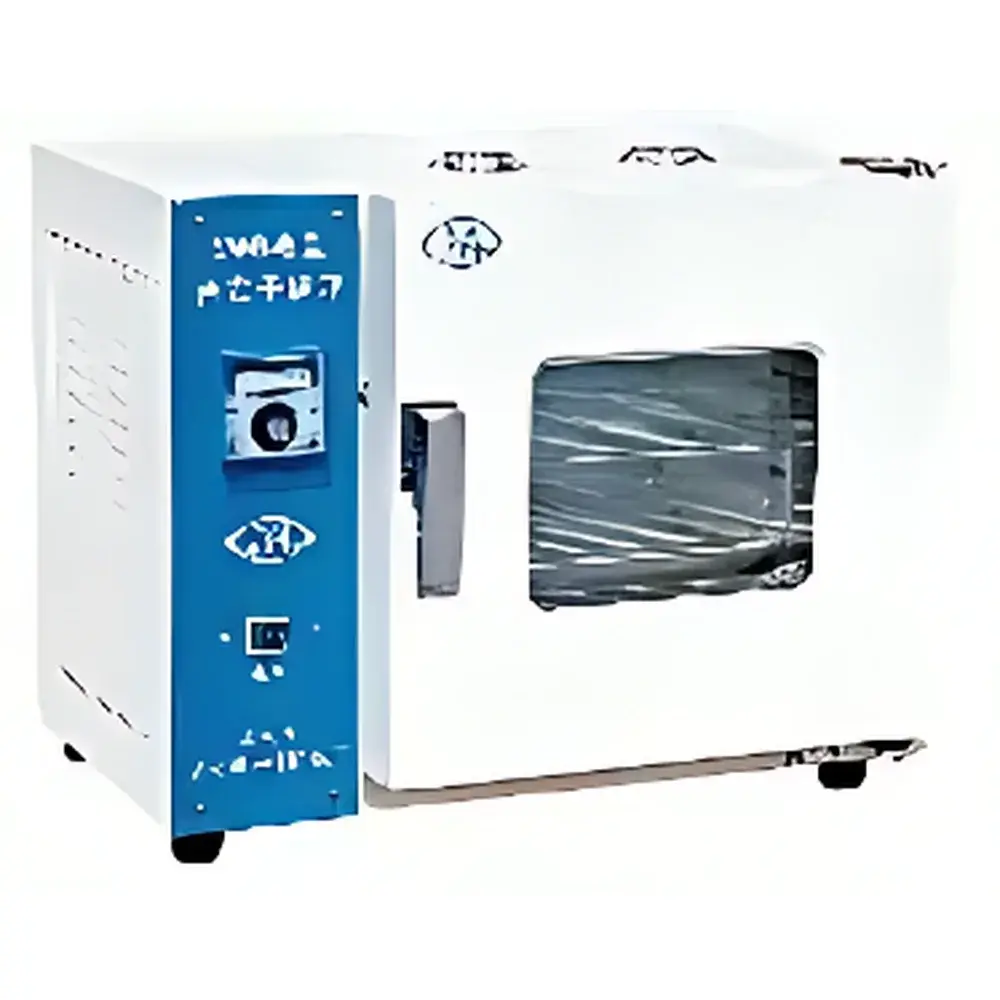
Shanghai-made 101-3EBS Stainless Steel Interior Forced-Air Drying Oven
| Origin | Shanghai, China |
|---|---|
| Manufacturer Type | Authorized Distributor |
| Country of Origin | China |
| Model | 101-3EBS |
| Rated Voltage/Power | 220 V / 4000 W |
| Chamber Dimensions (W×D×H) | 500 × 600 × 750 mm |
| External Dimensions (W×D×H) | 665 × 890 × 955 mm |
| Temperature Range | 50–250 °C |
| Interior Material | AISI 304 Stainless Steel |
| Control System | Digital PID Temperature Controller with LED Display |
| Heating Method | Electric Resistance Heaters with Horizontal Forced-Air Circulation |
Overview
The 101-3EBS Stainless Steel Interior Forced-Air Drying Oven is a precision-engineered laboratory drying and thermal processing system designed for consistent, uniform heat distribution across large-volume chambers. It operates on the principle of horizontal forced-air convection—using an internal centrifugal blower to circulate heated air tangentially across the chamber, minimizing thermal stratification and ensuring ±1.5 °C temperature uniformity (per ISO 17025-recommended validation protocols) at setpoints within its 50–250 °C operating range. Unlike natural-convection ovens, this model delivers accelerated drying kinetics, reliable sterilization hold times, and repeatable curing profiles—making it suitable for routine QC workflows in pharmaceutical manufacturing, polymer R&D labs, and academic materials science facilities. The AISI 304 stainless steel interior resists corrosion from solvents, saline residues, and repeated autoclave-compatible cleaning agents, extending service life under GLP-compliant usage conditions.
Key Features
- Robust chamber construction featuring seamless 1.2 mm-thick AISI 304 stainless steel interior walls, floor, and door liner—optimized for chemical resistance and long-term dimensional stability under thermal cycling.
- Electrostatically applied epoxy-polyester powder coating on the external cold-rolled steel cabinet, providing scratch-resistant, non-porous surface integrity and compliance with IEC 61000-6-3 EMC emission standards.
- Double-layer tempered glass observation window with silicone-sealed frame, enabling real-time visual monitoring without compromising chamber integrity or thermal efficiency.
- Digital PID temperature controller with 0.1 °C resolution, programmable ramp-soak profiles (up to 9 segments), and auto-tuning capability—supporting traceable calibration via external reference thermocouples (Type K, supplied).
- Horizontal airflow design with rear-mounted axial blower and perforated baffle plates ensures laminar, low-turbulence circulation—validated per ASTM E2234 for thermal uniformity mapping in Class II laboratory ovens.
- Over-temperature cut-off protection (mechanical backup thermostat), door-open safety interlock, and grounded chassis conforming to IEC 61010-1 Edition 3 safety requirements.
Sample Compatibility & Compliance
The 101-3EBS accommodates standard laboratory ware including porcelain crucibles, borosilicate glass Petri dishes, stainless steel trays (up to 500 mm × 600 mm footprint), and stacked aluminum sample racks. Its stainless interior eliminates iron contamination risks critical for trace-metal analysis prep (e.g., EPA Method 3050B digestion residue drying) and avoids outgassing during high-temperature polymer crosslinking. The unit meets essential regulatory benchmarks: it supports IQ/OQ/PQ documentation packages aligned with FDA 21 CFR Part 11 data integrity expectations when paired with optional RS-485 Modbus RTU interface; complies with ISO 14644-1 Class 8 cleanroom-compatible operation when installed with HEPA-filtered intake (add-on kit available); and satisfies EN 60529 IP20 ingress protection for indoor laboratory environments.
Software & Data Management
While the base configuration features standalone digital control, optional connectivity modules enable integration into centralized lab infrastructure. An RS-485 port (standard) permits bidirectional communication with SCADA or LIMS platforms using Modbus RTU protocol—allowing remote setpoint adjustment, real-time temperature logging, and alarm event forwarding. Optional USB data logger firmware (v2.1) records timestamped chamber temperature at user-defined intervals (1 s–30 min), generating CSV files compliant with 21 CFR Part 11 electronic record requirements—including operator ID tagging, audit trail metadata, and cryptographic hash verification. Calibration certificates include as-found/as-left data per ISO/IEC 17025-accredited third-party verification.
Applications
- Pharmaceutical: Moisture content determination (USP ), excipient drying prior to tablet compression, and depyrogenation validation studies (250 °C for ≥30 min).
- Materials Science: Pre-baking of ceramic green bodies, solvent evaporation from sol-gel coatings, and post-cure conditioning of composite laminates.
- Environmental Testing: Gravimetric analysis of total suspended solids (TSS), filter drying per EPA Method 160.1, and residual solvent removal from soil extracts.
- Microbiology: Sterilization of glassware and metal instruments (non-critical items), agar plate drying prior to incubation, and desiccant reactivation.
- Quality Control Labs: Stability testing of reference standards, packaging material moisture equilibration, and adhesive bond-line curing verification.
FAQ
What is the maximum load capacity for uniform heating performance?
The chamber maintains ≤±2.0 °C uniformity (per ASTM E2234 Zone III mapping) with up to 30 kg of evenly distributed mass—exceeding typical ISO 17025 dry-weight validation requirements.
Is the stainless steel interior electropolished or passivated?
Standard units feature mechanically polished AISI 304 surfaces; electropolishing and nitric acid passivation are available as factory-installed options (lead time +12 business days).
Can the oven be validated for GMP environments?
Yes—documentation packages include URS templates, FAT/SAT checklists, and IQ/OQ protocols compatible with Annex 15 and EU GMP guidelines; IQ/OQ execution support provided by certified field engineers.
Does the controller support alarm relay outputs for building management systems?
A configurable dry-contact relay (NO/NC, 250 VAC/3 A) is included for over-temperature, door-open, and fan-failure alerts—wiring diagrams and BMS integration notes supplied in the technical manual.
What maintenance intervals are recommended for optimal performance?
Blower motor lubrication every 12 months; heater element resistance verification semiannually; and full thermal mapping every 6 months for regulated applications—detailed PM schedule included in the Operations Manual.



