
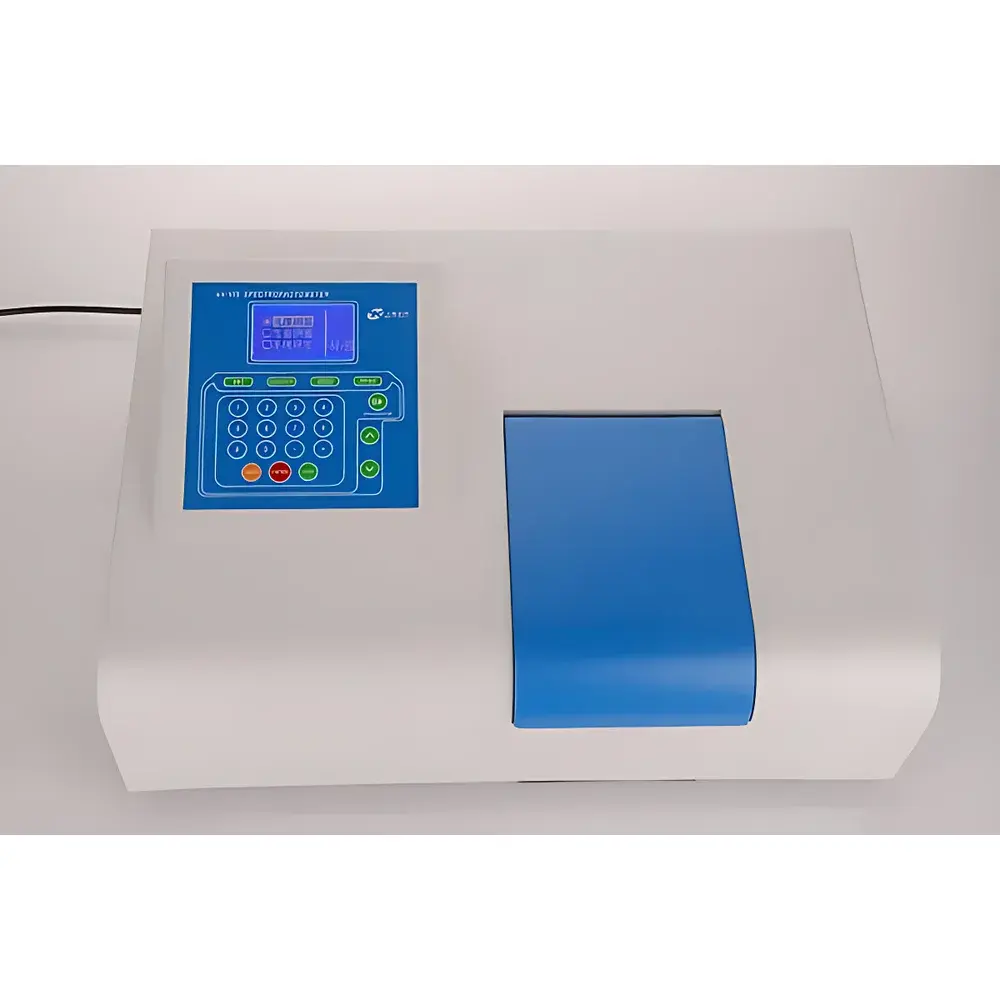
Chu Ding Tech 7230G Scanning Visible Spectrophotometer
| Brand | Chu Ding Tech |
|---|---|
| Origin | Shanghai, China |
| Model | 7230G |
| Optical System | Single-beam |
| Detector | Photodiode Array |
| Wavelength Range | 320–1100 nm |
| Wavelength Accuracy | ±0.5 nm |
| Spectral Bandwidth | 2 nm |
| Stray Light | ≤0.05% T @ 360 nm |
| Wavelength Repeatability | 0.2 nm |
| Photometric Accuracy | ±0.3% T |
| Photometric Repeatability | ±0.2% T |
| Baseline Linearity | ≤0.2% T |
| Drift | ≤0.001 A/h @ 500 nm |
| Noise | ≤0.1% T |
| Photometric Range | 0–200% T, −0.301–3.000 A |
| Light Source | Imported Tungsten Lamp |
| Weight | 12 kg |
| Interface | RS-232 (optional), USB, Parallel Port |
Overview
The Chu Ding Tech 7230G Scanning Visible Spectrophotometer is a precision single-beam optical instrument engineered for quantitative and qualitative analysis in the visible spectral region (320–1100 nm). Based on Beer–Lambert law principles, it measures absorbance (A), transmittance (%T), and concentration (C) of liquid samples using monochromatic light generated via a high-efficiency 1200 lines/mm holographic grating and collimated tungsten lamp illumination. Its scanning capability enables full-spectrum acquisition—critical for identifying absorption maxima, evaluating spectral purity, and validating method specificity in routine laboratory workflows. Designed for reliability in resource-constrained or high-throughput environments, the 7230G delivers reproducible photometric performance with <0.001 A/h baseline stability at 500 nm and ≤0.1% T noise—meeting foundational requirements for QC/QA applications across regulated and non-regulated sectors.
Key Features
- High-resolution wavelength scanning with 0.2 nm repeatability and ±0.5 nm absolute accuracy—validated against NIST-traceable standards.
- Optimized optical architecture featuring an imported tungsten lamp and photodiode array detector, ensuring uniform responsivity across the full 320–1100 nm range.
- Integrated 128 × 64 dot-matrix LCD display supporting real-time spectrum visualization, standard curve plotting, and numeric data readout without external software.
- Onboard memory stores up to 200 measurement sets and 100 user-named calibration curves—enabling rapid recall and comparative analysis between batches or operators.
- Automated wavelength initialization and self-calibration routines reduce operator dependency and minimize warm-up drift (<0.001 A/h).
- Wide sample compartment accommodating cuvettes from 5 mm to 100 mm pathlength—compatible with standard quartz, glass, and plastic cells.
- Multiple interface options: RS-232 (standard), USB (optional), and parallel port—facilitating integration into LIMS or custom data acquisition systems.
Sample Compatibility & Compliance
The 7230G is routinely deployed for aqueous and organic solvent-based solutions in environmental monitoring (e.g., COD, nitrate, phosphate), food safety testing (e.g., colorants, preservatives), pharmaceutical excipient verification, and industrial process control (e.g., dye concentration, catalyst activity). While not designed for UV-C or deep-UV measurements, its 320 nm lower limit supports common visible-region assays per ASTM E275, ISO 6226, and USP . The instrument’s photometric accuracy (±0.3% T) and stray light performance (≤0.05% T @ 360 nm) align with general-purpose spectrophotometric validation criteria outlined in CLSI EP10-A3 and EU GMP Annex 11 for non-critical analytical tasks. No built-in 21 CFR Part 11 compliance features; however, audit-ready data export via YOKE 3.0 software supports GLP documentation when paired with controlled file management protocols.
Software & Data Management
The optional YOKE 3.0 professional software provides extended functionality including kinetic scan mode, multi-wavelength quantitation, derivative spectroscopy, and customizable report generation (PDF/CSV). It supports instrument control via USB or RS-232, enabling remote wavelength programming, time-resolved data logging, and automated standard curve regression (linear, quadratic, cubic). All raw spectral datasets retain timestamp, operator ID (manually entered), and instrument serial metadata—essential for traceability in internal QA audits. Data exports include absorbance vs. wavelength tables, peak identification logs, and residual error summaries for method verification. Software installation requires Windows 7–11 (64-bit) and does not require administrative privileges for basic operation.
Applications
- Environmental Testing: Quantification of iron(II), manganese, chromium(VI), and phenolic compounds using APHA-approved colorimetric methods.
- Food & Beverage: Measurement of anthocyanin content in fruit juices, caramel color intensity (E150), and nitrite levels in cured meats.
- Clinical Screening: Hemoglobin assay kits, bilirubin determination, and enzymatic reaction monitoring (e.g., LDH, ALP) under standardized conditions.
- Chemical Manufacturing: In-process concentration checks for dyes, pigments, and surfactants during synthesis and purification.
- Educational Use: Teaching core spectroscopic concepts—including Beer’s law derivation, spectral deconvolution, and instrumental error sources—in undergraduate chemistry laboratories.
FAQ
Is the 7230G suitable for UV-range measurements below 320 nm?
No. The instrument uses a tungsten lamp source and optical components optimized for visible light; it is not configured for reliable operation below 320 nm. For UV–Vis applications, consider dual-beam models with deuterium/tungsten lamp combinations.
Can the 7230G perform kinetic measurements?
Yes—when operated with YOKE 3.0 software, the instrument supports time-scan mode with adjustable interval (0.1–60 s) and duration (up to 999 minutes), enabling enzyme kinetics or reaction rate studies.
What cuvette materials are compatible with the 7230G?
Standard 10 mm square quartz cuvettes (for high-transmission applications), borosilicate glass (for routine visible work), and disposable polystyrene cells (for low-cost screening). Avoid UV-grade fused silica unless validated for visible-only use.
Does the device support automatic cell changer integration?
Not natively. However, optional 4-position or 8-position manual turret holders are available as accessories—requiring manual indexing but improving throughput for multi-sample batch analysis.
How is wavelength calibration verified during routine use?
The instrument includes an internal calibration routine using a holmium oxide or didymium glass filter (user-supplied). Validation should be performed daily before critical measurements per internal SOPs aligned with ISO/IEC 17025 clause 5.9.






