
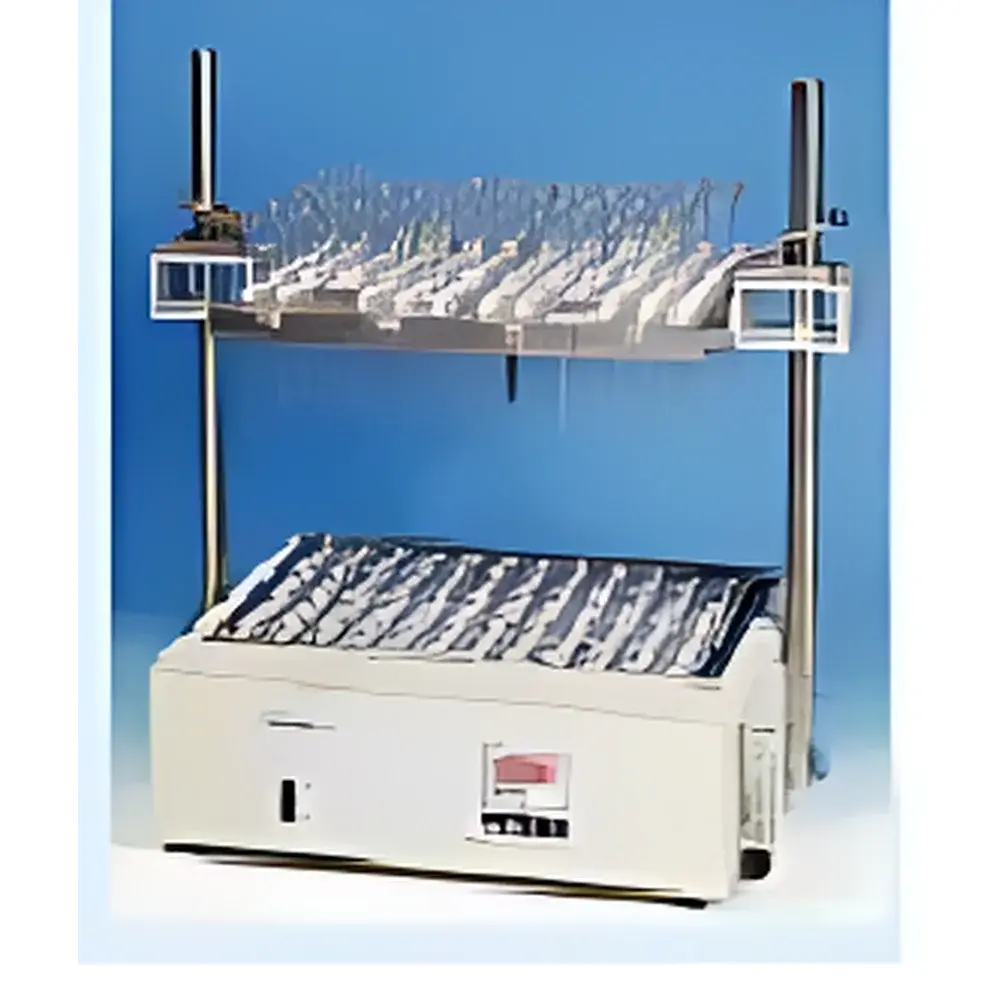
Chu Ding Technology HGC-96A Dry-Block Nitrogen Evaporator
| Brand | Chu Ding Technology |
|---|---|
| Origin | Shanghai, China |
| Manufacturer Type | Authorized Distributor |
| Country of Origin | China |
| Model | HGC-96A |
| Price | USD 3,780 (FOB Shanghai) |
| Sample Capacity | 96 positions |
| Temperature Range | Ambient to 150 °C |
| Temperature Accuracy | ±1 °C |
| Control Method | 4-digit LED display with PID temperature regulation and overheat protection |
| Power Supply | 220 V, 50 Hz |
Overview
The Chu Ding Technology HGC-96A Dry-Block Nitrogen Evaporator is an engineered solution for high-throughput, inert-atmosphere sample concentration in analytical laboratories. Unlike water-bath nitrogen evaporators, this instrument employs a precisely machined aluminum dry-block heating module that delivers rapid thermal response, exceptional temperature uniformity, and zero risk of water contamination or bath-level variability. It operates on the principle of gentle, controlled nitrogen gas flow directed perpendicularly onto the surface of liquid samples—effectively accelerating solvent evaporation while minimizing analyte degradation, oxidation, or foaming. Designed for compatibility with standard 96-well microplates, PCR tubes, and 1.5 mL centrifuge tubes, the HGC-96A supports parallel processing of up to 96 samples under identical thermal and gas-flow conditions. Its ambient-to-150 °C operating range accommodates volatile solvents (e.g., hexane, dichloromethide) as well as higher-boiling-point matrices (e.g., ethyl acetate, acetonitrile), making it suitable for LC-MS, GC-MS, and ELISA workflow integration.
Key Features
- 96-position dry-block heater with CNC-machined aluminum alloy block for optimal thermal conductivity and spatial uniformity (±0.8 °C across all wells at 80 °C)
- PID-controlled digital temperature regulation with 4-digit LED display and real-time feedback from embedded PT100 sensors
- Independent, height-adjustable stainless-steel nitrogen needle channels—each fitted with precision flow restrictors to ensure consistent gas delivery without cross-contamination
- Integrated overheat protection circuitry that automatically deactivates heating if sensor fault or temperature excursion exceeds preset safety threshold
- Compact footprint (320 × 280 × 210 mm) and low power consumption (≤500 W), enabling benchtop deployment in regulated QC labs and core facilities
- Corrosion-resistant housing with ventilated rear panel design for sustained operation at elevated temperatures (>120 °C) over extended cycles
Sample Compatibility & Compliance
The HGC-96A accepts common laboratory consumables including 96-well polypropylene plates (U/V-bottom), 0.5–2.0 mL conical-bottom microcentrifuge tubes, and skirted PCR plates. Its dry-block architecture eliminates water immersion risks—critical for moisture-sensitive analytes (e.g., organometallics, hygroscopic pesticides) and applications requiring strict ISO/IEC 17025 traceability. While the instrument itself does not carry CE or UL certification, its electrical design conforms to IEC 61010-1:2010 safety standards for laboratory equipment. When operated within validated SOPs—including documented temperature mapping (per ASTM E2879-22), nitrogen purity verification (≥99.998% N₂), and routine flow calibration—the system supports compliance with GLP, GMP, and FDA 21 CFR Part 11 requirements when paired with compliant LIMS or electronic lab notebook (ELN) platforms.
Software & Data Management
The HGC-96A is a standalone hardware platform with no embedded software or network interface. All operational parameters—including setpoint temperature, ramp rate (manual stepwise adjustment only), and run duration—are configured via front-panel controls. For audit-ready documentation, users are advised to record instrument ID, batch number, date/time, target temperature, actual block temperature (verified with external calibrated thermometer), and nitrogen inlet pressure in a secure logbook or validated electronic system. Optional third-party data loggers (e.g., Omega OM-DAQPRO-5300) may be connected to the unit’s analog output port (0–5 V DC proportional to block temperature) to generate time-stamped temperature profiles compatible with CSV export and statistical process control (SPC) analysis.
Applications
- Routine cleanup and concentration of pesticide residues (e.g., organophosphates, neonicotinoids) in food and environmental extracts prior to GC-ECD or LC-MS/MS analysis
- High-throughput preparation of biological fluids (plasma, urine, tissue homogenates) for therapeutic drug monitoring and toxicology screening
- Concentration of derivatized amino acids and organic acids in clinical nutrition assays
- Parallel solvent exchange in oligonucleotide synthesis QC workflows
- Pre-concentration of trace-level pharmaceutical impurities in forced degradation studies per ICH Q1–Q5 guidelines
FAQ
Is the HGC-96A compatible with automated liquid handlers or robotic arms?
No—the unit lacks mounting interfaces, communication ports, or programmable triggers for integration into automated workcells. It is intended for manual, operator-supervised use.
What nitrogen supply specifications are recommended?
A clean, oil-free nitrogen source delivering 0.1–0.5 MPa (15–70 psi) with flow rates adjustable from 0–15 L/min per channel is required. Use of a centralized lab nitrogen generator or high-purity cylinder with dual-stage regulator is strongly advised.
Can the heating block be replaced or customized for non-standard tube formats?
Yes—Chu Ding Technology offers optional interchangeable blocks (e.g., 48×2.0 mL, 32×15 mL) under part numbers HGC-BLK-48 and HGC-BLK-32; custom machining is available upon request with minimum order quantity.
Does the instrument include a nitrogen flow meter or pressure gauge?
No—these must be supplied externally. We recommend installing an inline rotameter or digital mass flow controller upstream of the manifold to ensure inter-run reproducibility.
How often should temperature uniformity be verified?
Per ISO/IEC 17025 clause 5.5.2, initial qualification and annual requalification are mandatory; additionally, daily verification using at least nine calibrated probes (per ASTM E2879-22 Annex A1) is recommended for regulated environments.
Related Products



