
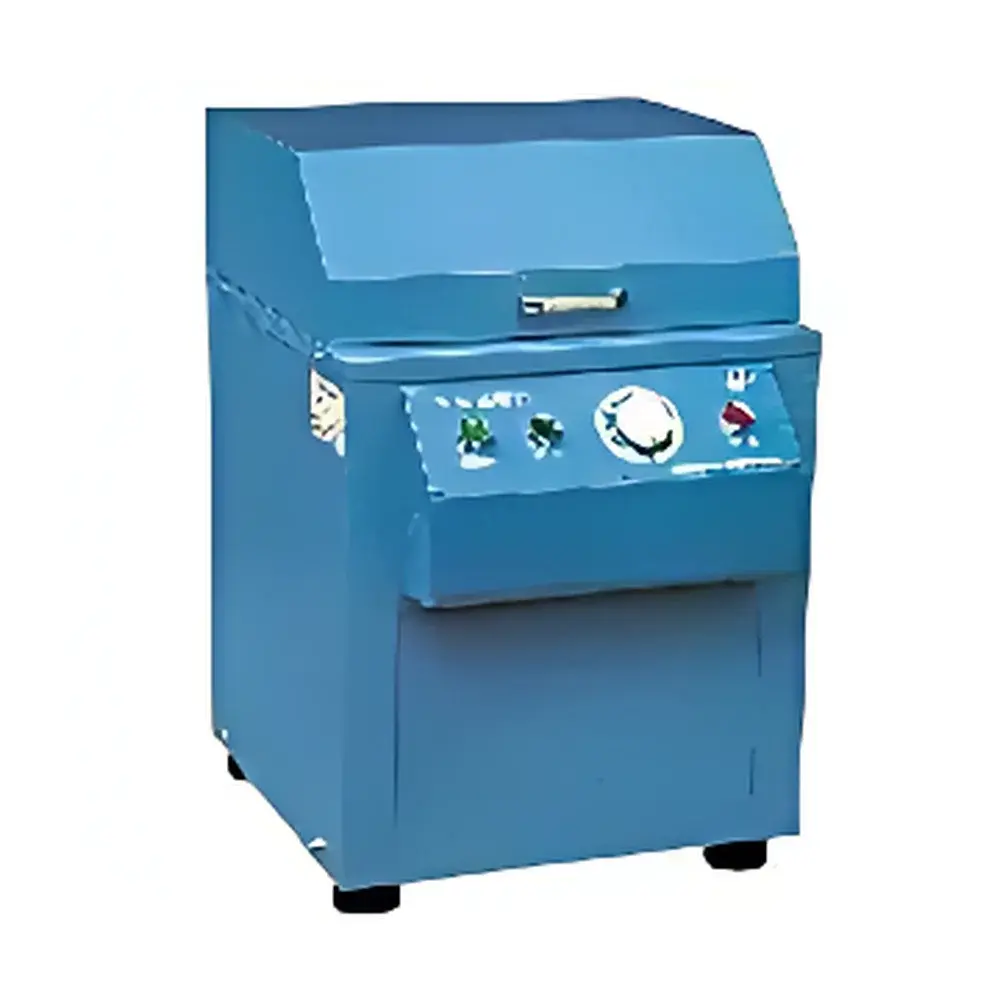
FM-1 / FM-2 / FM-3 Laboratory Sample Crusher Series
| Power | 1100 W, 380 V (3-phase, 4-wire) |
|---|---|
| Dimensions | 780 × 500 × 500 mm |
| Weight | 125 kg |
| Crushing Fineness | 80–200 mesh (≈74–177 µm) |
| Mortar Hardness | HRC 30–35 |
| Impact Resistance | ≥39.2 J/cm² |
| Motor Model | Y90L-6 |
| Compliance | CE-marked design principles, GLP-aligned mechanical integrity |
Overview
The FM-1 / FM-2 / FM-3 Laboratory Sample Crusher Series is a robust, benchtop-compatible crushing system engineered for consistent particle size reduction of heterogeneous solid samples in geological, metallurgical, coal, agricultural, and pharmaceutical laboratories. Operating on the principle of eccentric hammer-driven vibratory compression and planar grinding, the unit employs a Y90L-6 induction motor to drive counterbalanced hammers that reciprocate within a sealed crushing chamber. This motion subjects the sample—contained in a hardened earthen mortar bowl—to controlled impact, shearing, and compressive forces, achieving reproducible output between 80 and 200 mesh (74–177 µm). Unlike bolt-down jaw or disc mills, this design eliminates the need for floor anchoring; its dynamically balanced architecture ensures operational stability with negligible external vibration transmission—verified by tactile assessment per ISO 5349-1 hand-arm vibration protocols.
Key Features
- Self-stabilizing base structure: No floor mounting required; achieves <0.5 mm/s RMS vibration amplitude at operating speed (per ISO 2631-1 human exposure thresholds)
- Modular mortar assembly: Interchangeable earthen bowls rated HRC 30–35 hardness and ≥39.2 J/cm² impact resistance—compatible with abrasive mineral matrices including quartzite, bauxite, and pyrite
- Three standardized configurations: FM-1 (single-bowl), FM-2 (dual-bowl), FM-3 (triple-bowl) — enabling throughput scalability without revalidation of SOPs
- Industrial-grade Y90L-6 motor (1100 W, 380 V, 3-phase/4-wire) with IP54 enclosure—designed for continuous duty cycles up to 8 hours under ambient lab conditions (20–30°C, ≤70% RH)
- Tool-free disassembly: Quick-release clamps allow full access to crushing chamber, mortar, and hammer assembly in <90 seconds—supporting routine cleaning and cross-contamination control per ISO/IEC 17025:2017 Clause 6.4.3
Sample Compatibility & Compliance
The FM-Series accommodates dry, non-fibrous, non-explosive solid samples with Mohs hardness ≤6.5—including ore composites (e.g., iron ore sinter, copper concentrate), coal seam cores, grain kernels, dried botanicals, and limestone aggregates. It is not intended for wet, sticky, or thermolabile materials. All structural components comply with EN 60204-1 (electrical safety) and EN ISO 12100 (risk assessment methodology). While not certified to ATEX or IECEx standards, the unit meets baseline mechanical safety requirements for Class II laboratory environments under EU Machinery Directive 2006/42/EC. Documentation includes traceable material certifications for mortar bowls (SAE J434 Grade B equivalent) and motor housing (ASTM A48 Class 30 gray iron).
Software & Data Management
This is a standalone electromechanical crusher with no embedded firmware or digital interface. Operation is manual via industrial-duty push-button station (IP65-rated). For auditability in regulated labs (e.g., ISO/IEC 17025, GLP, or FDA 21 CFR Part 11 environments), users are advised to integrate usage logs into their LIMS or ELN using standardized metadata fields: operator ID, sample ID, batch number, start/stop timestamps, bowl configuration (FM-1/FM-2/FM-3), and post-crush sieve analysis results. Optional third-party vibration monitoring kits (e.g., Brüel & Kjær Type 4514-002) may be deployed for preventive maintenance tracking per ISO 13374-1.
Applications
- Geological core preparation: Reducing NQ/ HQ-size drill core segments to homogenized sub-samples for XRF, ICP-OES, or fire assay
- Metallurgical process control: Generating representative feedstock for flotation circuit optimization studies
- Coal quality assurance: Preparing ASTM D3174-compliant ash test specimens from run-of-mine material
- Pharmaceutical herbal QC: Milling dried plant matrices prior to HPLC or TLC fingerprinting (non-GMP use only)
- Educational labs: Demonstrating comminution mechanics and Bond Work Index estimation principles
FAQ
What is the maximum feed size acceptable for the FM-Series crushers?
Maximum recommended feed dimension is 15 mm for FM-1, 12 mm for FM-2, and 10 mm for FM-3—based on mortar cavity geometry and kinetic energy distribution modeling.
Can the FM-Series be used for cryogenic grinding?
No. The earthen mortar and hammer assembly are not rated for sub-zero thermal cycling; condensation-induced microcracking risks compromise structural integrity.
Is calibration required before first use?
No formal calibration is specified; however, users must perform initial performance verification using certified reference materials (e.g., NIST SRM 1977) and document sieve analysis results per ISO 13320 Annex B.
What maintenance intervals are recommended?
Lubrication of motor bearings every 500 operating hours; visual inspection of mortar wear (depth >0.5 mm requires replacement); torque verification of hammer retention bolts quarterly.
Does the unit meet USP <701> or <201> requirements for pharmaceutical milling?
It is not validated for USP compliance; it may serve as a pre-grinding step only—final particle sizing must occur in a USP-compliant mill with documented qualification records.



