
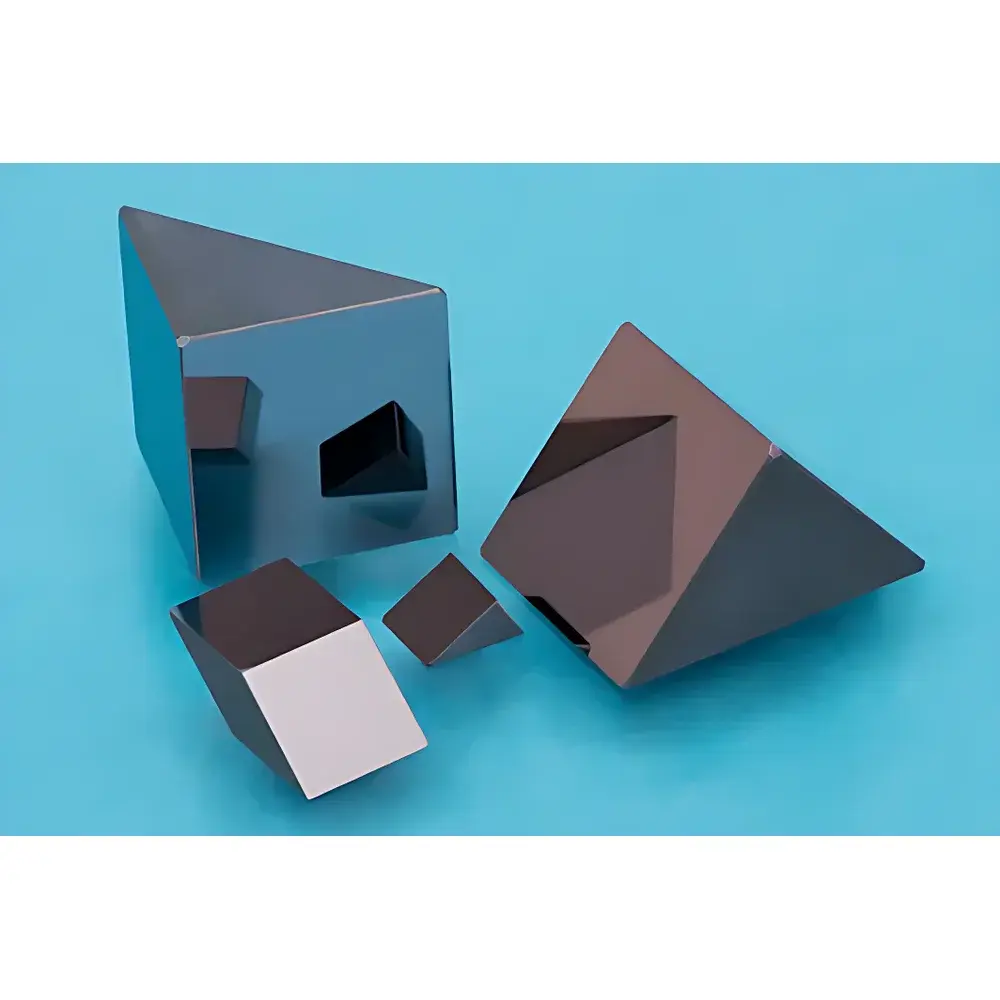
Tydex THz Prism (Right-Angle and Attenuated Total Reflection Types)
| Brand | TYDEX |
|---|---|
| Origin | Russia |
| Prism Types | Right-Angle Prism & Attenuated Total Internal Reflection (ATR) Prism |
| Material | High-Resistivity Silicon (HR-Si) or Polyethylene (PE), as specified per model |
| Spectral Range | 0.1–3 THz (100 GHz–3000 GHz) |
| Refractive Index (HR-Si @ 1 THz) | ~3.42 |
| Surface Quality | λ/10 @ 633 nm |
| Clear Aperture | ≥90% of geometric aperture |
| Coating | Anti-Reflection (AR) coating optimized for THz band, optional |
| Compliance | ISO 10110-7, MIL-PRF-13830B (scratch-dig) |
Overview
The Tydex THz Prism is a precision optical component engineered for manipulation and spectral interrogation of terahertz (THz) radiation in laboratory and industrial research environments. Designed for operation across the 0.1–3 THz band, it leverages the unique dispersion and transmission characteristics of high-resistivity silicon (HR-Si) or ultra-high-molecular-weight polyethylene (UHMW-PE), both exhibiting low absorption and minimal dispersion in this spectral region. Two primary configurations are offered: right-angle prisms for beam steering, collimation, and optical path folding in THz time-domain spectroscopy (THz-TDS) and continuous-wave (CW) systems; and attenuated total internal reflection (ATR) prisms—optimized for contact-based, surface-sensitive spectroscopic analysis of highly absorbing or opaque samples where conventional transmission geometry fails.
Key Features
- Two functionally distinct geometries: standard right-angle prism for alignment and beam routing; ATR prism with precisely calculated base angle (typically 45° or 60°) to ensure incidence angles exceeding the critical angle at the prism-sample interface
- Substrate materials selected for broadband THz transparency: HR-Si (for higher power handling and thermal stability) or PE (for cost-effective, low-loss performance below 2 THz)
- λ/10 surface flatness and scratch-dig compliance per MIL-PRF-13830B ensure minimal wavefront distortion and high coupling efficiency in coherent THz systems
- Optional broadband anti-reflection (AR) coatings deposited via physical vapor deposition (PVD), reducing Fresnel losses by >90% across the operational bandwidth
- Robust mechanical architecture compatible with standard kinematic mounts and vacuum-compatible flanges (upon request)
Sample Compatibility & Compliance
The ATR configuration enables quantitative analysis of materials with absorption coefficients ranging from 102 to 104 cm−1—including polymers, pharmaceutical tablets, biological tissues, paints, and semiconductor wafers—without requiring thin-sectioning or solvent dissolution. The evanescent field penetration depth (typically 0.5–5 µm, dependent on frequency, incident angle, and sample complex refractive index) provides intrinsic surface selectivity. All prisms are manufactured under controlled cleanroom conditions and conform to ISO 10110-7 for optical element specification. Documentation includes material certification, surface metrology reports, and spectral transmittance verification data traceable to NIST-calibrated FTIR-THz reference standards.
Software & Data Management
While the Tydex THz Prism is a passive optical component, its integration into THz-TDS platforms (e.g., Menlo Systems TeraK15, Toptica TeraScan) or CW systems (e.g., Virginia Diodes WR-3.4 modules) supports full GLP/GMP-compliant workflows. When used with spectrometers equipped with FDA 21 CFR Part 11–compliant software (e.g., TeraView’s EVA, Bruker OPUS), ATR spectral acquisition—including incident angle, polarization state, and temperature-stabilized contact pressure metadata—is automatically logged with audit-trail capability. Raw interferograms or amplitude/phase spectra acquired using the prism can be processed using standard algorithms (e.g., Fourier deconvolution, Kramers-Kronig transformation, multi-layer optical modeling) implemented in MATLAB, Python (SciPy, NumPy), or commercial packages such as OriginPro.
Applications
- Non-destructive quality control of polymer coatings and multilayer packaging films
- In-line monitoring of tablet coating uniformity and API crystallinity in pharmaceutical manufacturing
- Hydration state mapping of corneal tissue and skin in biomedical THz imaging
- Characterization of carrier dynamics and phonon resonances in 2D materials (e.g., graphene, MoS2)
- Standoff detection of concealed explosives and illicit substances via fingerprint absorption features in the 0.5–2.5 THz range
- Calibration reference for THz refractometers and ellipsometers
FAQ
What substrate material should I choose for my application: HR-Si or PE?
HR-Si offers superior thermal conductivity, higher laser damage threshold (>100 kW/cm² for pulsed THz), and broader spectral coverage up to 5 THz—but requires AR coating for optimal performance below 0.3 THz. PE is ideal for low-cost, room-temperature CW applications below 2 THz and exhibits negligible birefringence.
Can the ATR prism be used in ambient air or does it require nitrogen purging?
Operation in dry air (RH < 10%) is sufficient for most measurements. For highest signal-to-noise ratio below 0.3 THz—where water vapor absorption dominates—purged enclosures or vacuum integration is recommended.
Is custom base angle or facet size available?
Yes. Tydex offers OEM customization including non-standard apex angles (e.g., 40°, 50°, 65°), elliptical or rectangular clear apertures, and integrated alignment fiducials—subject to minimum order quantity and lead time confirmation.
How is the evanescent field depth controlled in ATR mode?
It is determined by the wavelength, angle of incidence, refractive indices of prism and sample, and polarization. At fixed frequency, increasing the incident angle beyond ΘC reduces penetration depth; TE and TM polarizations yield measurably different decay lengths, enabling polarization-resolved analysis.
Do you provide calibration certificates with traceability to national standards?
Yes. Each prism shipped with metrology documentation includes interferometric surface flatness maps, spectral transmittance curves (measured on a calibrated THz-TDS system), and material refractive index verification at discrete frequencies.




