
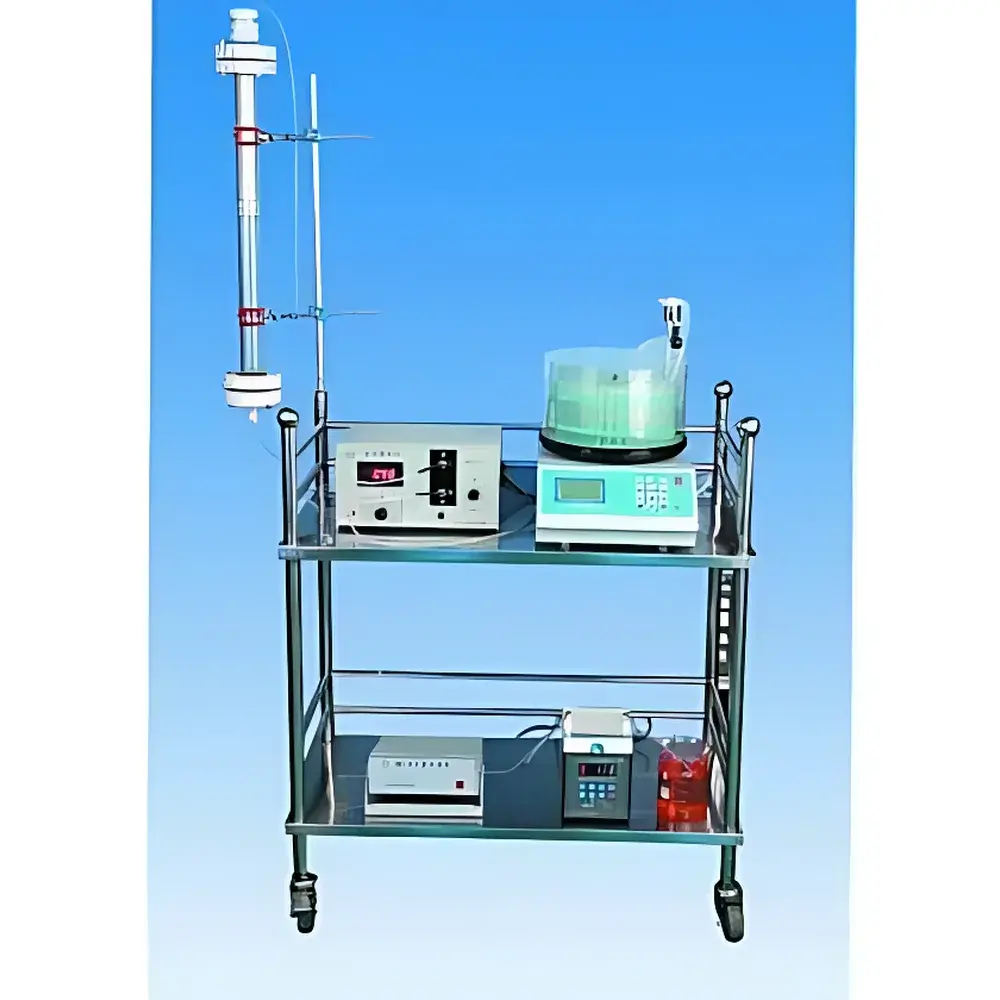
ME99-1 Automated Liquid Chromatography Fractionation System with Temperature-Controlled Chromatography Cabinet
| Origin | Shanghai, China |
|---|---|
| Manufacturer Type | Authorized Distributor |
| Regional Origin | Domestic (PRC) |
| Model | ME99-1 |
| Price | USD 4,500 (FOB Shanghai) |
| UV Wavelengths | 220, 254, 280, 340 nm |
| Timer Range | 1 min – 24 h |
| Flow Rate | 0.1–10 mL/min |
| Fraction Capacity | 12 mL × 100 tubes |
| Temperature Control Range | 0–45 °C |
| Chromatography Cabinet Volume | 250 L |
| Net Weight | 105 kg |
| Detection Principle | UV-Vis Absorbance at Fixed Wavelengths |
| Data Acquisition | Analog signal output to external recorder or PC via dedicated chromatogram acquisition interface |
Overview
The ME99-1 Automated Liquid Chromatography Fractionation System is a bench-scale preparative chromatography platform engineered for reproducible biomolecule and small-molecule separation under controlled thermal conditions. Designed for academic laboratories, quality control units, and pilot-scale purification workflows, the system integrates fixed-wavelength UV-Vis detection, precision peristaltic flow delivery, timed fraction collection, and active temperature regulation within a dedicated 250 L chromatography cabinet. Unlike high-pressure liquid chromatography (HPLC) systems, the ME99-1 operates under ambient pressure using gravity- or pump-driven column elution—making it ideal for gel filtration, ion exchange, and affinity chromatography of heat-sensitive proteins, peptides, nucleic acids, and natural product extracts. Its core detection module (HD-3 UV detector) employs dual-beam optical design with four discrete wavelengths (220, 254, 280, 340 nm), enabling selective monitoring of peptide bonds, aromatic residues, nucleic acid bases, or cofactor absorbance without spectral scanning capability. Real-time analog output interfaces directly with either a strip-chart recorder (XWT-S) or a PC-based acquisition unit (HD-A), supporting baseline-stable analog-to-digital conversion at configurable sampling intervals.
Key Features
- Integrated temperature-controlled environment: CXG-1 chromatography cabinet maintains stable 0–45 °C operation across full 250 L internal volume, minimizing solvent viscosity drift and column bed contraction during extended runs.
- Modular six-component configuration: Includes HD-3 fixed-wavelength UV detector, BSZ-100 time-programmable fraction collector (12 mL × 100 positions), HL-2 constant-flow peristaltic pump (0.1–10 mL/min), XWT-S analog strip-chart recorder, CXG-1 cabinet, and three standard glass columns (Φ1.0×40 cm, Φ1.6×50 cm, Φ2.5×60 cm).
- Dual-output detection architecture: Simultaneous analog output of absorbance (A) and transmittance (%T) signals, compatible with legacy chart recorders and modern PC-based data acquisition systems.
- Robust mechanical design: All fluidic components constructed from chemically resistant PTFE, silicone, and borosilicate glass; pump head rated for continuous operation at ≤10 mL/min with ≤5% flow variability over 8-hour cycles.
- Calibration traceability: UV lamp intensity and detector zero/baseline stability verified per manufacturer’s calibration protocol; optional NIST-traceable photometric verification kits available upon request.
Sample Compatibility & Compliance
The ME99-1 supports aqueous and organic-aqueous mobile phases commonly used in low-pressure liquid chromatography—including phosphate-buffered saline (PBS), Tris-HCl, ammonium acetate, methanol/water gradients, and acetonitrile/water mixtures. Column packing materials include Sephadex®, DEAE-cellulose, CM-Sepharose™, and silica-based reversed-phase media (C18, C8). The system complies with general laboratory safety standards (IEC 61010-1) and meets electromagnetic compatibility requirements per EN 61326-1. While not validated for GMP production environments, its analog signal chain and manual parameter entry support GLP-aligned documentation when paired with controlled electronic notebooks and audit-trail-enabled acquisition software (e.g., LabChart or custom LabVIEW applications). All electrical components carry CE marking; cabinet insulation conforms to ISO 8573-1 Class 4 for particulate control in non-sterile lab settings.
Software & Data Management
The ME99-1 does not include embedded firmware or touchscreen interface. Data acquisition relies on external hardware: the HD-A computerized chromatogram collector digitizes analog A/%T signals at 10 Hz resolution and outputs ASCII-formatted time-series files (.txt) containing timestamp, absorbance, transmittance, and event markers (e.g., fraction switch triggers). These files are importable into MATLAB, Python (pandas), OriginLab, or Excel for peak integration, retention time alignment, and fraction mapping. Optional add-ons include USB-compatible HD-A modules with Windows-compatible drivers (Windows 10/11 x64), supporting real-time plotting and automated peak thresholding. No FDA 21 CFR Part 11 compliance features are built-in; however, third-party ELN platforms (e.g., Benchling, LabArchives) may be configured to capture acquisition logs, user metadata, and raw file hashes for regulatory traceability.
Applications
- Purification of recombinant proteins from E. coli lysates via size-exclusion chromatography (SEC) at 4 °C to prevent aggregation.
- Desalting and buffer exchange of oligonucleotides prior to HPLC or mass spectrometry analysis.
- Isolation of polyphenols and flavonoids from plant extracts using diol or amino-silica columns under isocratic methanol/water elution.
- Educational demonstrations of chromatographic theory—including resolution calculation (Rs), theoretical plate count (N), and asymmetry factor (As)—using standardized dye mixtures (e.g., bromophenol blue + methyl orange).
- Preparative isolation of monoclonal antibody fragments (Fab, scFv) from papain digestion supernatants using Protein A affinity columns operated at 25 °C.
FAQ
What types of columns are included with the ME99-1 system?
Three standard glass columns are supplied: Φ1.0 × 40 cm, Φ1.6 × 50 cm, and Φ2.5 × 60 cm—each fitted with fritted glass sinter bottoms and top adapters compatible with common slurry-packing protocols.
Can the system operate without a PC?
Yes. All core functions—including UV detection, timed fraction collection, and pump actuation—operate independently using front-panel controls and the XWT-S strip-chart recorder for analog visualization.
Is the temperature range uniform throughout the 250 L cabinet?
Air circulation is maintained via dual axial fans and a PID-controlled refrigeration/heating module; temperature deviation across the working volume is ≤±1.5 °C at setpoints between 4–35 °C (verified per ISO 17025-accredited validation report).
What maintenance is required for long-term reliability?
UV lamp replacement every 1,500 operating hours; pump tubing inspection and rotation every 200 hours; quarterly calibration of timer accuracy and flow rate verification using gravimetric measurement.
Does the HD-3 detector support wavelength scanning?
No. It provides fixed-wavelength selection only at 220, 254, 280, and 340 nm—optimized for routine protein, nucleic acid, and small-molecule detection without spectral deconvolution capability.




