
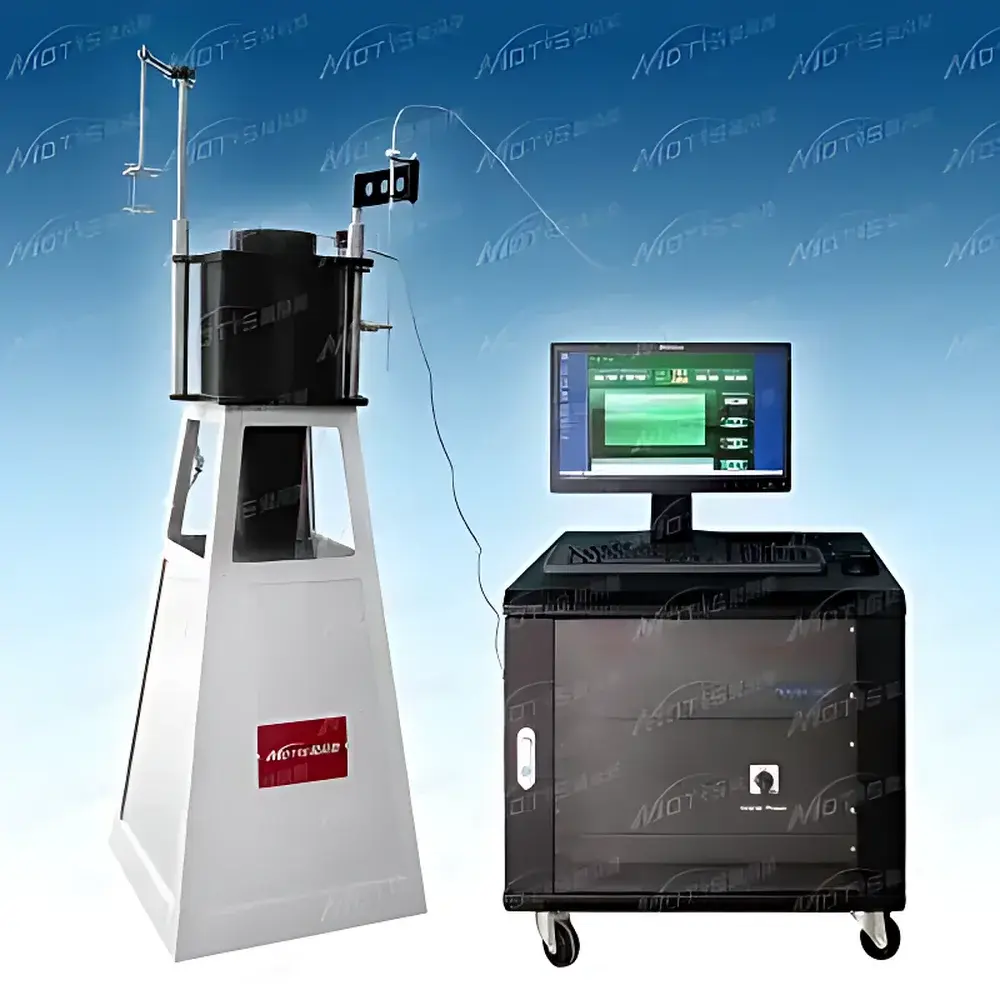
MOTIS NCF Non-Combustibility Test Furnace for Building Materials
| Brand | MOTIS |
|---|---|
| Origin | Jiangsu, China |
| Manufacturer Type | Authorized Distributor |
| Country of Origin | China |
| Model | NCF |
| Pricing | Available Upon Request |
| Temperature Control | PID → Constant Power Switching at 750±5°C |
| Max Furnace Temp | 900°C |
| Data Interface | RS-232C with Dedicated Acquisition Card |
| Calibration Compliance | ISO 1182 & GB/T 5464-2010 |
| Reporting | Automated Report Generation & Printing |
| Sensor Suite | Integrated Internal Thermocouple + Scanning Wall Thermocouples |
| Software Functions | In-Furnace & Wall Temperature Calibration Curve Mapping |
Overview
The MOTIS NCF Non-Combustibility Test Furnace is a precision-engineered thermal testing system designed specifically for evaluating the non-combustibility classification of building materials in accordance with internationally harmonized fire safety standards. It operates on the principle of controlled high-temperature exposure—subjecting conditioned test specimens to a precisely regulated thermal environment at 750 ± 5 °C for a defined duration—while continuously monitoring both internal furnace temperature and radial wall temperature profiles. This dual-temperature monitoring architecture ensures strict adherence to the heat transfer boundary conditions specified in ISO 1182:2010 and GB/T 5464–2010, which form the technical basis for determining compliance with Class A1 (non-combustible) requirements under GB 8624–2011. Unlike conventional furnaces relying solely on open-loop heating or fixed-power operation, the NCF integrates a dynamic control strategy: initial ramp-up employs PID-based thermal regulation for stability and repeatability; upon reaching the target setpoint, the system autonomously transitions to constant-power mode to maintain thermal inertia and minimize overshoot—enabling consistent thermal loading across sequential test cycles without manual intervention.
Key Features
- Intelligent dual-mode temperature control: PID algorithm during ramp phase, automatic switch to constant-power regulation at 750 ± 5 °C for sustained thermal stability
- Maximum operational furnace temperature of 900 °C—providing headroom for method validation, calibration verification, and future standard extensions
- TPR (Thermal Profile Regulation)-enabled stabilization protocol ensuring ±0.5 °C short-term deviation and <±2 °C long-term drift over 30-minute dwell periods
- Modular furnace chamber design with quick-release hardware for rapid thermocouple replacement and routine maintenance
- Dedicated data acquisition card with RS-232C interface supporting real-time streaming of up to eight synchronized analog channels (including internal and scanning wall thermocouples)
- Fully automated test sequencing: specimen loading confirmation, thermal soak initiation, data logging trigger, and endpoint detection executed via software-defined logic
- Integrated calibration workflow supporting traceable verification of both furnace core and circumferential wall temperature fields per ISO 1182 Annex B and GB/T 5464 Clause 6.2
Sample Compatibility & Compliance
The NCF accommodates standard cylindrical specimens measuring 45 mm in diameter and 50 mm in height, as required by ISO 1182 and GB/T 5464. It supports rigid, semi-rigid, and lightly bonded composite materials—including mineral wool, calcium silicate boards, fiber-cement panels, ceramic tiles, and metallic cladding substrates—provided they meet dimensional tolerances and mass density criteria outlined in Clause 5 of the referenced standards. The furnace’s geometric configuration, insulation layer thickness, and thermocouple placement conform strictly to the dimensional specifications defined in ISO 1182 Figure 1 and GB/T 5464 Figure 2. All calibration procedures—including furnace temperature uniformity mapping and wall thermocouple spatial sweep—are documented and executable within the software environment, enabling full audit readiness for GLP-compliant laboratories and third-party certification bodies.
Software & Data Management
The proprietary NCF Control Suite runs on Windows-based host systems and provides role-based access control, electronic signature support, and full 21 CFR Part 11-compliant audit trail functionality—including timestamped records of operator actions, parameter modifications, calibration events, and report generation. Raw thermal data are stored in encrypted binary format with embedded metadata (test ID, operator, date/time, ambient conditions), while processed outputs—including temperature vs. time curves, peak deviation metrics, and pass/fail determinations—are exportable in CSV, PDF/A-1b, and XML formats. The software includes built-in validation tools for verifying thermocouple linearity, cold-junction compensation accuracy, and data acquisition sampling integrity—features essential for maintaining metrological traceability in accredited testing laboratories.
Applications
This furnace serves as a primary test platform for manufacturers, certification agencies (e.g., CNAS-accredited labs), and regulatory authorities validating compliance with national and international fire performance classifications. Typical use cases include type approval testing for external wall insulation systems, fire-stopping components, structural fire protection coatings, and interior finish materials intended for high-rise residential or public assembly buildings. It also supports R&D activities related to low-fire-risk material development, comparative thermal degradation analysis, and inter-laboratory proficiency testing programs aligned with ILAC P9 requirements.
FAQ
Does the NCF comply with GB 8624–2011 Class A1 classification requirements?
Yes—the system satisfies all thermal exposure, instrumentation, and reporting stipulations defined in GB 8624–2011 Annex A for non-combustibility assessment.
Can the furnace be used for ISO 1182:2010 testing outside China?
Yes—it is fully compliant with ISO 1182:2010 and has been successfully deployed in EU Notified Bodies and APAC accreditation schemes.
Is third-party calibration support available for the thermocouple array?
Yes—MOTIS provides NIST-traceable calibration certificates for all installed thermocouples, with optional on-site verification services.
What is the minimum recommended maintenance interval for the furnace insulation and heating elements?
Insulation integrity and heater resistance should be verified every 200 test cycles or biannually, whichever occurs first, using the diagnostic routines embedded in the control software.
Does the software support multi-user environments with permission tiers?
Yes—administrator, technician, and reviewer roles are configurable with granular permissions for method editing, test execution, and report approval.



