
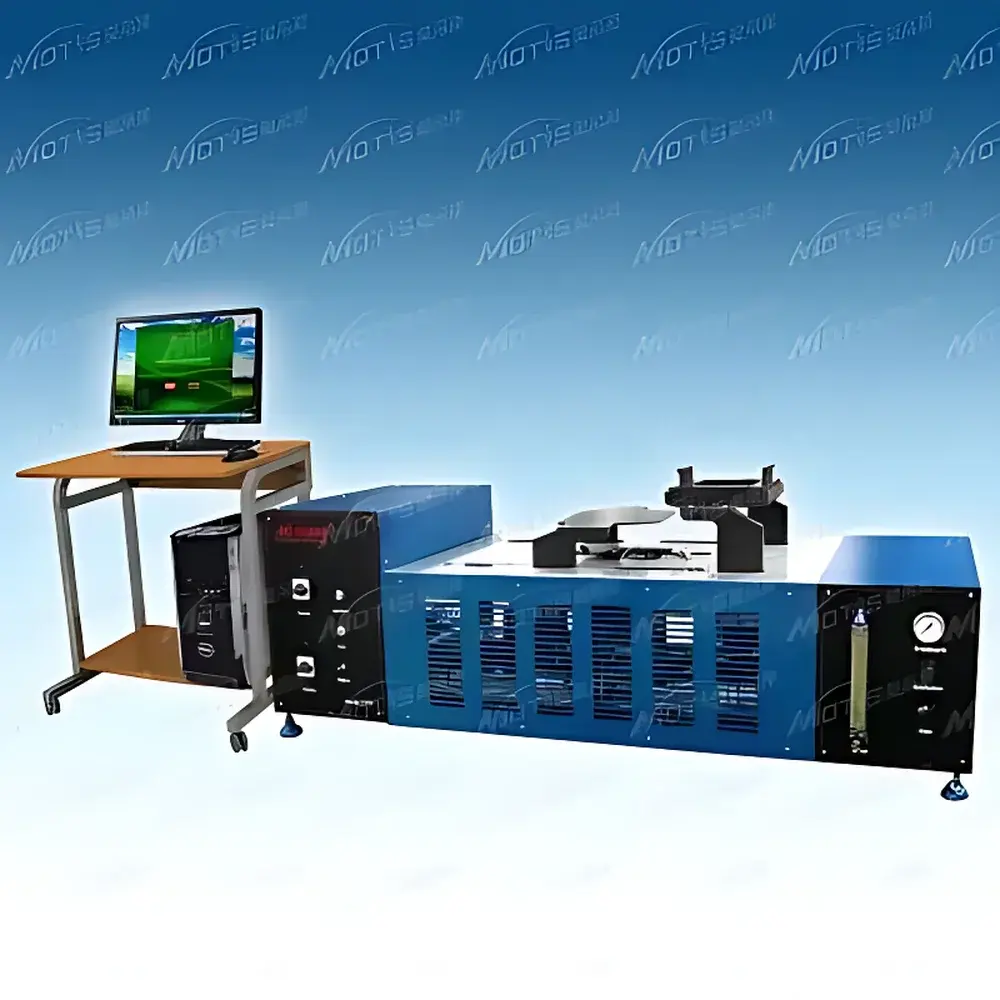
MOTIS TPP Thermal Protective Performance Tester
| Brand | MOTIS |
|---|---|
| Origin | Shanghai, China |
| Model | TPP |
| Compliance | NFPA 1971, ASTM D4018, GB 8965.1–2009 |
| Heat Source | Dual 45° Meker burners + 9-piece T150 quartz infrared array |
| Total Incident Heat Flux | 83 kW/m² ± 2 kW/m² |
| Radiant Flux (IR only) | 13 kW/m² ± 4 kW/m² |
| Calibrated Water-Cooled Heat Flux Sensor | 0–100 kW/m², response time < 200 ms, emissivity > 0.95 |
| Data Acquisition | ≥10 Hz, thermocouple resolution 0.1 °C, accuracy ±0.75 °C, cold-junction compensation |
| Gas Flow Control | Rotameter (±2% accuracy, >3 L/min), pressure regulation (0–15 psi), quarter-turn shutoff valve |
| Software | Standard TPP test suite with real-time flux monitoring, curve plotting, and pass/fail evaluation per NFPA/ASTM protocols |
Overview
The MOTIS TPP Thermal Protective Performance Tester is an engineered platform for quantitative evaluation of thermal barrier efficacy in personal protective equipment (PPE) materials—including flame-resistant fabrics, turnout gear, safety footwear uppers, gloves, and helmet shells. It operates on the principle of controlled convective-radiative heat exposure, replicating flash-fire or radiant heat scenarios encountered in structural firefighting, industrial furnace operations, and arc-flash environments. The system integrates two distinct thermal energy sources: a pair of precision-aligned 45° Meker burners delivering calibrated convective heat, and a nine-element T150 quartz infrared tube array generating uniform radiant flux. This dual-source configuration enables compliance testing per internationally recognized standards including NFPA 1971 (Standard on Structural Fire Fighting Protective Clothing), ASTM D4018 (Standard Test Method for Thermal Protective Performance of Materials for Protective Clothing), and GB 8965.1–2009 (Chinese national standard for flame-retardant protective clothing). The instrument measures time-to-second-degree skin burn (TPP value) by correlating sensor-recorded backside temperature rise with the Stoll curve—a physiologically validated thermal injury model—thereby providing objective, repeatable performance metrics essential for certification, R&D validation, and quality assurance.
Key Features
- Dual-mode heat delivery: Independent control of convective (Meker burner) and radiant (quartz IR array) components ensures full spectrum simulation of real-world thermal hazards.
- High-fidelity heat flux calibration: Water-cooled heat flux sensor traceable to NIST, rated 0–100 kW/m², with emissivity >0.95 and response time <200 ms—meeting ASTM E903 and ISO 8503 requirements for radiometric accuracy.
- Precision gas management: Stainless steel rotameter (±2% full-scale accuracy, range >3 L/min), adjustable pressure regulator (0–15 psi), and quarter-turn manual shutoff valve ensure reproducible fuel-air mixture and operational safety.
- Robust mechanical architecture: Movable stainless steel shield, rigid sample holder assembly with standardized mounting geometry, and integrated flame arrestor and ventilation hood comply with laboratory safety best practices (NFPA 51B, OSHA 1910.106).
- Real-time thermal monitoring: Digital heat flux display provides immediate verification of incident flux prior to and during test execution—critical for pre-test validation and audit readiness.
- Automated data acquisition: 10 Hz sampling rate, 0.1 °C resolution, ±0.75 °C accuracy, and automatic cold-junction compensation eliminate manual interpolation and reduce operator-induced variability.
Sample Compatibility & Compliance
The TPP tester accommodates flat, rigid, or semi-flexible specimens up to 150 mm × 150 mm, mounted in a fixed horizontal orientation per ASTM D4018 Annex A1. It supports layered systems (e.g., outer shell/moisture barrier/thermal liner composites) and allows edge-sealing to minimize lateral heat conduction artifacts. All hardware, calibration procedures, and test protocols align with GLP (Good Laboratory Practice) documentation requirements. The system supports 21 CFR Part 11-compliant software audit trails when configured with optional electronic signature modules. Certificates of calibration include uncertainty budgets and measurement traceability statements compliant with ISO/IEC 17025:2017—enabling direct acceptance by notified bodies under EU PPE Regulation (EU) 2016/425.
Software & Data Management
The included TPP Test Suite software runs on Windows-based host computers and provides full test lifecycle management: method setup (flux level, exposure duration, pass/fail criteria), real-time visualization of front-side flux and backside thermocouple response, automated TPP calculation using the Stoll equation, and export of CSV/PDF reports with embedded metadata (operator ID, calibration date, ambient conditions). Raw data files retain timestamped sensor values at native 10 Hz resolution. Audit logs record all user actions—including parameter changes, calibration events, and report generation—with immutable timestamps. Optional integration with LIMS platforms is supported via OPC UA or REST API interfaces.
Applications
- Validation of NFPA 1971-certified turnout gear components against minimum TPP thresholds (≥35 cal/cm² for outer shell, ≥40 cal/cm² for full ensemble).
- Comparative assessment of next-generation flame-resistant fibers (e.g., meta-aramid, polybenzimidazole, bio-based char-formers) under standardized thermal insult.
- QC release testing for textile mills supplying military-spec FR fabrics (MIL-STD-2021, A-A-55252).
- Root-cause analysis of thermal degradation mechanisms in multilayer composite systems exposed to combined radiant-convective loads.
- Supporting technical submissions to Underwriters Laboratories (UL), SGS, or DEKRA for CE marking or ANSI/ISEA certification.
FAQ
What standards does the MOTIS TPP tester fully support?
NFPA 1971 (2022 edition), ASTM D4018–22, and GB 8965.1–2009—including all mandatory apparatus specifications, calibration frequency requirements, and pass/fail criteria.
Is the heat flux sensor recalibration required before each test?
No—NIST-traceable calibration is performed annually or after any maintenance affecting optical path or cooling flow; however, daily verification using the built-in flux display and reference check procedure is recommended per ASTM E2584.
Can the system be used for arc thermal performance value (ATPV) testing?
No—the TPP tester is designed exclusively for convective-radiative thermal exposure per ASTM D4018; ATPV requires arc flash simulation per ASTM F1959/F1959M and dedicated high-current arc chambers.
Does the software generate reports compliant with ISO 17025 documentation requirements?
Yes—reports include instrument ID, calibration status, environmental conditions, raw data plots, calculated TPP values, uncertainty estimates, and digital signatures meeting ILAC-P14 and CNAS-CL01 requirements.
What gas types are compatible with the Meker burners?
Propane (C₃H₈) is the specified fuel per NFPA 1971; natural gas (methane) may be used with revalidation of heat flux profiles and burner tuning per ASTM D4018 Annex B.



