
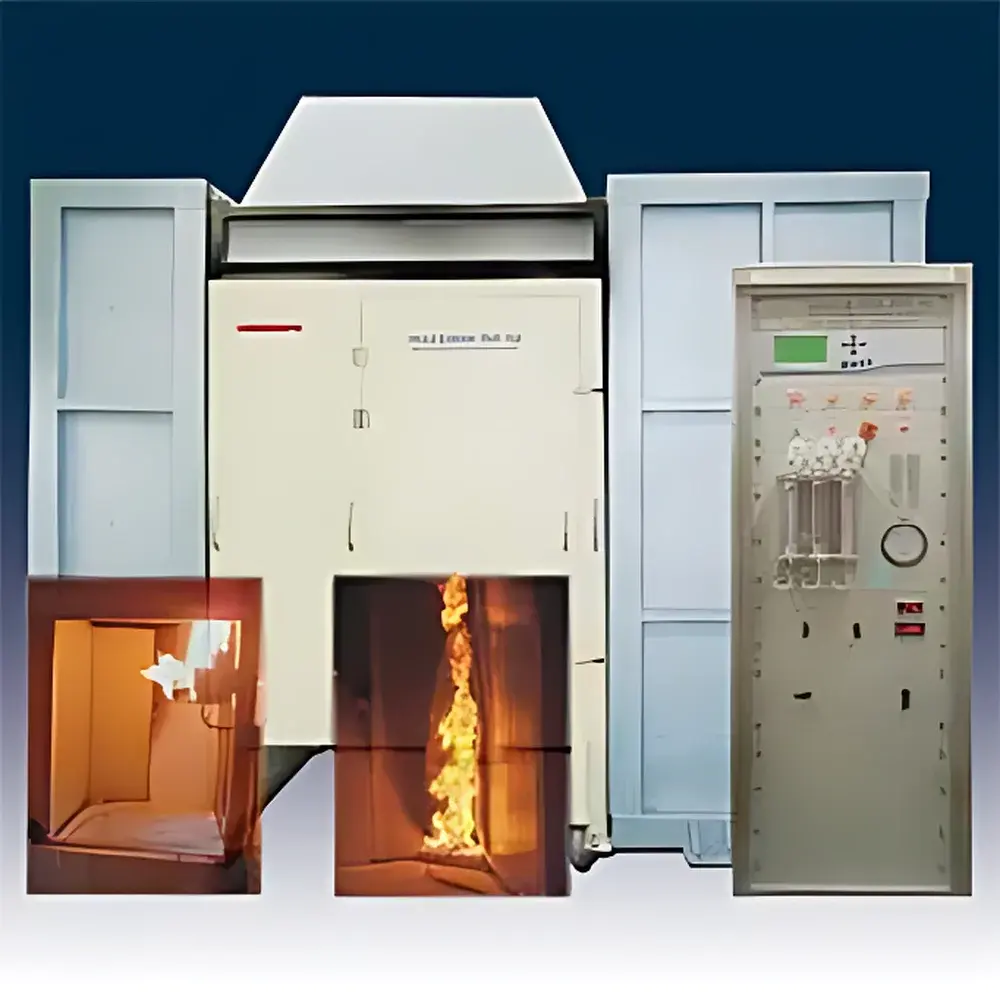
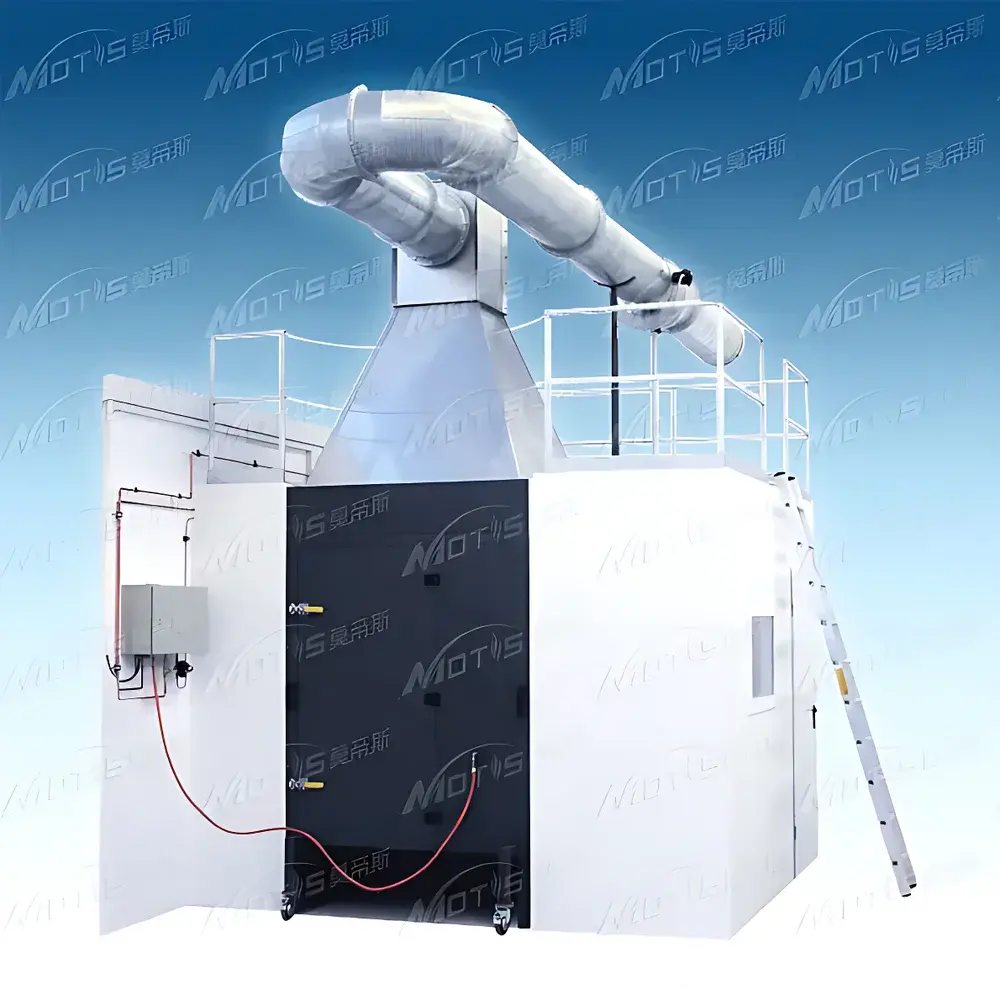
MOTIS SBI Single Burning Item Test Apparatus
| Brand | MOTIS |
|---|---|
| Origin | Jiangsu, China |
| Model | SBI |
| Compliance | EN 13823, GB/T 20284 |
| Measurement Principles | Oxygen depletion calorimetry, optical smoke density analysis, flame spread observation, droplet collection |
| Key Outputs | FIGRA, THR, SMOGRA, TSP, LFS, flaming droplets/particles |
| Gas Analysis | O₂ (0–25% vol), CO (0–1% vol), CO₂ (0–10% vol) |
| Temperature Sensing | K-type thermocouples (up to 1000 °C) |
| Flow Measurement | Stainless steel bidirectional pitot probe with micro-differential pressure sensor |
| Data Acquisition | Multi-channel analog input board (temperature, pressure, gas concentration, flow) |
| Software | ISO/IEC 17025-aligned calibration routines, real-time parameter calculation, audit-trail-enabled reporting |
Overview
The MOTIS SBI Single Burning Item Test Apparatus is a rigorously engineered bench-scale fire testing system designed to assess the reaction-to-fire performance of building products under controlled, intermediate-scale combustion conditions. It operates in accordance with the internationally recognized small-scale fire test methodology defined in EN 13823 and its national adoption GB/T 20284. The apparatus implements oxygen depletion calorimetry as its primary heat release quantification method: by continuously measuring the volumetric flow rate and oxygen concentration decline in the exhaust stream, it calculates heat release rate (HRR) and integrates it to determine total heat released (THR). Concurrently, optical attenuation across a defined light path within the exhaust duct yields smoke production data—used to compute smoke growth rate (SMOGRA) and total smoke produced (TSP). Flame spread is monitored visually via calibrated time-lapse imaging to determine lateral flame spread (LFS), while molten droplet and particle generation is captured on standardized aluminum foil substrates positioned beneath the specimen. All measurements are synchronized at 1 Hz resolution and traceable to NIST-traceable reference gases and certified thermocouples.
Key Features
- Full EN 13823-compliant test chamber: 3 m × 3 m floor area, 2.4 m ceiling height, integrated conical exhaust hood and 300 mm diameter sampling duct
- Dual combustion source configuration: Primary 31 kW propane corner burner (250 mm × 250 mm × 80 mm sand-filled rectangular burner) plus auxiliary burner for reproducible ignition initiation
- High-fidelity gas analysis suite: Siemens OXYMAT 61 paramagnetic oxygen analyzer (0–25% O₂, ±1% FS weekly drift, <3 s response) and U23 NDIR analyzers for CO (0–1%) and CO₂ (0–10%), all with 4–20 mA analog outputs and GLP-compliant calibration logging
- Multi-parameter exhaust stream monitoring: K-type thermocouples (±1.5 °C accuracy up to 1000 °C), stainless-steel bidirectional pitot probe with micro-differential pressure transducer (±0.5 Pa resolution), and PTFE-lined gas sampling train for corrosive species
- Integrated environmental conditioning: Refrigerated cold trap (−10 °C dew point), mass flow controller (MFC)-regulated air supply with back-pressure regulation, and corrosion-resistant PTFE tubing throughout
- Real-time data acquisition system: 16-bit resolution analog input board capturing temperature, differential pressure, gas concentrations, and volumetric flow; timestamped at 1 ms intervals with hardware-triggered start
Sample Compatibility & Compliance
The SBI apparatus accommodates rectangular specimens measuring 495 mm × 1500 mm (height × width), mounted vertically on a motorized trolley between two non-combustible refractory boards. Specimen thickness is unrestricted but must be representative of actual installed configurations—including layered composites, claddings, and insulation systems. The test method explicitly excludes materials intended for structural load-bearing roles without additional mechanical validation. Regulatory alignment includes full technical equivalence to EN 13823 Annex A (test procedure), Annex B (instrumentation requirements), and Annex C (uncertainty evaluation). All calibration protocols adhere to ISO/IEC 17025:2017 clause 6.5, with documented traceability to national metrology institutes. The system supports audit-ready documentation for GLP and GMP environments, including electronic signature-capable software logs compliant with FDA 21 CFR Part 11 requirements for data integrity.
Software & Data Management
The proprietary SBI Control & Analysis Software provides a deterministic real-time operating environment built on Windows IoT Enterprise LTSB. It performs continuous on-the-fly computation of FIGRA (Fire Growth Rate Index = HRRₚₑₐₖ / time to peak), THR (integrated HRR over 20 min), SMOGRA (smoke growth rate), and TSP (cumulative optical density integral). Each test generates an encrypted .sbi binary file containing raw sensor streams, metadata (operator ID, ambient conditions, calibration timestamps), and processed parameters. Export options include CSV (for third-party statistical analysis), PDF test reports with embedded digital signatures, and XML files conforming to CEN/TS 15372:2007 schema for inter-laboratory data exchange. Audit trails record all user actions—including calibration modifications, parameter overrides, and report generation—with immutable timestamps and operator authentication.
Applications
This apparatus serves as a critical tool for fire safety engineers evaluating façade systems, interior wall and ceiling finishes, thermal insulation materials, and sandwich panels prior to large-scale room corner tests or full-scale façade fire simulations. It enables comparative ranking of material formulations during R&D—e.g., halogen-free vs. brominated flame retardants—or verification of batch-to-batch consistency in production QA. Regulatory bodies use SBI-derived classifications (e.g., Class B-s1, d0 per EN 13501-1) to determine permissible applications in high-risk occupancies such as hospitals, schools, and high-rise residential buildings. Academic researchers employ the platform for fundamental studies on flame inhibition mechanisms, soot formation kinetics, and ventilation-controlled fire dynamics under transient airflow conditions.
FAQ
What standards does the MOTIS SBI system fully comply with?
EN 13823:2010+A1:2014 and GB/T 20284–2006, including all annexes governing instrumentation accuracy, calibration frequency, and uncertainty budgeting.
Is the system suitable for testing composite or multi-layered building products?
Yes—specimens may include bonded laminates, mechanically fastened assemblies, or hybrid cladding systems, provided they are mounted as intended for end-use application.
How is data integrity ensured during long-duration tests (up to 20 minutes)?
Hardware-level watchdog timers prevent data loss; all analog inputs are sampled synchronously at ≥10 Hz and buffered in non-volatile RAM before disk write, with SHA-256 checksum validation on file closure.
Can the system be integrated into an existing laboratory LIMS?
Yes—the software exposes RESTful API endpoints for automated result ingestion, and raw data exports support ASTM E2500-14-compliant metadata tagging for traceability.
What maintenance intervals are recommended for gas analyzers and flow sensors?
Oxygen and infrared analyzers require zero/span verification every 24 hours prior to testing; pitot probe and thermocouple assemblies undergo quarterly NIST-traceable recalibration per ISO 17025 internal procedures.



