
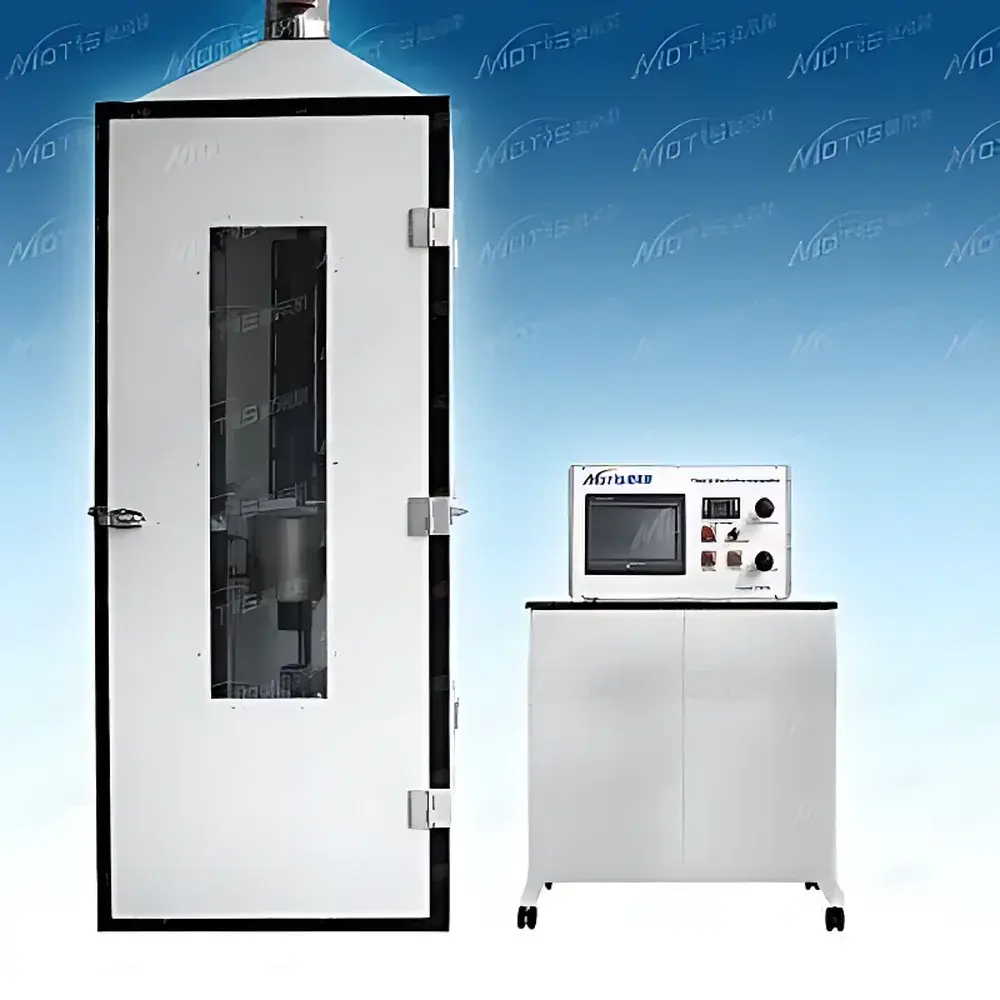
MOTIS CWFP French Electrical Cable Fire Resistance Tester
| Brand | MOTIS |
|---|---|
| Origin | Shanghai, China |
| Model | CWFP |
| Applicable Standards | NFC 32-070 (France), UL 2556 |
| Heating Source | Electric Furnace + Dual Butane Burners |
| Sample Mounting | Vertically Suspended Cable |
| Smoke Duct | PTFE-Coated, Rotatable with Three 120° Ventilation Orifices |
| Ignition System | Electric Spark-Ignited Butane Burners with V-Shaped Wind Shield |
| Airflow Control | Variable-Frequency Fan + Adjustable Top-Mounted Damper + Anemometer |
| Calibration | Standard Radiant Rod for Furnace Power Verification |
| Chamber Construction | Integrated Combustion Test Enclosure with Forced-Air Ventilation |
| Compliance Support | Designed for GLP-aligned test execution and traceable calibration protocols |
Overview
The MOTIS CWFP French Electrical Cable Fire Resistance Tester is a purpose-engineered combustion test system designed to evaluate the flame propagation behavior of insulated and sheathed electrical cables under standardized fire exposure conditions. It operates on the principle of combined radiant–convective heating, integrating a vertically adjustable electric furnace with dual butane-fueled burners to simulate realistic fire scenarios defined in NFC 32-070 (French standard for fire performance of cables) and UL 2556 (Standard for Wire and Cable Flammability Tests). The apparatus subjects vertically mounted cable specimens to controlled thermal flux and direct flame impingement while maintaining defined airflow dynamics within a fully enclosed, instrumented test chamber. Its architecture enables precise replication of the thermal boundary conditions required for pass/fail assessment of flame spread distance, char length, and self-extinguishing capability—key metrics in regulatory fire safety qualification.
Key Features
- Vertically adjustable electric furnace mounted on a precision linear guide, enabling reproducible positioning at high or low elevation relative to the cable specimen.
- Dual independent butane burners equipped with electric spark ignition and integrated V-shaped wind shields to stabilize flame geometry and minimize ambient draft interference during testing.
- PTFE-coated smoke duct with three symmetrically spaced 120° ventilation orifices; fully rotatable and sealable to accommodate varying exhaust configurations per test method requirements.
- Robust vertical cable suspension assembly featuring upper and lower clamping fixtures to ensure axial alignment and mechanical stability throughout thermal exposure.
- Integrated variable-frequency fan system with calibrated anemometer and top-mounted damper valve for real-time airflow regulation—critical for maintaining specified air velocity profiles (e.g., 0.2–0.5 m/s) inside the combustion chamber as mandated by NFC 32-070 Annex B.
- Traceable furnace power calibration using a certified standard radiant rod, ensuring consistent thermal output across test cycles and laboratories.
Sample Compatibility & Compliance
The CWFP accommodates single-core and multi-core insulated cables with outer diameters ranging from 4 mm to 30 mm, including PVC, LSZH, XLPE, and rubber-insulated constructions. Specimens are prepared per NFC 32-070 Section 5.2 (minimum length: 1.2 m) and UL 2556 Section 9.1 (vertical tray flame test configuration). The system supports full documentation traceability aligned with GLP principles, including operator ID logging, timestamped test initiation/termination events, and environmental parameter recording (chamber temperature, airflow velocity). While not certified to IEC 60332-3 or ISO 5659-2 out-of-the-box, its modular airflow and burner control architecture allows adaptation for comparative studies under those frameworks when validated per laboratory SOPs.
Software & Data Management
The CWFP operates via a dedicated industrial HMI interface with embedded logic for sequence control (furnace ramp, burner ignition timing, airflow stabilization delay). All operational parameters—including furnace setpoint, burner runtime, damper position, and real-time anemometer readings—are logged to non-volatile memory with UTC timestamps. Exportable CSV reports include pre-test verification data (calibration rod response), dynamic chamber airflow traces, and user-annotated test outcomes. The system supports optional integration with LIMS platforms via Modbus TCP, enabling automated result ingestion and audit trail generation compliant with FDA 21 CFR Part 11 requirements when paired with electronic signature modules and access-controlled user roles.
Applications
- Qualification testing of low-smoke zero-halogen (LSZH) cables for metro and tunnel infrastructure projects in France and Francophone regions.
- Pre-certification screening for manufacturers seeking NFC 32-070 Class C or Class D classification prior to notified body submission.
- Comparative fire performance evaluation of alternative insulation materials under identical thermal exposure profiles.
- Root cause analysis of cable failure modes during post-fire forensic investigations involving vertical flame spread mechanisms.
- Development and validation of fire-retardant additives in polymer compounding R&D labs requiring repeatable radiant–flame coupling environments.
FAQ
Does the CWFP comply with NFC 32-070 Edition 2022?
Yes—the system implements all mandatory mechanical, thermal, and procedural requirements outlined in NFC 32-070:2022 Sections 6.3 (furnace positioning), 6.4 (burner specification), and Annex B (airflow control), subject to proper calibration and operator training.
Can it be used for UL 2556 Vertical Tray Flame Testing?
It supports UL 2556 Section 9.1 (Vertical Flame Test) with appropriate tray fixture adaptation and airflow verification per UL’s specified 0.3 ± 0.05 m/s chamber velocity requirement.
Is third-party certification available for this instrument?
MOTIS provides factory calibration certificates traceable to NIST-equivalent national standards; CE marking applies to the electrical safety subsystem (EN 61000-6-3/6-4), though full Notified Body certification for fire test instrumentation is typically performed at the end-user laboratory level per ISO/IEC 17025.
What maintenance intervals are recommended for the PTFE smoke duct?
Visual inspection after every 20 test cycles; cleaning with isopropyl alcohol if residue accumulation exceeds 5% surface coverage; replacement recommended after 200 cycles or visible micro-cracking.



