
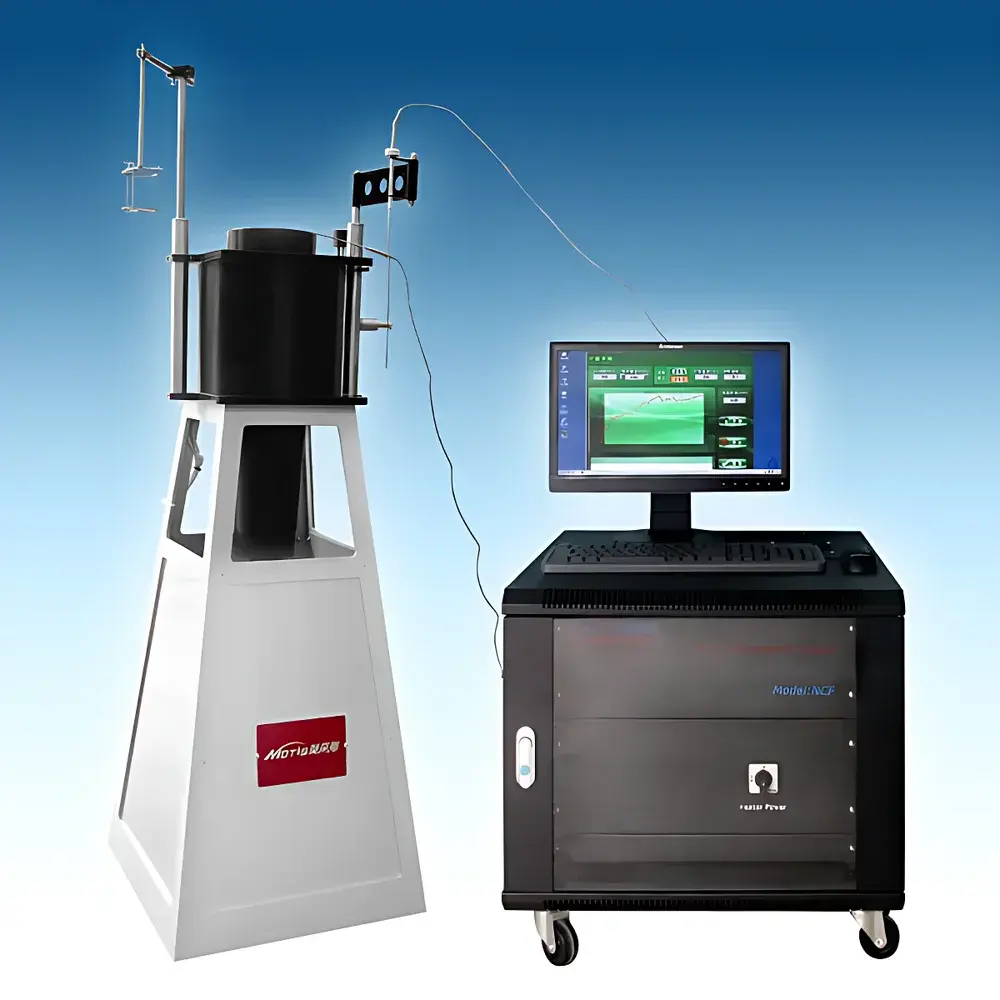
MOTIS NCF Non-Combustibility Test Furnace for Building Materials
| Brand | MOTIS |
|---|---|
| Origin | Jiangsu, China |
| Model | NCF |
| Compliance | ISO 1182, GB/T 5464, BS 476-4 & BS 476-11, IMO FTP Code Part 1 |
| Temperature Control Range | 750 ± 5 °C |
| Heating Method | Radiant Tube with Kanthal® Resistance Band |
| Thermocouple Type | OMEGA™ Type K (NiCr-NiAl) |
| Temperature Monitoring Points | Furnace Chamber, Specimen Surface, Specimen Center |
| Calibration Capabilities | 360° Rotatable & Vertically Adjustable Thermocouple Scanning System for Furnace Wall and Internal Temperature Mapping |
| Airflow Stabilization | PTFE-Coated Stainless Steel Inverted Conical Air Stabilizer and Cylindrical Flow Guide |
| Software | Integrated Windows-Based Data Acquisition, Real-Time Curve Plotting, Automated Report Generation (PDF/Excel), ASTM/ISO-Compliant Data Logging with Timestamped Audit Trail |
Overview
The MOTIS NCF Non-Combustibility Test Furnace is a precision-engineered thermal testing system designed to evaluate the non-combustibility performance of building materials in strict accordance with internationally recognized fire safety standards. It operates on the principle of radiant heating under controlled atmospheric conditions, wherein a specimen is exposed to a defined thermal flux within a calibrated furnace environment maintained at 750 ± 5 °C. The furnace implements the core methodology specified in ISO 1182 and GB/T 5464—both of which define pass/fail criteria based on three critical temperature parameters: average furnace temperature rise, average surface temperature rise of the specimen, and average center temperature rise of the specimen over a 30-minute exposure period. Unlike conventional furnaces relying solely on fixed-point thermocouples, the NCF integrates spatially resolved thermal monitoring to ensure traceable, repeatable, and standards-compliant measurements essential for classification under GB 8624 Class A (non-combustible) materials.
Key Features
- Automated dual-mode temperature control architecture: seamless transition between PID-based temperature regulation and power-based stabilization—eliminating manual intervention while maintaining strict compliance with ISO 1182 equilibrium requirements.
- Kanthal® resistance heating bands integrated into a high-efficiency radiant tube assembly, delivering uniform thermal radiation and extended service life (>5,000 operational hours under standard cycling).
- Tri-point thermocouple configuration using OMEGA™ Type K sensors—mounted at furnace chamber, specimen surface, and specimen center—to capture synchronized thermal response data with ±0.5 °C accuracy.
- Motorized 360° rotatable and vertically adjustable thermocouple scanning system for full circumferential mapping of furnace wall temperature distribution, enabling ISO 1182 Annex B-compliant calibration verification.
- PTFE-coated stainless steel inverted conical air stabilizer and cylindrical flow guide to ensure laminar, low-turbulence airflow—critical for minimizing convective interference during radiant-only exposure.
- Programmable multi-stage heating profile control via embedded firmware, allowing ramp rate optimization to reduce thermal stress on furnace components and extend system longevity.
Sample Compatibility & Compliance
The NCF furnace accommodates both homogeneous building materials and composite systems—including insulation boards, ceiling tiles, wall panels, and structural claddings—as well as individual constituent layers thereof. It supports specimen dimensions up to 45 mm × 45 mm × 50 mm (L × W × H), per ISO 1182 and GB/T 5464. Regulatory alignment extends beyond national standards: the system is validated for use in assessments required by BS 476-4 (fire tests for materials and structures—non-combustibility test) and BS 476-11 (assessment of heat and smoke release), as well as IMO FTP Code Part 1 (fire test procedures for surface finishes and interior construction materials used aboard ships). All thermal calibrations are traceable to NIST-certified reference standards, and the system architecture supports GLP-compliant operation with full audit trail functionality.
Software & Data Management
The NCF is operated through a dedicated Windows-based software platform compliant with FDA 21 CFR Part 11 requirements for electronic records and signatures. The interface provides real-time visualization of all thermocouple channels, automatic calculation of mean temperature rises per ISO 1182 Annex A, and dynamic validation of thermal equilibrium attainment. Data logging occurs at 1 Hz resolution with timestamped metadata, including operator ID, environmental ambient conditions, calibration status, and instrument configuration history. Final reports are generated in PDF and Excel formats, embedding raw time-series data, annotated temperature curves, pass/fail determinations per clause 7.2 of GB/T 5464, and full traceability of calibration events. Software updates are delivered via secure authenticated channels and include version-controlled change logs.
Applications
This furnace serves as a primary evaluation tool for quality assurance laboratories, national fire testing institutes, and third-party certification bodies engaged in fire safety compliance for construction products. Typical applications include: verification of mineral wool, calcium silicate board, fiber cement, ceramic tile, and gypsum-based composites for Class A non-combustibility under GB 8624; pre-certification screening of rail vehicle interior linings per EN 45545-2; qualification of marine cabinetry and bulkhead materials against IMO FTP Code Part 1; and comparative thermal stability analysis of novel fire-retardant additives in polymer-modified cementitious systems. Its design also supports research into transient thermal behavior of emerging bio-based insulation materials under standardized radiant exposure.
FAQ
Does the NCF furnace meet ISO 1182:2014 Annex B requirements for furnace wall temperature uniformity?
Yes—the integrated 360° thermocouple scanning system enables full circumferential mapping of furnace wall temperature at multiple axial positions, fulfilling the spatial measurement density and reporting requirements specified in Annex B.
Can the system be used for testing specimens with irregular geometry or curved surfaces?
The furnace accepts only flat-faced, prismatic specimens conforming to ISO 1182 dimensional tolerances; non-planar or highly irregular geometries require prior machining to achieve valid test configuration.
Is the software capable of generating audit-ready reports for regulatory submissions?
Yes—reports include digital signatures, full calibration history, operator log entries, and timestamped raw data export, satisfying documentation requirements for CNAS, UKAS, and EU Notified Body assessments.
What maintenance intervals are recommended for the Kanthal® heating elements and OMEGA™ thermocouples?
Kanthal® bands are rated for ≥5,000 cycles at 750 °C; thermocouples undergo annual recalibration per ISO/IEC 17025, with field verification recommended before each test series using certified reference junctions.
Does the system support remote diagnostics or integration with LIMS platforms?
Yes—via TCP/IP Ethernet interface, the furnace supports OPC UA protocol for bidirectional communication with laboratory information management systems and remote firmware diagnostics through authorized MOTIS technical support channels.



