
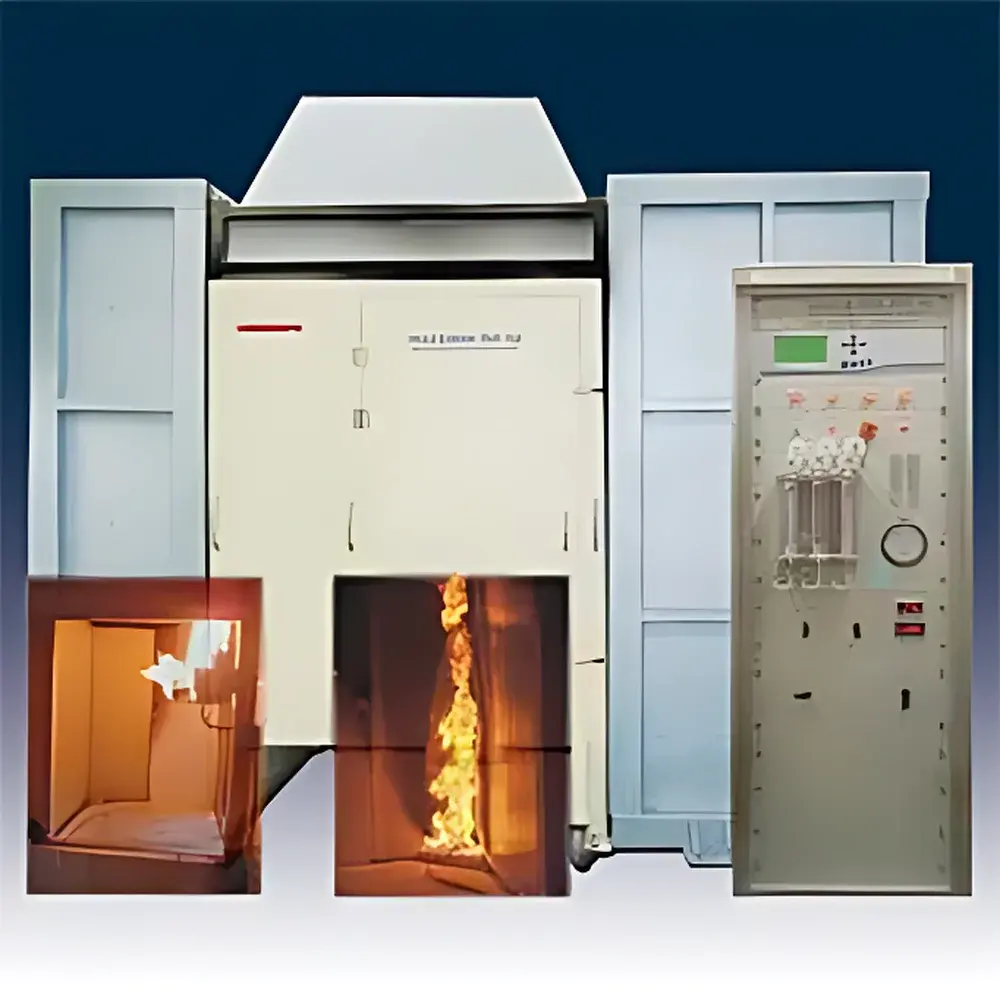
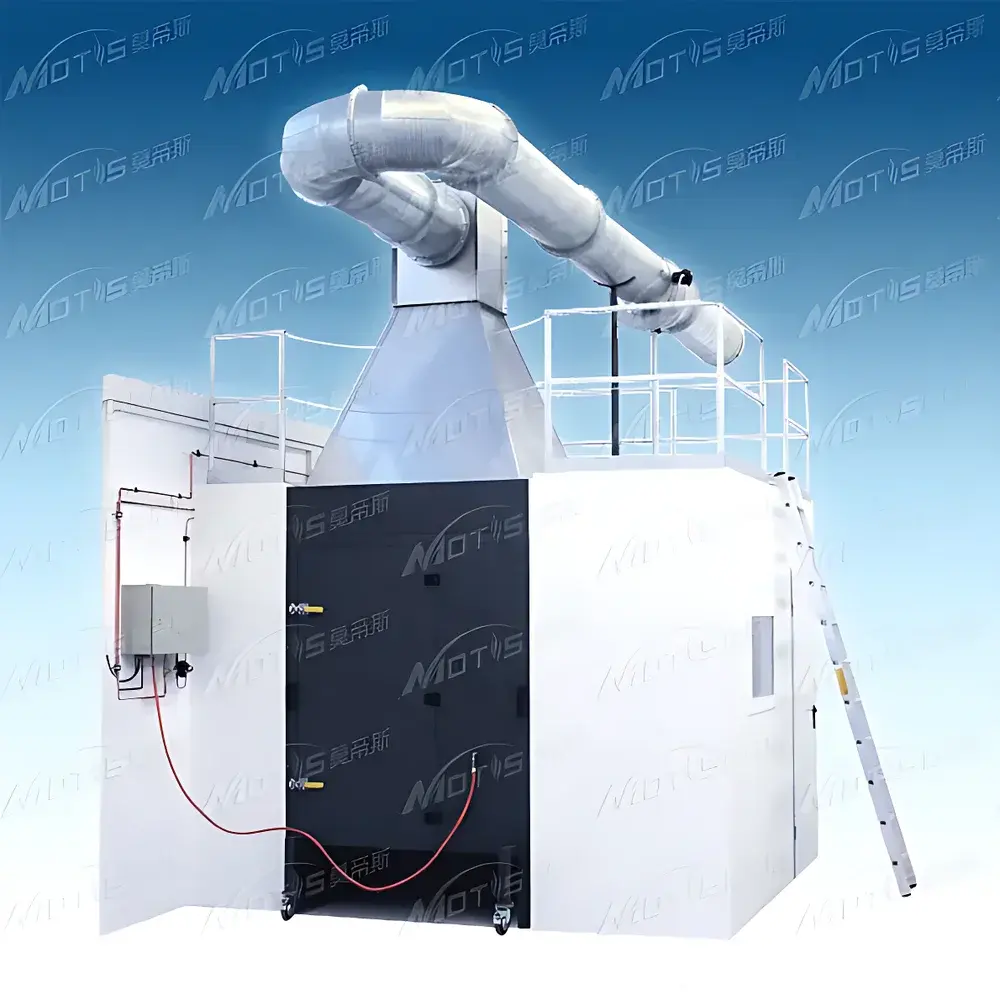
MOTIS SBI Single Burning Item Test System
| Brand | MOTIS |
|---|---|
| Origin | Jiangsu, China |
| Model | SBI |
| Compliance | EN 13823, GB/T 20284 |
| Heat Release Rate Measurement | Oxygen consumption calorimetry |
| Smoke Measurement | Optical density (light extinction) via white-light beam |
| Flame Spread Assessment | Lateral flame spread (LFS) up to 1.5 m × 1.0 m specimen edge |
| Droplet Collection | Integrated metal drip tray with thermal shielding |
| Chamber Dimensions | 3 m × 3 m × 2.4 m (W × D × H) |
| Ignition Source | 31 kW propane corner burner (250 mm × 250 mm × 80 mm) mounted on specimen trolley |
| Sampling Duct | Stainless-steel duct with integrated probe zone for multi-parameter gas analysis |
| Data Acquisition | Simultaneous sampling of O₂, CO, CO₂, flue gas temperature, mass flow, and optical density |
| Analyzer Specifications | Siemens OXYMAT 61 (0–25% O₂, ±1% FS/week drift, <3 s response), U23 NDIR (CO: 0–1%, CO₂: 0–10%, ±0.5% FS linearity) |
| Calibration Support | Full software-based calibration routines per ISO 5660-1 and EN 13823 Annex B |
Overview
The MOTIS SBI Single Burning Item Test System is a fully integrated, standards-compliant fire testing apparatus engineered for quantitative assessment of the reaction-to-fire performance of building products under controlled, intermediate-scale combustion conditions. Based on the principle of oxygen consumption calorimetry—recognized as the most accurate and reproducible method for heat release rate (HRR) determination—the system measures the depletion of oxygen in the exhaust stream to calculate heat release rate (HRR), total heat released (THR), and fire growth index (FIGRA). Concurrently, it employs standardized white-light attenuation methodology to quantify smoke production, yielding smoke growth index (SMOGRA) and total smoke production (TSP). Flame propagation is monitored visually and timed against defined geometric thresholds (e.g., lateral flame spread to the 1.5 m × 1.0 m specimen edge), while molten droplet behavior is captured using thermally shielded stainless-steel collection trays. The test configuration strictly adheres to the dimensional, operational, and instrumentation requirements specified in EN 13823 and GB/T 20284, ensuring regulatory acceptability for CE marking, Chinese CCC certification, and third-party conformity assessments.
Key Features
- Modular combustion chamber (3 m × 3 m × 2.4 m) with refractory-lined walls and integrated ceiling hood connected to a dedicated extraction duct
- Motorized specimen trolley equipped with dual non-combustible mineral boards (vertical and horizontal) for standardized mounting per EN 13823 Annex A
- Calibrated 31 kW propane corner burner (250 mm × 250 mm × 80 mm) with precision mass-flow-controlled gas supply, including backfire arrestor and pressure regulation
- Dual-path gas analysis suite: Siemens OXYMAT 61 paramagnetic oxygen analyzer (0–25% O₂, ±1% FS/week stability) and U23 non-dispersive infrared analyzers for CO (0–1%) and CO₂ (0–10%) with trace-level resolution
- Multi-point flue gas monitoring: K-type thermocouples (±0.5 °C accuracy), stainless-steel bidirectional Pitot-static probe with differential pressure transducer, and calibrated optical density sensor (white-light beam, 550 nm)
- Corrosion-resistant sampling train: PTFE-lined probe assembly, chilled dew point trap, gas conditioning module (flow/pressure stabilization), and diaphragm sampling pump
- Real-time data acquisition system capturing ≥16 analog channels (temperature, pressure, gas concentrations, optical density, airflow) at 10 Hz sampling rate with timestamped binary logging
- Comprehensive software platform supporting automated test sequencing, live parameter visualization, post-test FIGRA/SMOGRA/THR/LFS calculation, and export to CSV/PDF per ISO/IEC 17025 reporting templates
Sample Compatibility & Compliance
The SBI system accommodates flat, rigid, or semi-rigid construction products—including insulation boards, sandwich panels, wall claddings, ceiling tiles, and floor coverings—with maximum dimensions of 1.5 m (height) × 1.0 m (width) × 200 mm (thickness). Specimens are conditioned per EN ISO 139 and mounted vertically on the trolley’s mineral board support. All instrumentation, calibration protocols, and data reduction algorithms conform to EN 13823 Annexes A–F and GB/T 20284 Clause 6–9. The system supports full audit readiness for GLP-compliant laboratories and meets functional requirements for ISO/IEC 17025 accreditation. Optional integration with LIMS enables traceable chain-of-custody logging, electronic signature support, and 21 CFR Part 11–compliant audit trails when paired with validated software modules.
Software & Data Management
The embedded Windows-based control and analysis software provides end-to-end workflow management—from pre-test system self-check and zero/span calibration to real-time combustion parameter overlay and post-test compliance verification. Raw data files are stored in binary format with embedded metadata (operator ID, calibration dates, ambient conditions, specimen ID), ensuring integrity and long-term readability. Built-in calculation engines automatically derive FIGRA (kW/s), THR (MJ), SMOGRA (m²/s), TSP (m²), and LFS time (s) using standardized numerical integration and interpolation methods aligned with EN 13823 Section 9. Reports are generated in bilingual (English/Chinese) PDF with embedded graphs, uncertainty statements, and pass/fail annotations against classification criteria (e.g., Class B-s1, d0). Export options include CSV for statistical process control (SPC) integration and XML for enterprise QA databases.
Applications
This system serves as a core tool for fire safety R&D labs, national testing institutes (e.g., CNAS-accredited bodies), and product certification organizations evaluating materials for façade systems, interior finishes, and structural composites. It delivers critical input for fire modeling (e.g., CFD input parameters such as HRR curve shape, smoke yield), regulatory submissions to EU Notified Bodies or CNCA, and development of fire performance declarations under EN 15804 and GB/T 27025. Users routinely apply it to compare halogen-free vs. brominated flame retardants, assess charring depth in bio-based insulations, validate intumescent coating efficacy, and benchmark commercial façade systems against harmonized classification thresholds.
FAQ
What standards does the MOTIS SBI system fully support?
EN 13823 and GB/T 20284 are natively implemented—including all mandatory instrumentation tolerances, calibration frequencies, and data reduction algorithms.
Can the system be upgraded to meet future revisions of EN 13823?
Yes—firmware and software updates are provided under annual maintenance contracts, ensuring alignment with CEN TC127 amendments and ISO/IEC 17025:2017 technical requirements.
Is third-party verification of calibration traceability available?
All gas analyzers ship with NIST-traceable calibration certificates; optional on-site verification by UKAS- or CNAS-accredited metrology providers is supported.
How is data integrity ensured during extended tests (up to 20 minutes)?
The acquisition system features battery-backed real-time clock, cyclic redundancy check (CRC) on all analog inputs, and automatic gap-filling interpolation for transient sensor dropouts per EN 13823 Annex E.
Does the system support remote diagnostics and preventive maintenance alerts?
Yes—integrated Ethernet connectivity enables secure remote access for firmware updates, log review, and predictive analytics based on burner duty cycle, filter pressure drop, and analyzer signal drift trends.



