
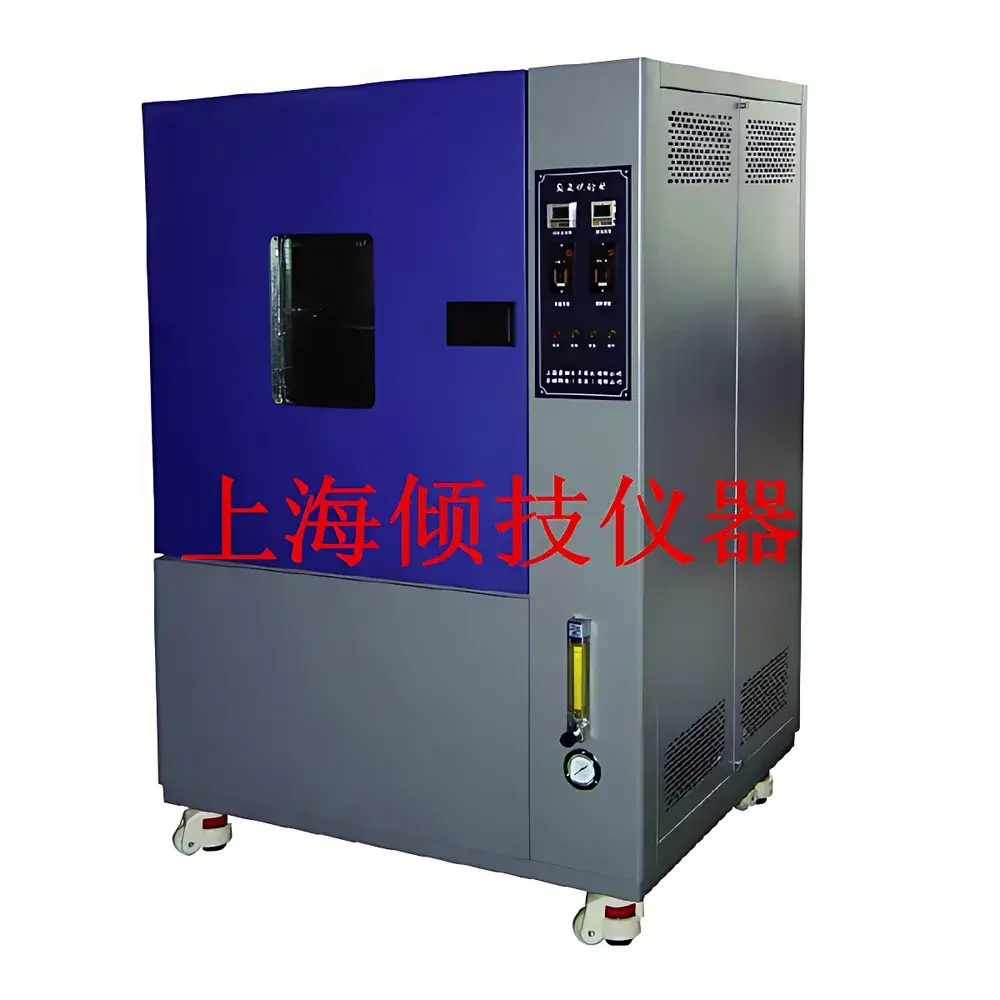
QJCYX-542 Ozone Aging Test Chamber
| Origin | Shanghai, China |
|---|---|
| Manufacturer Type | Authorized Distributor |
| Origin Category | Domestic (China) |
| Model | QJCYX-542 |
| Price | USD 6,300 (FOB Shanghai) |
| Temperature Range | 0–60 °C |
| Humidity Range | 40–98% RH (at 30–60 °C) |
| Temp. Stability | ≤ ±0.5 °C |
| Temp. Uniformity | ≤ ±2 °C |
| Humidity Stability | +2 / −3% RH |
| Heating Rate | 0.7–1.0 °C/min |
| Cooling Rate | ≤20 min (from ambient to 10 °C, uncontrolled) |
| Ozone Concentration Range | 10–1000 pphm |
| Gas Flow Velocity | 12–16 mm/s |
| Sample Mounting | Static Exposure Rack |
| Compliance | GB/T 7762–2003, GB/T 3642–1992 |
Overview
The QJCYX-542 Ozone Aging Test Chamber is an engineered environmental simulation system designed specifically for evaluating the ozone resistance and aging behavior of elastomeric materials—including natural rubber, SBR, NBR, EPDM, and silicone compounds—under controlled oxidative stress conditions. It operates on the principle of static exposure in a fully sealed, recirculating gas loop where ozone is continuously generated via ultraviolet (UV) photolysis of oxygen and precisely regulated via feedback-controlled UV lamp intensity and air flow modulation. Unlike dynamic flexing or tensile fatigue testers, this chamber subjects specimens to sustained, uniform ozone concentrations within a thermally and hygrothermally stabilized environment—enabling standardized assessment of surface cracking initiation, propagation rate, and morphology per internationally recognized test protocols.
Key Features
- Integrated ozone generation and real-time concentration control (10–1000 pphm) using UV-based ozone synthesis with closed-loop electrochemical sensor feedback
- Independent dual-control climate system: PID-regulated heating/cooling and humidity conditioning (40–98% RH at 30–60 °C), ensuring stable thermal-hygrometric profiles during extended exposure cycles
- Static sample rack configuration compliant with ISO 1431-1 and ASTM D1149 requirements for non-flexed specimen orientation and uniform gas impingement
- Gas flow velocity maintained between 12–16 mm/s across the test zone—optimized to prevent boundary layer stagnation while avoiding turbulent erosion of micro-cracks
- Temperature uniformity ≤ ±2 °C and stability ≤ ±0.5 °C over full operating range; humidity control accuracy ±2/+3% RH under defined temperature bands
- Structural housing constructed from corrosion-resistant stainless steel (AISI 304) with ozone-resistant gasketing and UV-shielded viewing window for safe visual monitoring
Sample Compatibility & Compliance
The QJCYX-542 accommodates standard dumbbell-shaped, ring, or flat-sheet specimens up to 150 mm × 150 mm, mounted on fixed-position aluminum or ceramic racks. It supports both unstressed and pre-strained (e.g., 20% elongation) configurations when used with optional mechanical stretch fixtures. The system meets the physical and operational requirements of GB/T 7762–2003 (“Rubber—Determination of resistance to ozone cracking—Static strain method”), GB/T 3642–1992 (“Test method for ozone resistance of rubber products”), and aligns with the test methodology frameworks of ISO 1431-1:2018 and ASTM D1149–19. While not certified to IEC 61000 or CE for direct EU market placement without local Notified Body validation, its design principles conform to general safety provisions outlined in EN 61010-1 for laboratory equipment.
Software & Data Management
The embedded controller provides local setpoint programming, real-time logging of ozone concentration (pphm), temperature (°C), relative humidity (%RH), and elapsed exposure time (hours). Data is stored internally for up to 30 days and exportable via USB interface in CSV format. Optional PC-based software (QJ-LogSuite v2.1) enables multi-channel trending, alarm threshold configuration, automated report generation (PDF/Excel), and audit-trail functionality supporting GLP-aligned documentation practices. All parameter changes are timestamped and user-ID logged—facilitating traceability required under internal quality systems referencing ISO/IEC 17025 clause 7.7.
Applications
- Evaluation of ozone-induced surface cracking in automotive weatherstrips, hoses, seals, and tire sidewalls
- Comparative screening of antioxidant package efficacy in synthetic rubber formulations
- Quality conformance testing for rubber components supplied to Tier-1 automotive OEMs requiring ISO/TS 16949-compliant aging validation
- Research into degradation kinetics of bio-based elastomers and halogen-free flame-retardant compounds
- Supporting accelerated life modeling for outdoor infrastructure gaskets exposed to urban ozone gradients
FAQ
What ozone concentration ranges does the QJCYX-542 support, and how is accuracy verified?
The chamber delivers 10–1000 pphm ozone with ±10% full-scale accuracy, verified using factory-calibrated electrochemical sensors traceable to NIST-standard reference gases. Annual recalibration is recommended.
Is dynamic stretching capability available as an option?
No—the QJCYX-542 is configured exclusively for static exposure per GB/T 7762 and ISO 1431-1. Dynamic flexing requires separate equipment (e.g., QJDLX series).
Does the system comply with FDA 21 CFR Part 11 requirements?
Out-of-the-box, it does not include electronic signature or role-based access controls required for Part 11. However, the optional QJ-LogSuite software can be configured with supplementary validation documentation upon request.
What maintenance intervals are recommended for ozone generator lamps and sensors?
UV ozone lamps require replacement every 8,000 operating hours; electrochemical ozone sensors should be zero-checked weekly and calibrated quarterly using certified span gas.
Can the chamber operate continuously for 1,000-hour aging studies?
Yes—designed for unattended operation up to 1,500 hours, with redundant thermal cutoffs, ozone leak detection, and automatic shutdown on sensor fault or door interlock breach.



