
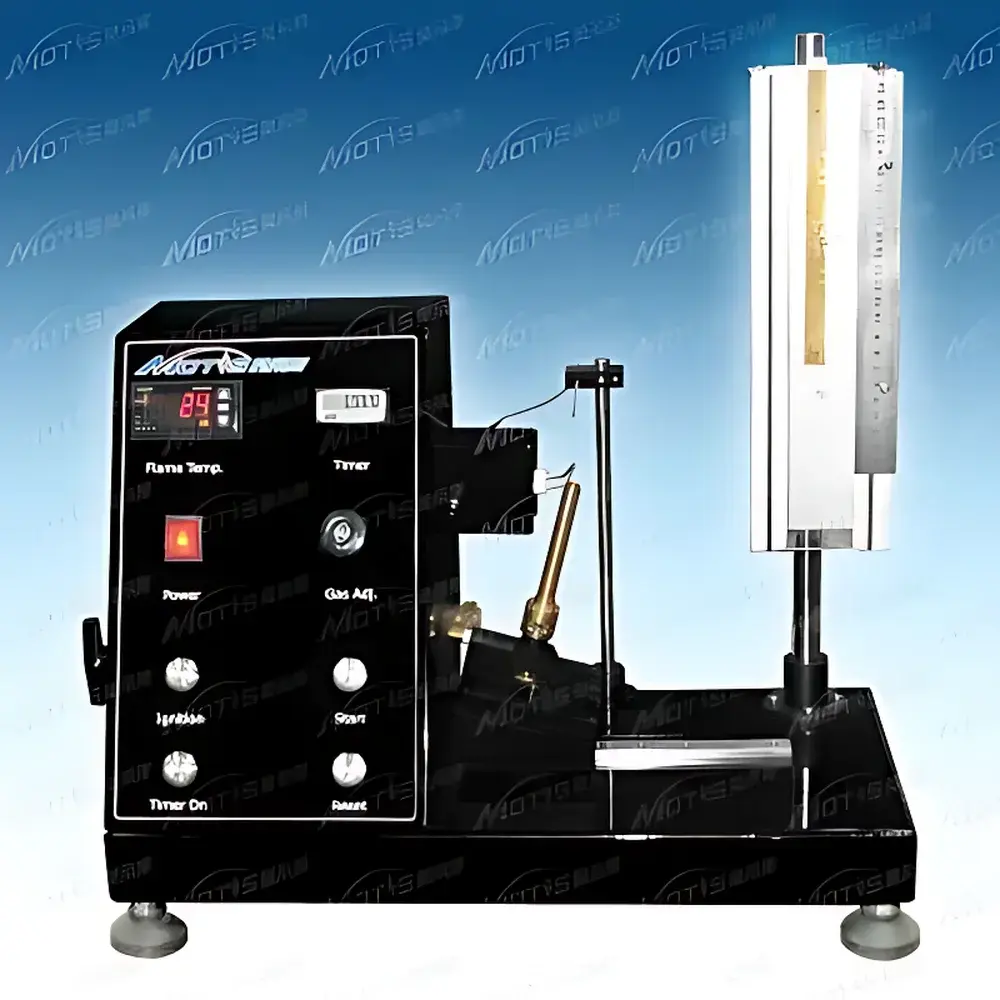
MOTIS FVT Vertical Burning Tester for Rigid Foam Plastics
| Brand | MOTIS |
|---|---|
| Origin | Shanghai, China |
| Model | FVT |
| Compliance | GB/T 8333, ASTM D3014a |
| Burner Type | Bunsen burner |
| Maximum Flame Temperature | 900 °C |
| Thermocouple | Manually Positionable |
| Automation | Motorized Burner Translation |
| Flame Height Measurement | Calibrated Steel Scale |
| Gas Flow Control | Adjustable and Auto-Shutoff |
| Chamber Lining | PTFE-Coated Interior |
| Operation Mode | One-Touch Test Initiation |
Overview
The MOTIS FVT Vertical Burning Tester is an engineered test system designed specifically for evaluating the flammability behavior of rigid thermoset foam plastics under standardized vertical orientation conditions. It operates on the principle of controlled open-flame exposure in accordance with the gravimetric and dimensional assessment methodology defined in GB/T 8333 (Chinese National Standard) and ASTM D3014a (Standard Test Method for Determining the Flammability of Rigid Cellular Plastics in the Vertical Position). During testing, a specimen is clamped vertically and exposed to a calibrated Bunsen burner flame at 900 °C for a prescribed duration. The instrument quantifies critical fire performance parameters—including afterflame time, afterglow time, total burn time, char length (measured directly via integrated steel scale), and mass loss—providing objective data for material classification, formulation development, and regulatory documentation.
Key Features
- High-precision Bunsen burner assembly delivering stable 900 °C flame output, independently verified per ASTM D3014a thermal calibration requirements
- Manually adjustable K-type thermocouple positioning system, enabling optimal thermal monitoring without prolonged exposure to radiant heat or direct flame impingement
- Motor-driven burner translation mechanism ensuring repeatable flame contact distance and dwell time, minimizing operator-induced variability
- Dedicated calibrated steel ruler mounted within the test chamber viewport for direct, real-time observation and recording of flame front progression and char length
- Integrated gas flow regulator with fine-tuning capability and programmable auto-shutoff function, enhancing both safety and test repeatability
- PTFE-coated interior chamber surfaces resist chemical degradation from combustion byproducts and facilitate rapid post-test cleaning and residue removal
- One-touch test initiation sequence automates flame application, timing, and gas cutoff—reducing procedural complexity and supporting consistent operator training across laboratory environments
Sample Compatibility & Compliance
The FVT accommodates standard specimen dimensions as specified in GB/T 8333 and ASTM D3014a: 150 mm × 12.7 mm × 12.7 mm (L × W × H), with tolerance control to ±0.5 mm. It supports rigid cellular plastics including polyurethane (PUR), phenolic (PF), melamine-formaldehyde (MF), and polyisocyanurate (PIR) foams. All mechanical and thermal operating parameters are traceable to national metrological standards. The system design aligns with laboratory safety protocols outlined in ISO/IEC 17025:2017 for testing laboratories, and its documented test procedures support audit readiness for GLP-compliant quality systems. While not inherently Part 11–compliant, raw test logs (time-stamped flame-on/off events, char length readings, mass loss values) can be exported in CSV format for integration into validated electronic lab notebook (ELN) or LIMS platforms.
Software & Data Management
The FVT operates via embedded microcontroller logic with no proprietary software dependency. All operational parameters—including burner activation timing, gas shutoff delay, and user-initiated pause/resume—are stored in non-volatile memory with timestamped event logging. Test records include operator ID (manually entered), specimen ID, ambient temperature/humidity (optional external sensor input), start/end timestamps, observed afterflame/afterglow durations, measured char length, and pre-/post-test mass (when used with compatible analytical balance). Exported data files conform to UTF-8 encoding and contain no embedded macros or executable content, facilitating secure archival and cross-platform analysis in Excel, Python Pandas, or statistical validation tools.
Applications
- Formulation screening of flame-retardant additives in rigid foam insulation materials for construction and transportation sectors
- Pre-certification testing prior to submission for UL 94 V-0/V-1/V-2 classification or EN 13501-1 fire reaction classification
- Quality assurance testing of incoming raw foam stock against supplier specifications and internal fire safety thresholds
- Root-cause analysis of batch-to-batch flammability variation during production process validation
- Supporting technical documentation for CE marking, CCC certification, and U.S. CPSC compliance dossiers
- Academic and industrial research into thermal decomposition kinetics and charring mechanisms of thermoset polymer matrices
FAQ
Does the FVT comply with UL 94 testing requirements?
No—the FVT implements GB/T 8333 and ASTM D3014a, which are distinct from UL 94’s specimen geometry, holder configuration, and pass/fail criteria. UL 94 requires separate apparatus and procedure validation.
Can the instrument be used for flexible foams?
Not recommended. ASTM D3014a and GB/T 8333 explicitly specify rigid cellular plastics; flexible foams deform under vertical clamping and yield non-representative flame spread behavior.
Is calibration certificate included with shipment?
A factory calibration report verifying burner flame temperature (900 °C ±15 °C at tip), gas flow rate (260 mL/min ±10 mL/min), and timer accuracy (±0.1 s) is provided. Third-party accredited calibration is available upon request.
What maintenance intervals are recommended?
Bunsen burner nozzle inspection and cleaning every 50 tests; PTFE chamber coating inspection quarterly; thermocouple verification annually or after impact exposure.
Is remote diagnostics supported?
No—this is a stand-alone electromechanical test platform without network interface or cloud connectivity. All diagnostics are performed locally via LED status indicators and manual functional checks.



