
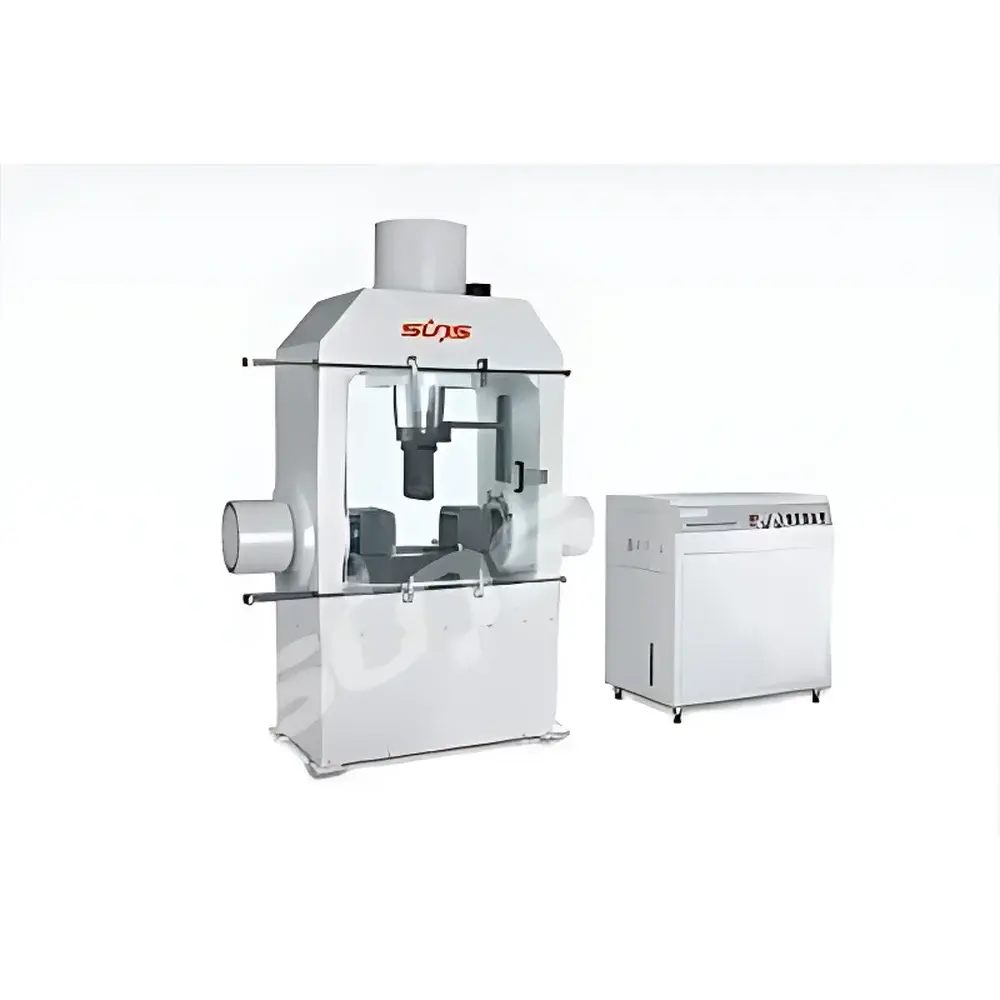
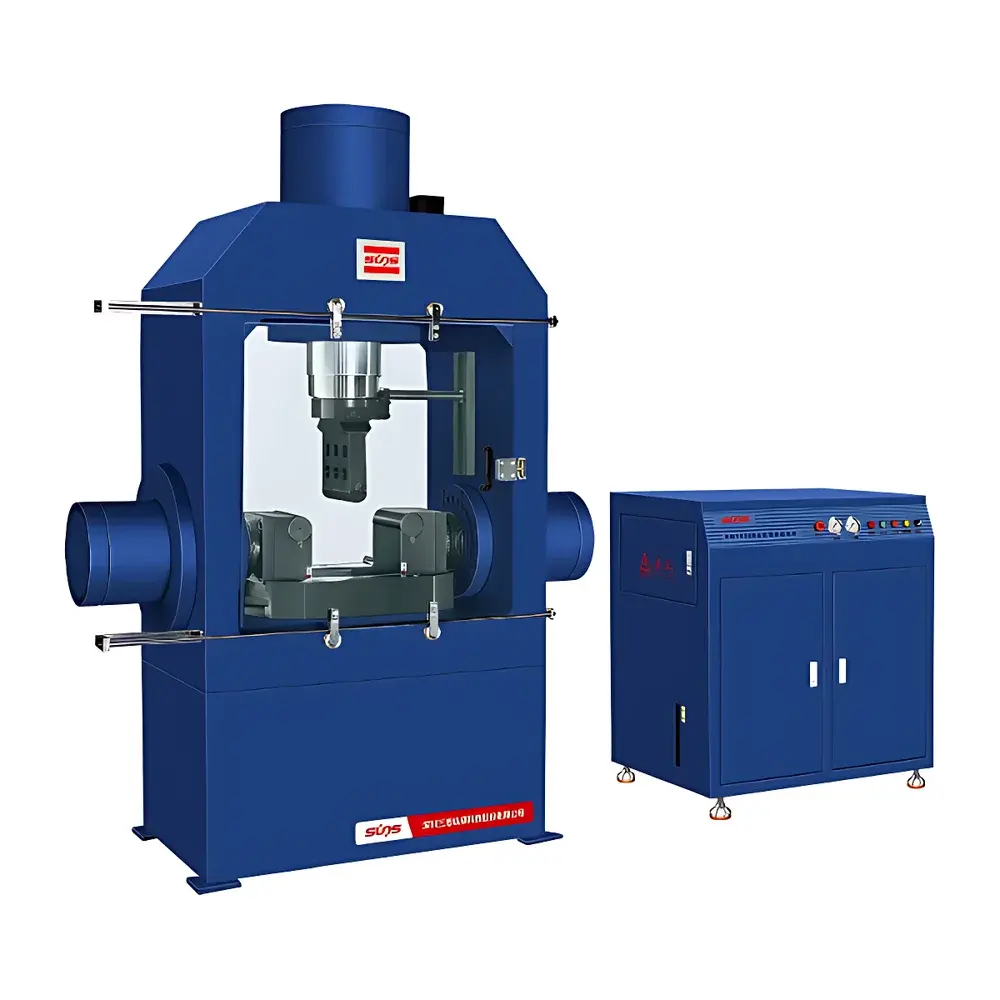
SUNS WZW Series Three-Cylinder Bending Testing Machine
| Brand | SUNS |
|---|---|
| Origin | Shenzhen, China |
| Manufacturer Type | Direct Manufacturer |
| Region of Origin | Domestic (China) |
| Model | WZW Series |
| Max Torque | 350 N·m |
| Torque Measurement Range | 0–360 N·m |
| Torque Resolution | 1/500,000 FS |
| Torsion Angle Measurement Range | 0–400° |
| Motor Power | 6 kN (380 V AC) + 2 kN (220 V AC) |
| Load Capacity Options | 500 kN, 1000 kN, 2000 kN |
| Applicable Standards | GB/T 232, ISO 7438, ASTM E290, DIN 50111, JIS Z 2248 |
Overview
The SUNS WZW Series Three-Cylinder Bending Testing Machine is a high-precision, electro-mechanical testing system engineered for standardized bending evaluation of metallic flat products—including sheets, strips, plates—and solid-section bars. It operates on the principle of three-point or four-point bending under controlled displacement or load control, with integrated torque and angular displacement transduction to quantify material ductility, yield behavior, and fracture initiation under flexural stress. Unlike conventional single-actuator bending frames, the WZW series employs three synchronized hydraulic or electromechanical cylinders—two support cylinders and one loading cylinder—to ensure uniform load distribution, eliminate parasitic moments, and maintain strict alignment throughout the test cycle. This architecture enables direct compliance with international bending standards requiring precise support span control, consistent loading rate, and real-time angular feedback—critical for quality assurance in automotive stamping, aerospace sheet metal fabrication, and structural steel certification.
Key Features
- Triple-cylinder actuation system with independent closed-loop position and force control for each cylinder, ensuring sub-0.1 mm synchronization accuracy across full travel range
- Modular load frame design supporting multiple capacity configurations: 500 kN, 1000 kN, and 2000 kN—each validated per ISO 7500-1 Class 0.5 accuracy requirements
- High-resolution torque measurement (1/500,000 full scale) coupled with ±0.1° angular resolution over 0–400° range, enabling precise determination of plastic hinge formation and elastic recovery angles
- Ergonomic console layout with dual-mode operation: fully automated sequence execution via preloaded test methods, or manual step-by-step control with real-time digital readouts for operator-guided calibration and validation
- Structural rigidity exceeding 1.2 × 10⁶ N/mm in vertical bending plane, verified by finite element analysis and third-party static stiffness certification
- Energy-efficient drive architecture combining 6 kN @ 380 V and 2 kN @ 220 V motor modules, compliant with IEC 60034 efficiency class IE3 and meeting GB 18613 Tier 2 energy consumption limits
Sample Compatibility & Compliance
The WZW series accommodates specimens up to 300 mm wide and 40 mm thick, with adjustable support spans from 20 mm to 1000 mm (standard), extendable to 1500 mm upon configuration. Specimen clamping utilizes hardened steel rollers with self-aligning bearings to minimize edge stress concentration. The system is pre-configured to execute tests per GB/T 232 (Metallic Materials — Bend Test), ISO 7438 (Metallic Materials — Bend Test), ASTM E290 (Standard Test Methods for Bend Testing of Metallic Flat Materials), DIN 50111 (Bend Testing of Metallic Materials), and JIS Z 2248 (Bend Test for Metallic Materials). All hardware and firmware comply with ISO/IEC 17025:2017 requirements for testing laboratories, and the mechanical safety architecture conforms to EN ISO 13857 and EN 60204-1.
Software & Data Management
Control and data acquisition are managed through SUNS TestSuite v4.2—a Windows-based platform supporting multi-channel real-time plotting (load vs. deflection, torque vs. angle, strain vs. time), automatic pass/fail evaluation against user-defined acceptance criteria, and export to CSV, PDF, and XML formats. Audit trail functionality logs all operator actions, parameter changes, and calibration events with timestamp and user ID—fully traceable for GLP/GMP environments. Raw data files include embedded metadata compliant with ASTM E1447 and ISO/IEC 17025 documentation requirements. Optional FDA 21 CFR Part 11 compliance package available with electronic signature, role-based access control, and immutable data archiving.
Applications
- Quality conformance testing of cold-rolled steel sheets used in automotive body-in-white assemblies
- Process validation of hot-dip galvanized coil batches prior to coil coating lines
- Mechanical property verification of aluminum alloy extrusions per AMS 4027 and EN AW-6060 specifications
- Research-grade bending fatigue pre-screening of titanium Grade 2 and Grade 5 sheet stock
- Third-party certification testing for ISO 3834-compliant welding procedure qualification (WPQR) where bend testing forms part of mechanical testing requirements
- Education and training labs requiring repeatable, standards-aligned demonstrations of plastic deformation mechanics
FAQ
What bending standards does the WZW series natively support?
The system includes built-in test method templates for GB/T 232, ISO 7438, ASTM E290, DIN 50111, and JIS Z 2248—with automatic calculation of required support span, mandrel diameter, and pass criteria based on specimen thickness and material grade.
Can the WZW machine perform both 3-point and 4-point bending?
Yes—the triple-cylinder configuration allows reconfiguration between three-point bending (single central load, two supports) and four-point bending (two symmetric loads, two outer supports) without hardware modification; software-driven actuator coordination ensures correct load ratio and span geometry.
Is torque calibration traceable to national metrology institutes?
All torque sensors are factory-calibrated using NIM (National Institute of Metrology, China)-certified reference standards, with optional UKAS or DAkkS-traceable calibration certificates available upon request.
Does the system meet requirements for accredited laboratory use?
Yes—mechanical performance, software audit trails, calibration documentation, and uncertainty budgets align with ISO/IEC 17025:2017 clause 6.4 (Equipment) and clause 7.7 (Ensuring validity of results).



