
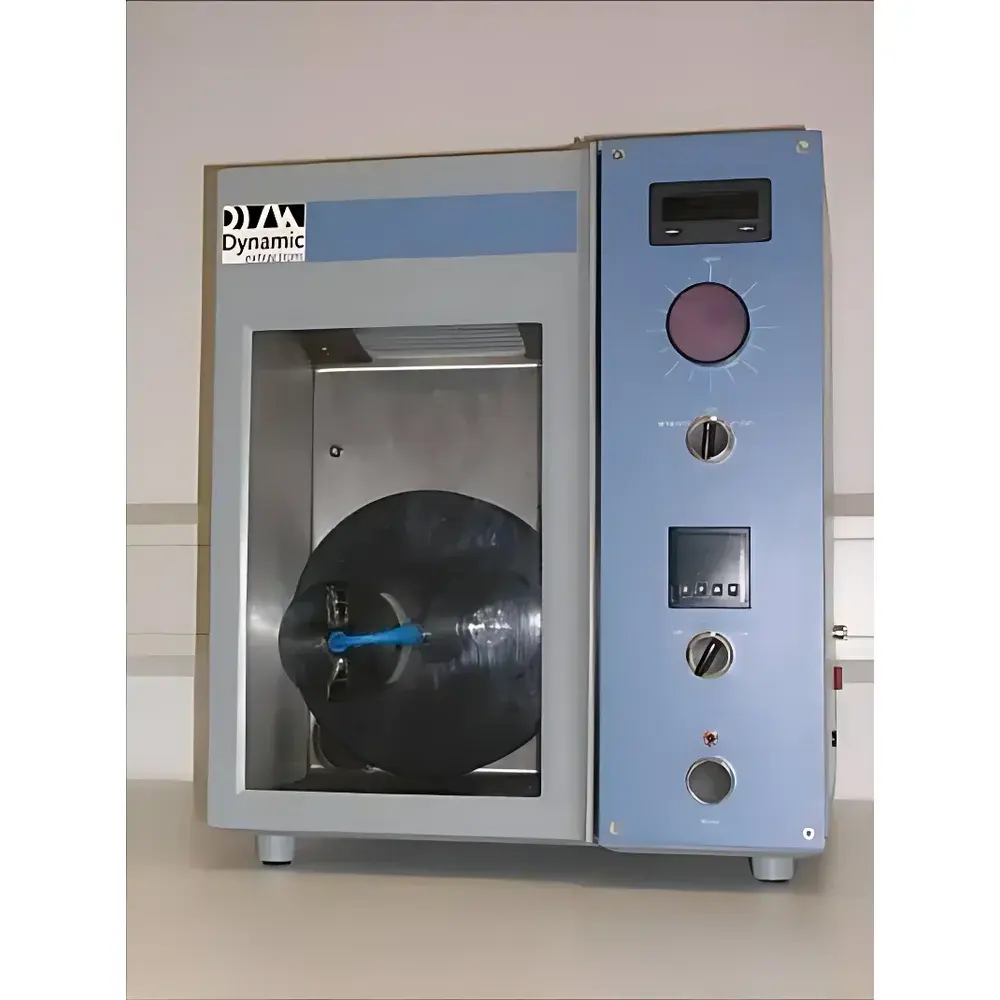
DE Mini HPCCC High-Speed Counter-Current Chromatography System
| Brand | DE |
|---|---|
| Origin | United Kingdom |
| Model | DE Mini HPCCC |
| Column Volume | 5–17 mL |
| Sample Load Capacity | 0–500 mg per run |
| Flow Rate | 2 mL/min |
| Rotation Speed | 2100 rpm |
| Phase System | Liquid–Liquid Biphasic Solvent System |
| Operating Pressure | Near Ambient (≤ 5 psi) |
| Solvent Consumption | ~10% of crude sample mass |
| Recovery Rate | >95% (theoretical quantitative recovery) |
Overview
The DE Mini HPCCC is a benchtop high-speed counter-current chromatography (HSCCC) system engineered for preparative and analytical-scale separation of complex natural product mixtures—particularly botanical extracts, herbal constituents, and secondary metabolites derived from traditional Chinese medicine (TCM) research. Unlike conventional solid-phase chromatographic techniques (e.g., silica-based flash or HPLC), HPCCC operates on the principle of liquid–liquid partition chromatography without a solid stationary phase. Separation is achieved through precise control of centrifugal force, rotational symmetry, and biphasic solvent immiscibility in a multi-layer coil column. The instrument employs a planetary motion mechanism to retain the stationary phase (typically one solvent layer) while the mobile phase percolates through it under controlled flow and rotation. This physics-based approach eliminates irreversible adsorption, silanol interactions, and column fouling—making it uniquely suited for labile, polar, or highly viscous phytochemicals that degrade or irreversibly bind on solid supports.
Key Features
- Zero Solid Support Architecture: Eliminates sample loss due to irreversible adsorption, enabling full quantitative recovery (>95%) of injected material—critical for trace natural product isolation and metabolic profiling.
- Low-Pressure Operation: Functions at near-ambient pressure (≤ 5 psi), reducing mechanical stress on sensitive compounds and minimizing safety hazards associated with high-pressure systems.
- Scalable Solvent Economy: Consumes only ~10% of the crude sample mass in solvent volume—significantly lower than conventional prep-HPLC or flash chromatography—reducing disposal costs and environmental footprint.
- High Sample Loading Capacity: Supports up to 500 mg per run within a 5–17 mL column volume, bridging the gap between analytical validation and early-stage preparative purification.
- Reproducible Method Translation: Identical solvent systems and rotational parameters can be directly transferred across DE’s HPCCC platform range (Mini → Lab → Pilot), supporting seamless process development under GLP-compliant workflows.
- Robust Coil Design: PTFE-coated stainless steel multi-layer coil ensures chemical compatibility with chlorinated, polar, and fluorinated solvent systems (e.g., hexane–ethyl acetate–methanol–water, DCM–MeOH–H₂O).
Sample Compatibility & Compliance
The DE Mini HPCCC demonstrates exceptional compatibility with crude plant extracts, fermented broths, essential oils, glycosides, alkaloids, flavonoids, terpenoids, and polyphenolic fractions—materials often incompatible with silica-based media due to chelation, oxidation, or precipitation. It complies with fundamental requirements for natural product standardization under ISO 21568 (herbal drug analysis), USP (chromatographic separations), and ICH Q5C (stability testing of biotechnological products). While not intrinsically 21 CFR Part 11–compliant, its analog/digital I/O architecture supports integration with validated LIMS and ELN platforms when paired with optional data acquisition modules—enabling audit-trail-ready operation in GMP-aligned R&D environments.
Software & Data Management
The system operates via a dedicated Windows-based control interface providing real-time monitoring of rotation speed (±5 rpm accuracy), flow rate (±0.05 mL/min), temperature (optional jacketed column support), and UV detection output (when coupled with external detectors). All method parameters—including solvent gradient profiles, dwell time, and fraction collection triggers—are stored as encrypted XML protocol files. Raw chromatograms export in ASCII or .csv format for post-processing in third-party tools (e.g., Chromeleon, OpenChrom, MATLAB). Full electronic record retention—including operator ID, timestamped runs, and version-controlled methods—is achievable when deployed with compliant network storage infrastructure.
Applications
- Isolation of bioactive markers from TCM herbs (e.g., ginsenosides from Panax ginseng, berberine from Coptis chinensis)
- Purification of unstable marine natural products prone to decomposition on silica
- Removal of phospholipids and fatty acids from lipidomics extracts prior to LC–MS analysis
- Separation of enantiomeric pairs using chiral aqueous two-phase systems (ATPS)
- Process development for botanical drug substance manufacturing under FDA Botanical Guidance (2004)
- Reference standard preparation for pharmacopoeial monographs (EP, ChP, JP)
FAQ
How does HPCCC differ fundamentally from HPLC or flash chromatography?
HPCCC uses no solid stationary phase—separation relies entirely on differential partitioning between two immiscible liquid phases under centrifugal force. This avoids surface adsorption artifacts, column clogging, and irreversible binding common in solid-phase methods.
Can I use my existing HPLC solvents and gradients in HPCCC?
Only if they form stable, non-emulsifying biphasic systems. Solvent selection requires empirical or computational prediction (e.g., using CALSOLV or Koolman software) to ensure adequate partition coefficients (K = 0.5–2.0) and settling time <60 s.
Is method development time-intensive for new matrices?
Initial solvent system screening typically requires 3–5 days for crude botanicals; however, once optimized, methods demonstrate high inter-laboratory reproducibility due to thermodynamic rather than kinetic dependence.
What maintenance is required beyond routine coil cleaning?
No column packing, frit replacement, or pressure calibration is needed. Recommended quarterly verification of rotational balance, pump line integrity, and detector baseline stability.
Does DE provide application support for TCM-focused separations?
Yes—DE maintains an open-access library of validated solvent systems and fractionation protocols for >120 medicinal herbs, accessible via secure customer portal after system registration.




