
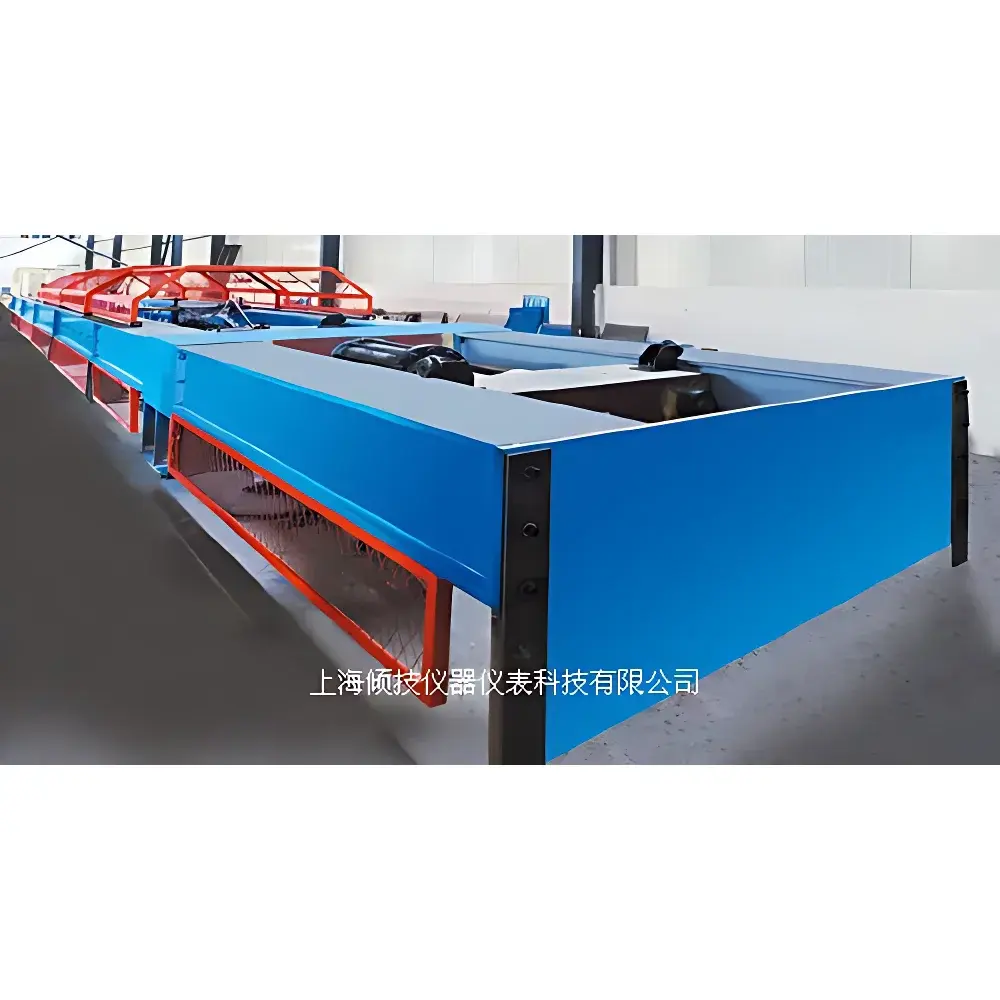
QJ Tech QJDW311 300 kN Computer-Controlled Horizontal Tensile Testing Machine
| Brand | QJ Tech |
|---|---|
| Origin | Shanghai, China |
| Model | QJDW311 |
| Maximum Load Capacity | 300 kN |
| Force Sensor Accuracy | ±0.01% of full scale |
| Measurement Accuracy Class | Class 1 (per ISO 7500-1 & ASTM E4) |
| Repeatability | ≤1% |
| Displacement Accuracy | ≤1% |
| Strain/Deformation Accuracy | ≤1% |
| Control System | Fully PC-based closed-loop control |
| Test Space | Custom-configurable (user-specified length and clearance) |
Overview
The QJ Tech QJDW311 is a high-capacity, computer-controlled horizontal tensile testing machine engineered for precise mechanical characterization of elongated, low-stiffness, and flexible specimens—particularly optical fibers, fiber optic cables, telecommunications cables, and other quasi-one-dimensional structural materials requiring extended gauge lengths and minimal bending interference. Unlike vertical frame configurations, its horizontal architecture eliminates gravitational sag effects and enables stable clamping and alignment of long, slender samples up to several meters in length. The system operates on a servo-hydraulic or electromechanical actuation platform (configurable per user specification), delivering controlled displacement or load ramping in accordance with ISO 6892-1, ASTM D412, ASTM D3822, IEC 60794-1-2, and GB/T 228.1 test methodologies. Its rigid welded steel frame, precision-ground guide rails, and dual-column load train ensure minimal lateral deflection and high axial alignment fidelity—critical for reliable determination of tensile strength, yield point, elongation at break, and modulus of elasticity in compliant materials.
Key Features
- Horizontal loading configuration optimized for long, flexible specimens including optical fiber ribbons, armored cables, and polymer-coated conductors
- 300 kN maximum static load capacity with overload protection and real-time force monitoring via high-stability S-type or load-cell-integrated transducers
- Force measurement traceable to national standards with sensor accuracy of ±0.01% FS and compliance with ISO 7500-1 Class 1 verification requirements
- Integrated closed-loop control system with Windows-based software enabling programmable multi-step tests (e.g., preload → ramp → hold → return)
- Adjustable test zone with modular grips—including pneumatic, wedge, and custom-designed fiber-optic cable fixtures—to accommodate varying diameters and surface geometries
- Real-time synchronization of load, displacement, and strain data at ≥1 kHz sampling rate, supporting dynamic compliance analysis and creep/stress-relaxation profiling
- Structural rigidity validated per ASTM E2309, ensuring minimal frame deflection (<0.05 mm under 300 kN) and measurement integrity across full range
Sample Compatibility & Compliance
The QJDW311 accommodates specimens ranging from 0.25 mm diameter single-mode optical fibers to bundled armored cables exceeding 30 mm outer diameter. Its open-front horizontal layout permits seamless integration with environmental chambers (optional), extensometers (contact and non-contact), and in-situ imaging systems. The machine meets mechanical verification criteria per ISO 7500-1, calibration traceability per ISO/IEC 17025, and supports audit-ready documentation for GLP and GMP environments. Test reports comply with FDA 21 CFR Part 11 requirements when paired with validated software modules, including electronic signatures, change history logs, and data immutability controls. It fully supports test method execution per ITU-T G.652, IEC 60794-1-2-E1/E3/E5, and YD/T 901–2018 for optical cable qualification.
Software & Data Management
Control and analysis are performed using QJ Tech’s proprietary TensilePro v4.x software suite—a CE-marked, 64-bit Windows application with configurable test templates, automatic curve fitting (linear, polynomial, hyperbolic sine), and export to CSV, XML, PDF, and MDF4 formats. The software includes built-in statistical process control (SPC) tools for batch comparison, tolerance band overlays, and Weibull modulus calculation. All raw data files are time-stamped, digitally signed, and stored with metadata (operator ID, calibration certificate ID, environmental conditions). Audit trails record every parameter modification, test initiation, and report generation event—fully compliant with ISO 17025 Clause 7.7 and FDA 21 CFR Part 11 Subpart B.
Applications
- Tensile strength and elongation testing of single-mode/multi-mode optical fibers during preform draw and cabling processes
- Proof testing and failure mode analysis of FTTH drop cables, ADSS, and OPGW under simulated service loads
- Creep behavior evaluation of polymeric buffer tubes and jacketing materials at elevated temperatures (with environmental chamber)
- Qualification testing of cable assemblies per Telcordia GR-20-CORE and ICEA S-87-640 standards
- R&D validation of novel composite reinforcement elements (e.g., aramid yarns, carbon fiber rods) in hybrid cable designs
- Quality assurance testing in cable manufacturing plants operating under ISO 9001 and IATF 16949 frameworks
FAQ
What standards does the QJDW311 support for optical fiber cable testing?
It natively supports IEC 60794-1-2 (E1, E3, E5), ITU-T G.652/G.655, YD/T 901, and Telcordia GR-20-CORE test sequences through configurable software templates.
Can the system be integrated with an environmental chamber?
Yes—the horizontal design allows front-access integration of temperature/humidity chambers (−40 °C to +85 °C, 10–95% RH) with feedthrough ports for load train and signal cabling.
Is third-party calibration certification available?
QJ Tech provides factory calibration certificates traceable to CNAS-accredited laboratories; optional on-site verification by ISO/IEC 17025-certified metrology providers is supported.
What grip types are standard for fiber optic cable testing?
Standard configurations include self-tightening pneumatic grips with soft jaw inserts (for coated fibers) and adjustable wedge grips with serrated stainless-steel faces (for armored cables).
Does the software support automated pass/fail evaluation against specification limits?
Yes—TensilePro allows definition of upper/lower specification limits per parameter (e.g., tensile strength ≥ 600 N, elongation ≤ 1.5%), with visual alerts and auto-generated nonconformance reports.



