
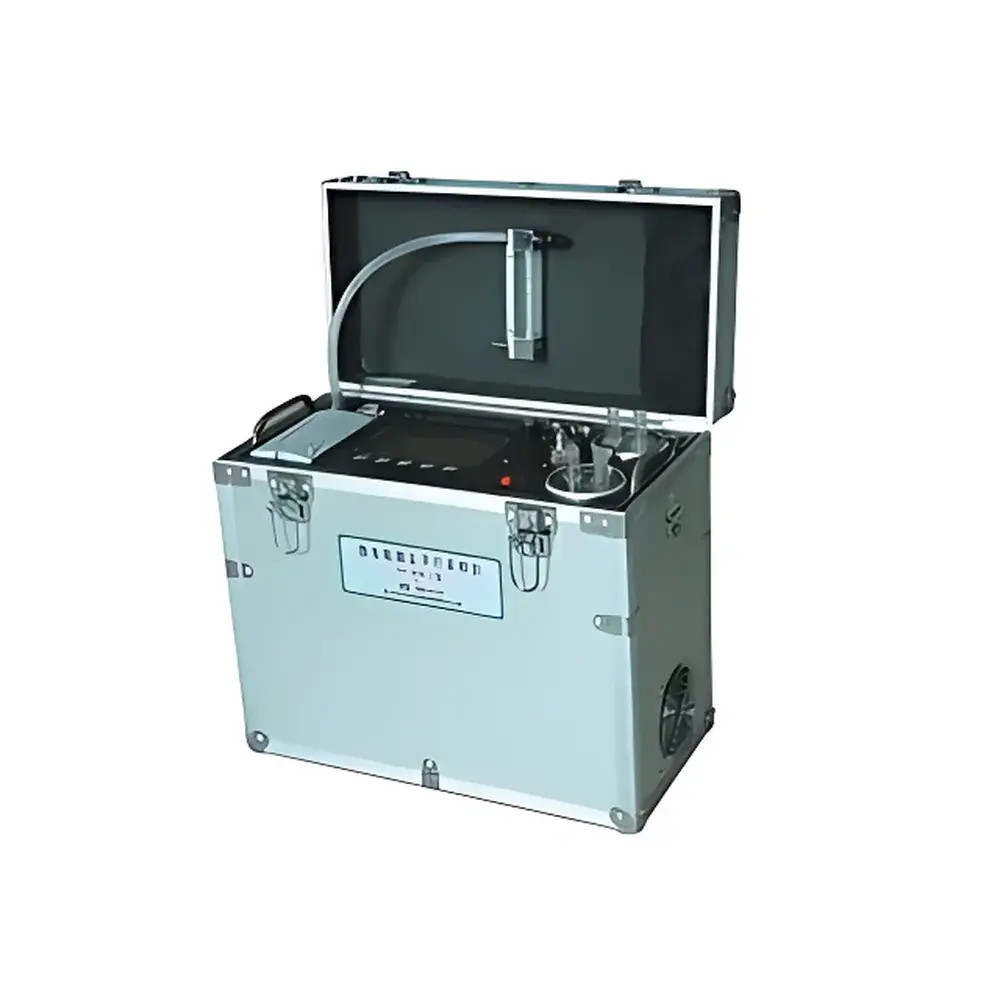
Tianhong TH-880 Series Portable Isokinetic Flue Gas and Particulate Sampling System
| Brand | Tianhong |
|---|---|
| Origin | Hubei, China |
| Model | TH-880 |
| Instrument Type | Portable Flue Gas & Particulate Sampler |
| Sensor Integration | Optional electrochemical sensors (SO₂, CO, O₂, NOₓ) |
| Compliance Basis | Designed for compliance with GB/T 16157–1996, HJ/T 48–1999, and ISO 9096:2003 principles |
| Operating Principle | Pitot-static parallel isokinetic sampling with real-time velocity tracking |
Overview
The Tianhong TH-880 Series Portable Isokinetic Flue Gas and Particulate Sampling System is an engineered solution for regulatory-grade stack emission monitoring in industrial combustion sources—including coal-fired boilers, industrial kilns, waste incinerators, and metal smelting facilities. It operates on the fundamental principle of isokinetic sampling as defined in ISO 9096:2003 and aligned with the technical basis of China’s HJ/T 48–1999 and GB/T 16157–1996 standards. The system ensures representative particulate (total suspended particulate, TSP) and gaseous pollutant capture by dynamically matching probe inlet velocity to actual flue gas velocity—thereby preventing particle inertia bias and size-selective under-sampling. This is achieved via integrated Pitot-static differential pressure sensing, dual thermocouple-based dry/wet-bulb temperature measurement, and high-resolution micro-differential pressure transducers—all continuously processed by an embedded microcontroller architecture.
Key Features
- Real-time isokinetic flow tracking: Response time < 8 seconds to flue gas velocity fluctuations, enabling stable sampling across turbulent or variable-flow stacks.
- Four-button intuitive interface: Large backlit LCD with full Chinese character display; eliminates complex menu navigation while supporting on-device calculation of sampling point coordinates, nozzle selection, and predicted flue gas parameters (velocity, moisture content, dew point).
- Dual-mode flow control: Configurable between dynamic velocity-following mode and fixed-rate constant-flow mode—optimized for either regulatory compliance sampling or diagnostic surveys.
- Integrated hardware design: Co-located sampling pump and main controller in a single ruggedized chassis; reduces field setup time and improves mechanical stability during transport and operation.
- Expandable sensor architecture: Onboard electrochemical sensor bays support user-configurable modules for SO₂, CO, O₂, and NOₓ—enabling simultaneous gaseous and particulate data acquisition without external analyzers.
- Embedded firmware calibration: Software-based zero/span adjustment and sensor linearity correction—performed in situ without disassembly, minimizing instrument downtime and technician exposure to hazardous environments.
- Power resilience: Built-in brownout protection and non-volatile memory retention; resumes interrupted sampling automatically after power restoration, preserving timestamped sequence integrity.
Sample Compatibility & Compliance
The TH-880 is validated for sampling at temperatures up to 200 °C (with optional high-temp probe), flue gas moisture content ≤ 30 % v/v, and particulate concentrations ranging from 10 to 10,000 mg/m³. Its isokinetic sampling train meets geometric and thermal requirements specified in ISO 9096 Annex B for particulate mass concentration determination. While not certified to EN 15267 or US EPA PS-11, its operational logic adheres to the physical sampling principles referenced in EPA Method 5, ISO 9096, and HJ/T 48. Data outputs comply with GLP-aligned record-keeping practices: all timestamps, flow rates, temperature differentials, and calculated isokinetic ratios are stored with audit-trail metadata.
Software & Data Management
A dedicated Windows-based PC application enables bidirectional communication via RS232/USB interface. The software supports automated report generation—including stack test summary sheets, isokinetic deviation logs, and multi-point velocity profiles—in customizable PDF or Excel formats. All raw sensor readings, computed parameters (e.g., standard-state dry volume, excess air ratio), and operator annotations are stored in encrypted binary files with SHA-256 checksum validation. Exported datasets retain traceable linkage to instrument serial number, calibration certificate IDs, and session-specific environmental conditions—facilitating internal QA review or third-party audit preparation.
Applications
- Regulatory stack testing for environmental compliance reporting (e.g., CEMS verification, permit renewal submissions)
- Source apportionment studies requiring concurrent particulate and gaseous speciation
- Performance evaluation of particulate control devices (ESP, baghouse, scrubber efficiency)
- Combustion optimization trials where O₂, CO, and smoke number correlation is required
- Indoor air quality assessments in commercial kitchens using optional油烟 (cooking oil fume) sampling configuration
FAQ
Does the TH-880 meet U.S. EPA or European Union regulatory requirements for stack testing?
It is designed to implement internationally recognized isokinetic sampling physics per ISO 9096 and national standards (HJ/T 48), but it is not EPA-certified or CE-marked for conformity with EN 15267. Users deploying it outside China should verify local acceptance protocols with competent authorities.
Can the instrument store sampling data without connecting to a PC?
Yes—internal flash memory retains ≥ 1,000 complete sampling sessions with full parameter sets, including time-stamped velocity traces and calibration history.
What maintenance intervals are recommended for the integrated sampling pump?
With original imported diaphragm pump assembly, routine inspection is advised every 500 operating hours; filter elements require replacement after each 20 sampling shifts in high-dust environments.
Is remote firmware update supported?
Firmware updates are performed locally via USB-connected PC using signed binary packages; no over-the-air or cloud-based update mechanism is implemented.
How is traceability ensured for calibration records?
Each calibration event is logged with operator ID, reference standard ID, date/time, and deviation values—exportable as CSV with digital signature hash for laboratory information management system (LIMS) ingestion.







