
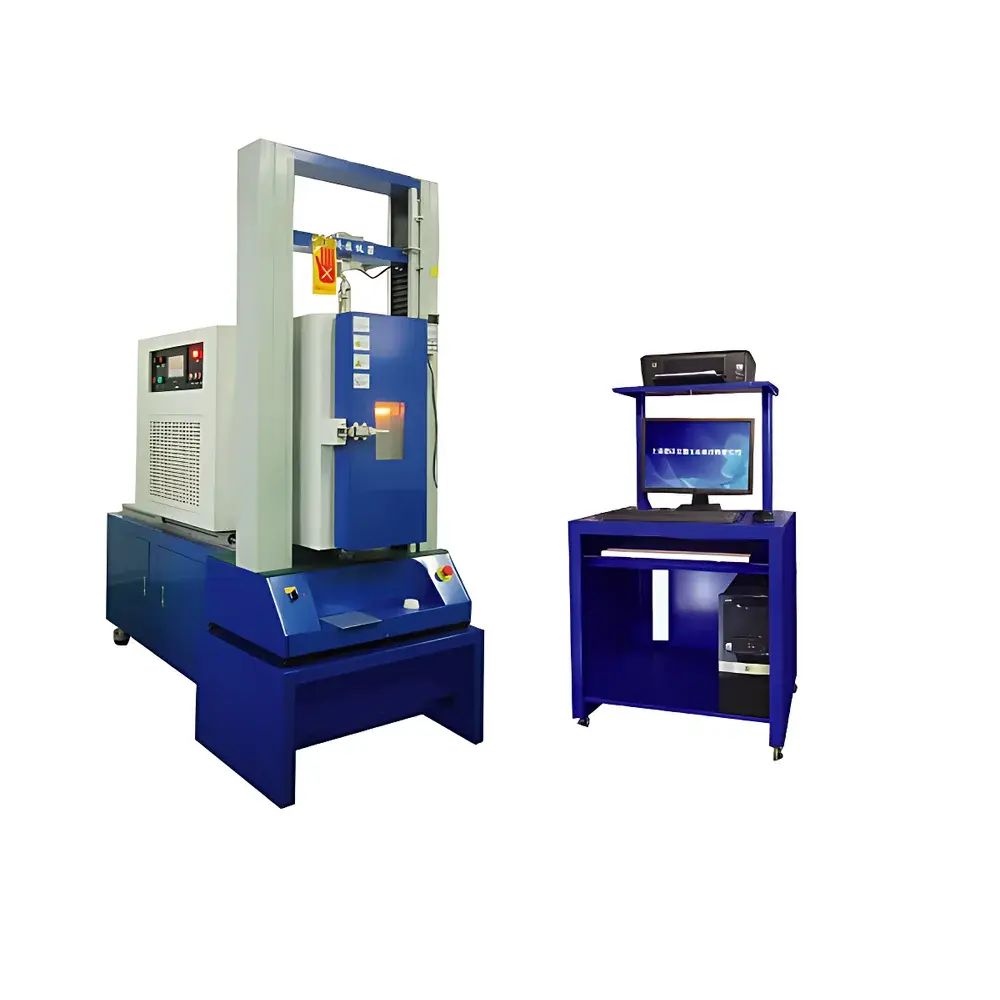
QJ211B High-Low Temperature Universal Testing Machine
| Origin | Shanghai, China |
|---|---|
| Manufacturer Type | Authorized Distributor |
| Origin Category | Domestic (PRC) |
| Model | QJ211B |
| Instrument Type | Electromechanical Universal Testing Machine |
| Load Capacity | 0–30 kN |
| Temperature Range | −70 °C to +350 °C (stable at 350 °C) |
| Temperature Ramp Rate | ≥5 °C/min |
| Temperature Controller Resolution | 0.1 °C |
| Effective Test Width | 420 mm |
| Effective Stroke | ~800 mm (extendable) |
| Test Speed Range | 0.001–500 mm/min (optional up to 1000 mm/min) |
| Speed Accuracy | ±0.5% |
| Load Cell Accuracy | ±0.01% of full scale |
| Measurement Accuracy (Force) | <±1% or <±0.5% FS |
| Displacement Accuracy | ±0.5% |
| Strain/Deformation Accuracy | ±0.5% |
| Safety Features | Electronic travel limit protection, emergency stop button |
| Net Weight | 135 kg |
Overview
The QJ211B High-Low Temperature Universal Testing Machine is an electromechanical testing system engineered for precision mechanical property evaluation of metallic, polymeric, composite, ceramic, and elastomeric materials under controlled thermal environments. It integrates a high-stiffness dual-column frame with a modular environmental chamber capable of sustained operation from −70 °C to +350 °C—enabling static and quasi-static tensile, compression, flexural, peel, tear, shear, puncture, and low-cycle fatigue testing across extreme temperature regimes. The system operates on the principle of servo-controlled displacement actuation, where load is measured via high-fidelity strain-gauge-based load cells and displacement via high-resolution linear encoders. Its architecture complies with fundamental metrological requirements outlined in ISO 7500-1 (static calibration of force-proving instruments) and ISO 5893 (tensile/compression testing machines), supporting traceable, repeatable, and auditable test execution.
Key Features
- Modular thermal chamber design: Removable environmental unit allows rapid reconfiguration for ambient-temperature testing—maximizing workspace flexibility and enabling concurrent setup of multiple test configurations.
- High-accuracy dual-range load measurement: 0–30 kN capacity with ±0.01% full-scale load cell accuracy; selectable sub-range optimization for low-force applications (e.g., thin films, biomedical polymers).
- Precision temperature control: PID-regulated chamber with 0.1 °C resolution and ≥5 °C/min ramp rate; validated thermal uniformity per ASTM E2202 and ISO 11357-2 across active test zone.
- Wide dynamic speed range: 0.001–500 mm/min (optionally up to 1000 mm/min), calibrated to ±0.5% accuracy per ISO 5893 Annex B—suitable for creep, stress-relaxation, and rate-dependent characterization.
- Robust mechanical frame: Rigid dual-column construction with preloaded ball screws and high-torque AC servo motor ensures minimal deflection (<0.02 mm/kN) and long-term dimensional stability.
- Integrated safety architecture: Dual-channel electronic limit switches, hardware-triggered emergency stop circuitry, and software-enforced operational boundaries conform to ISO 13857 and EN 60204-1.
Sample Compatibility & Compliance
The QJ211B accommodates standardized specimens per ASTM D638 (tensile plastics), ASTM D790 (flexural rigidity), ISO 6892-1 (metal tensile), ISO 178 (flexural properties), GB/T 228.1 (Chinese metal tensile standard), JIS K7113 (polymer tensile), and DIN 53455 (rubber tear). Gripping systems support pneumatic, hydraulic, wedge, and screw-type fixtures—including low-temperature cryo-grips rated to −70 °C and high-temperature ceramic-faced grips stable at 350 °C. All test methods are fully compliant with GLP documentation requirements, and raw data files include embedded metadata (test parameters, timestamps, operator ID, calibration certificates) to support FDA 21 CFR Part 11–compliant audit trails when paired with validated software modules.
Software & Data Management
Control and analysis are executed via a Windows-based platform supporting real-time multi-channel acquisition (load, displacement, temperature, extensometer), synchronized waveform logging at ≥1 kHz sampling, and automated method sequencing. Software includes built-in templates aligned with ASTM, ISO, and GB standards—including modulus calculation (secant/tangent), yield point detection (0.2% offset), fracture energy integration, and hysteresis loop analysis. Export formats include CSV, XML, PDF reports (with digital signatures), and .tdms for NI DIAdem compatibility. Calibration data is stored in encrypted binary containers with SHA-256 checksums; firmware and software revisions are version-locked and logged for GMP traceability.
Applications
- Thermo-mechanical characterization of aerospace composites under simulated service temperatures (−55 °C to +200 °C).
- Evaluation of polymer melt strength and cold-impact resistance in automotive interior materials.
- Creep rupture testing of high-temperature alloys per ASTM E139 and ISO 204.
- Adhesion strength assessment of pressure-sensitive adhesives across seasonal temperature profiles (−40 °C to +85 °C).
- Validation of additive-manufactured metal parts under thermal cycling conditions per ASTM F3122.
- Biomedical device testing—including suture tensile strength, stent radial force, and hydrogel compressive modulus—under physiologically relevant thermal conditions.
FAQ
Can the environmental chamber be operated independently of the testing frame?
Yes—the chamber is mechanically and electrically decoupled; it may be used as a standalone thermal exposure unit with external monitoring interfaces.
Is third-party calibration certification included with delivery?
A factory-issued ISO/IEC 17025-accredited calibration certificate (covering load, displacement, and temperature channels) is provided; on-site verification by accredited labs is supported upon request.
What extensometer options are compatible with low-temperature testing?
Contact-type clip-on extensometers with cryogenic-rated strain gauges (−70 °C to +150 °C) and non-contact video extensometry systems (with heated lens housings) are available as optional accessories.
Does the system support cyclic loading protocols for fatigue testing?
Yes—software-defined waveforms (sine, triangle, trapezoidal) with variable amplitude, frequency, and mean load are supported; maximum cycle count exceeds 10⁷ cycles with closed-loop strain control.
How is thermal gradient management handled during high-temperature tests?
The chamber employs forced-air convection with dual-zone heating elements and internal baffle geometry optimized per ISO 11357-2 to maintain axial thermal uniformity within ±2 °C across the 800 mm stroke zone at 350 °C.



