
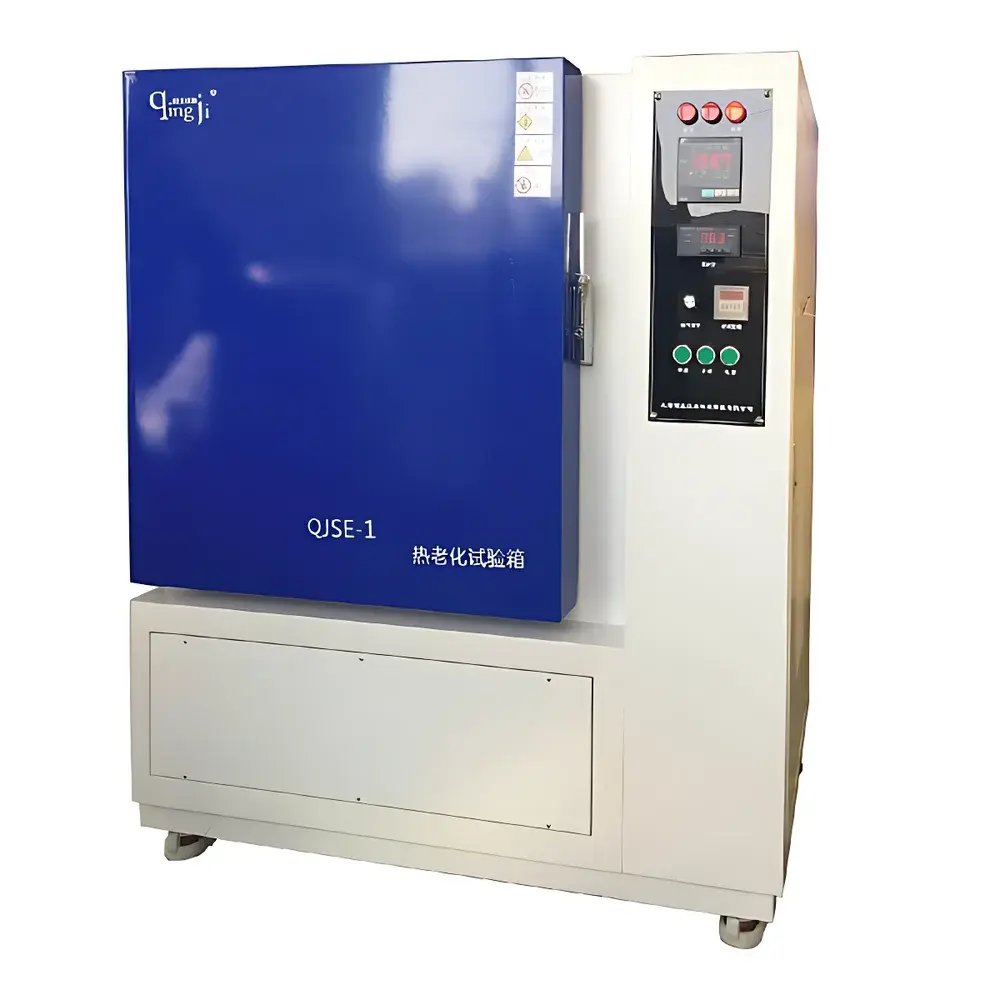
Qinji QJSE-1 Electrical Insulating Materials Aging Test Chamber
| Brand | Qinji |
|---|---|
| Origin | Shanghai, China |
| Model | QJSE-1 |
| Temperature Range | RT+20°C to 300°C |
| Max Operating Temperature | 400°C (short-term) |
| Temperature Uniformity | ≤±2.0°C (within 60 min at 200°C) |
| Temperature Fluctuation | ≤±0.5°C |
| Temperature Deviation | ≤±2.0°C |
| Heating Rate | RT+20°C → 200°C in ≤60 min |
| Total Power Consumption | 6.7 kW (Heating: 6.0 kW |
| Auxiliary Systems | 0.7 kW) |
| Internal Chamber Dimensions (W×H×D) | 500×500×600 mm |
| Noise Level | ≤65 dB(A) |
| Compliance | IEC 60540 (formerly IEC 540), ASTM D3045, ISO 188, UL 1581 Section 1000 |
Overview
The Qinji QJSE-1 Electrical Insulating Materials Aging Test Chamber is a precision-engineered environmental test system designed for accelerated thermal aging of polymeric insulating materials used in electrical and electronic applications. It operates on the principle of controlled, uniform convective heating within a dual-airflow recirculation chamber, enabling reproducible simulation of long-term thermal stress under standardized laboratory conditions. The chamber is specifically configured to meet the thermal exposure requirements outlined in international standards for insulation material qualification—including IEC 60540 (Cable and Cord Insulation and Sheath Testing), ASTM D3045 (Standard Practice for Heat Aging of Plastics), ISO 188 (Rubber—Accelerated Ageing and Heat Resistance Tests), and UL 1581 Section 1000 (Reference Standard for Electrical Wires and Cables). Its robust architecture supports continuous operation at temperatures up to 300°C (with short-term capability to 400°C), making it suitable for evaluating thermal degradation kinetics, oxidation onset, embrittlement progression, and dielectric property drift in elastomeric, thermoplastic, and cross-linked polymer systems.
Key Features
- Dual-channel forced-air circulation system ensures high thermal uniformity across the working volume, minimizing spatial gradients during extended aging cycles.
- Imported digital temperature controller with PID algorithm and real-time feedback loop delivers stable setpoint maintenance (≤±0.5°C fluctuation) and precise ramp profiling.
- Independent overtemperature protection circuitry—comprising both electronic (digital alarm) and mechanical (bimetallic cut-off) safeguards—meets functional safety requirements per IEC 61000-4-2 and EN 60335-1.
- Stainless steel interior chamber (SUS304) with seamless welding and rounded corners facilitates cleaning, prevents contaminant accumulation, and resists oxidative corrosion at elevated temperatures.
- Front-access observation window with double-layer heat-resistant glass enables non-intrusive visual monitoring without compromising thermal integrity.
- Modular power distribution design isolates heating elements (6.0 kW) from auxiliary subsystems (0.7 kW fan motors, control electronics), supporting predictive maintenance and fault isolation.
Sample Compatibility & Compliance
The QJSE-1 accommodates standard test specimens defined in IEC 60540 and ASTM D3045—including flat strips (e.g., 100 × 10 × 2 mm), wire segments (up to 300 mm length), and molded plaques—mounted on non-reactive stainless steel racks or suspended via ceramic hooks. Chamber volume (0.15 m³) allows simultaneous aging of multiple sample sets under identical thermal profiles, supporting statistical replication per ISO/IEC 17025 requirements. All operational parameters—including temperature logging intervals, dwell times, and cycle sequencing—are traceable and configurable to align with GLP-compliant testing protocols. The system’s thermal performance validation data (uniformity, deviation, stability) are documented per ISO 17025 Annex A.3 and satisfy pre-audit criteria for laboratories seeking accreditation under CNAS, A2LA, or UKAS frameworks.
Software & Data Management
While the base configuration employs a standalone microprocessor-based controller with local display and keypad interface, optional RS485/Modbus RTU or Ethernet TCP/IP communication modules enable integration into centralized laboratory information management systems (LIMS). Time-stamped temperature records—including setpoint, actual chamber mean, and sensor-specific readings—are stored internally for ≥30 days and exportable via USB flash drive in CSV format. Audit trail functionality (enabled via optional firmware upgrade) complies with FDA 21 CFR Part 11 requirements for electronic records and signatures, including user login authentication, change history logging, and immutable data archiving. Calibration certificates for integrated Pt100 sensors are provided with NIST-traceable documentation upon installation.
Applications
- Evaluation of thermal endurance class (IEC 60216) for insulating varnishes, encapsulants, and magnet wire coatings.
- Comparative aging studies of cross-linked polyethylene (XLPE), ethylene propylene rubber (EPR), and silicone elastomers used in medium-voltage cable systems.
- Validation of shelf-life predictions for polymer components in automotive ECUs, aerospace harnesses, and renewable energy inverters.
- Pre-compliance screening for UL Recognition, CSA Component Acceptance, and VDE certification testing programs.
- Research into thermo-oxidative degradation mechanisms using FTIR, DSC, or tensile property tracking post-aging.
FAQ
What standards does the QJSE-1 explicitly support for electrical insulation testing?
It is configured and validated for IEC 60540, ASTM D3045, ISO 188, and UL 1581 Section 1000. Custom calibration reports can be generated for additional standards upon request.
Can the chamber accommodate custom specimen fixtures or larger test loads?
Yes—standard internal dimensions (500×500×600 mm) allow reconfiguration with OEM-approved racks, trays, or hanging fixtures. Non-standard chamber sizes and mounting interfaces are available as factory options.
Is remote monitoring or automated reporting supported out-of-the-box?
Basic remote readout requires optional communication hardware and third-party SCADA/LIMS integration. Full audit-ready reporting requires the Part 11–compliant firmware package and external database server configuration.
What maintenance intervals are recommended for sustained accuracy?
Annual verification of temperature uniformity and sensor calibration is advised. Heating element resistance checks and airflow filter replacement should occur every 6 months under continuous operation.
Does the system include validation documentation for ISO/IEC 17025 compliance?
Yes—factory-as-delivered IQ/OQ documentation, sensor calibration certificates (NIST-traceable), and thermal mapping reports are included. PQ protocol templates aligned with ISO/IEC 17025 Annex A.3 are provided for user execution.



