
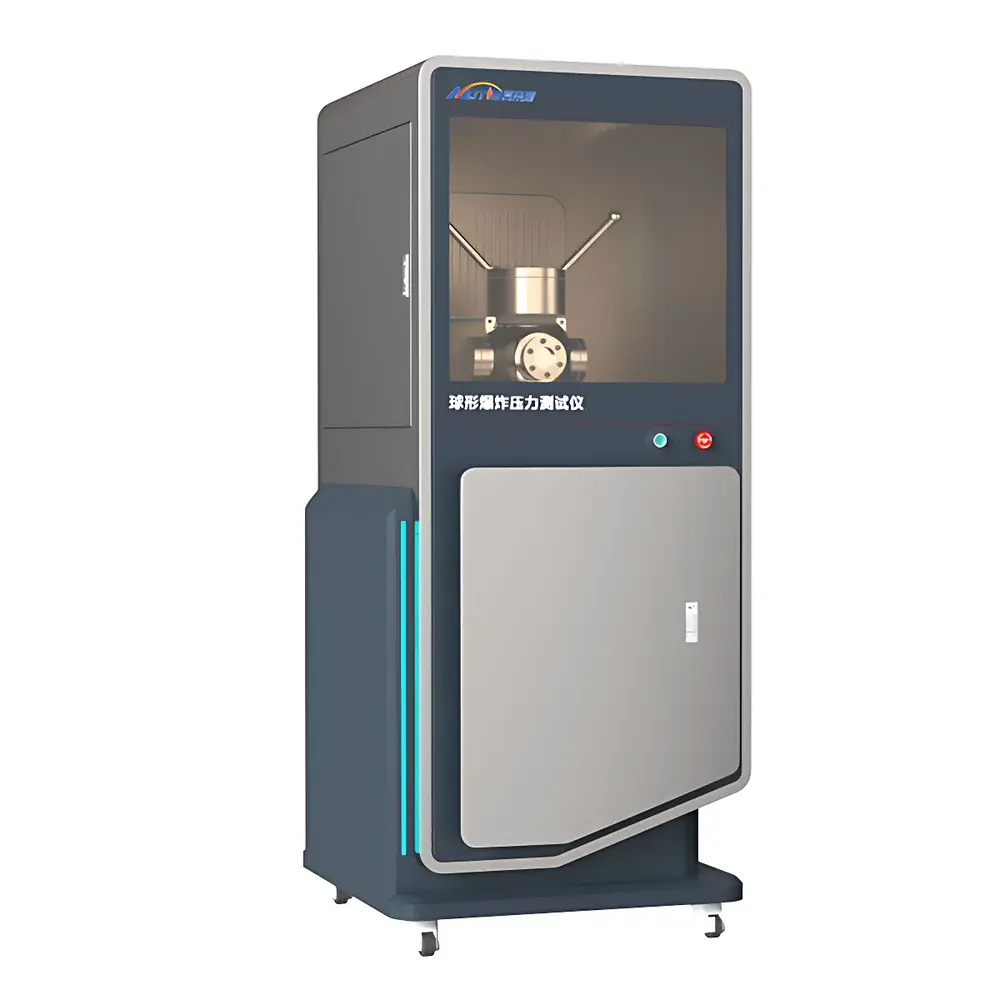
MOTIS LEL-8L Spherical Explosion Pressure Test System
| Brand | MOTIS |
|---|---|
| Origin | Jiangsu, China |
| Model | LEL-8L |
| Vessel Volume | 8 L ±10% |
| Maximum Operating Pressure | 2 MPa |
| Design Pressure | 3 MPa |
| Vessel Material | Dual-layer 316 stainless steel |
| Temperature Control | Integrated water-jacketed circulation |
| Pressure Measurement Range | 0–2 MPa |
| Ignition System | Dual tungsten-alloy ignition pins with 13–15 kV transformer |
| Temperature Sensor | K-type thermocouple, Class II accuracy, rated ≥1100 °C |
| Vacuum System | Rotary vane pump, pumping speed ≥2 L/s, ultimate vacuum ≤1.0 kPa, inlet port OD: 10 mm |
| Output Parameters | Peak explosion pressure (Pmax), maximum rate of pressure rise (dP/dt)max, initial temperature, time-resolved pressure/temperature profiles |
Overview
The MOTIS LEL-8L Spherical Explosion Pressure Test System is an engineered laboratory-scale apparatus designed for the quantitative assessment of deflagration behavior in combustible gas and vapor–air mixtures under controlled, standardized conditions. Based on the fundamental principles of closed-vessel explosion dynamics—governed by the ideal gas law, energy conservation, and transient pressure wave propagation—the system enables precise determination of key explosion parameters including peak explosion pressure (Pmax) and the maximum rate of pressure rise ((dP/dt)max). These metrics are directly referenced in international hazard classification standards such as EN 1839, ASTM E2079, ISO/IEC 80079-20-1, and the UN Manual of Tests and Criteria (Part I, Section 10.4). The spherical geometry ensures uniform flame propagation and minimizes wall quenching effects, thereby enhancing measurement reproducibility and reducing systematic bias associated with cylindrical or rectangular vessels.
Key Features
- Dual-layer 316 stainless steel explosion chamber (8 L ±10% internal volume) rated to 3 MPa design pressure and validated for repeated operation at 2 MPa working pressure—compliant with ASME BPVC Section VIII Div. 1 requirements for pressure boundary integrity.
- Integrated water-jacketed thermal management system enabling stable pre-test mixture conditioning between ambient and 100 °C, critical for evaluating temperature-dependent explosion severity.
- High-fidelity dynamic pressure acquisition using calibrated piezoresistive transducers (0–2 MPa full scale, natural frequency >100 kHz), synchronized with a 1 MHz sampling DAQ system to resolve sub-millisecond pressure transients.
- Dual-point ignition configuration with tungsten-alloy electrodes and a high-voltage transformer (13–15 kV output) ensuring reliable, spatially consistent spark initiation across diverse stoichiometries and minimum ignition energy (MIE) thresholds.
- K-type thermocouple (Class II, IEC 60584-2) mounted at the vessel centerline, rated to 1100 °C, providing traceable temperature monitoring before, during, and after ignition—essential for thermodynamic correction of Pmax values per ISO/IEC 80079-20-1 Annex C.
- Integrated vacuum subsystem featuring a two-stage rotary vane pump (≥2 L/s free air displacement, ≤1.0 kPa ultimate vacuum) with 10 mm OD inlet port, supporting rapid evacuation and inert gas purging cycles required for oxygen-controlled testing environments.
Sample Compatibility & Compliance
The LEL-8L accommodates gaseous and low-boiling-point volatile liquid samples—including hydrocarbons (e.g., methane, propane, hexane), hydrogen, ammonia, silane, and organic solvent vapors—provided they are compatible with 316 stainless steel and operate within defined flammability limits. Testing follows standardized protocols aligned with EN 1839:2015 (determination of explosion limits), ASTM E2079-21 (pressure-time analysis), and IEC 60079-11 (intrinsic safety evaluation). The system’s mechanical design, pressure relief provisions, and interlocked access door meet CE Machinery Directive 2006/42/EC essential health and safety requirements. All pressure instrumentation is calibrated per ISO/IEC 17025-accredited procedures, with traceability to NIM (China) or NIST (USA) primary standards.
Software & Data Management
Acquisition and analysis are performed via MOTIS proprietary EXPLODATA v3.2 software, which provides real-time visualization of synchronized pressure and temperature waveforms, automated calculation of Pmax, (dP/dt)max, and induction time (tind), and export to CSV, PDF, and XML formats compliant with GLP documentation requirements. Audit trails record user actions, calibration events, and test metadata—including operator ID, timestamp, atmospheric conditions, and gas composition—satisfying FDA 21 CFR Part 11 electronic record retention criteria where applicable. Raw data files are stored with SHA-256 checksums to ensure integrity verification.
Applications
- Hazard classification of new chemical substances for GHS Category 1–3 flammability assignment.
- Development and validation of explosion suppression and venting systems per NFPA 68 and EN 14491.
- Process safety studies for chemical manufacturing, pharmaceutical synthesis, and battery electrolyte handling facilities.
- Research into flame acceleration mechanisms, turbulence–combustion interactions, and inhibitor efficacy screening.
- Supporting ATEX/IECEx equipment certification through experimental derivation of KG values (deflagration index) for dust–gas hybrid systems.
FAQ
What standards does the LEL-8L comply with for explosion testing?
It supports test execution per EN 1839, ASTM E2079, ISO/IEC 80079-20-1, and UN Test Series 10, with mechanical design adhering to ASME BPVC Section VIII Div. 1 and CE Machinery Directive 2006/42/EC.
Can the system be used for dust explosion testing?
No—the LEL-8L is configured exclusively for gaseous and vapor-phase mixtures; dust dispersion and ignition require a separate 20 L or 1 m³ Hartmann tube or Siwek chamber per ISO/IEC 80079-20-2.
Is remote operation or integration with LIMS supported?
Yes—EXPLODATA v3.2 includes OPC UA server functionality for bidirectional communication with enterprise LIMS and DCS platforms, enabling automated report generation and audit-ready data archival.
What maintenance intervals are recommended for the pressure transducers and ignition system?
Pressure sensors require annual recalibration against deadweight testers; ignition pins should be inspected and cleaned after every 50 tests or upon visible electrode erosion, with transformer output verified quarterly using a high-voltage probe.
Does the system include explosion venting or suppression hardware?
No—vent sizing, rupture disc selection, and chemical suppression agent delivery must be designed externally per NFPA 68 or EN 14491 based on measured KG and Pmax outputs from this instrument.






