
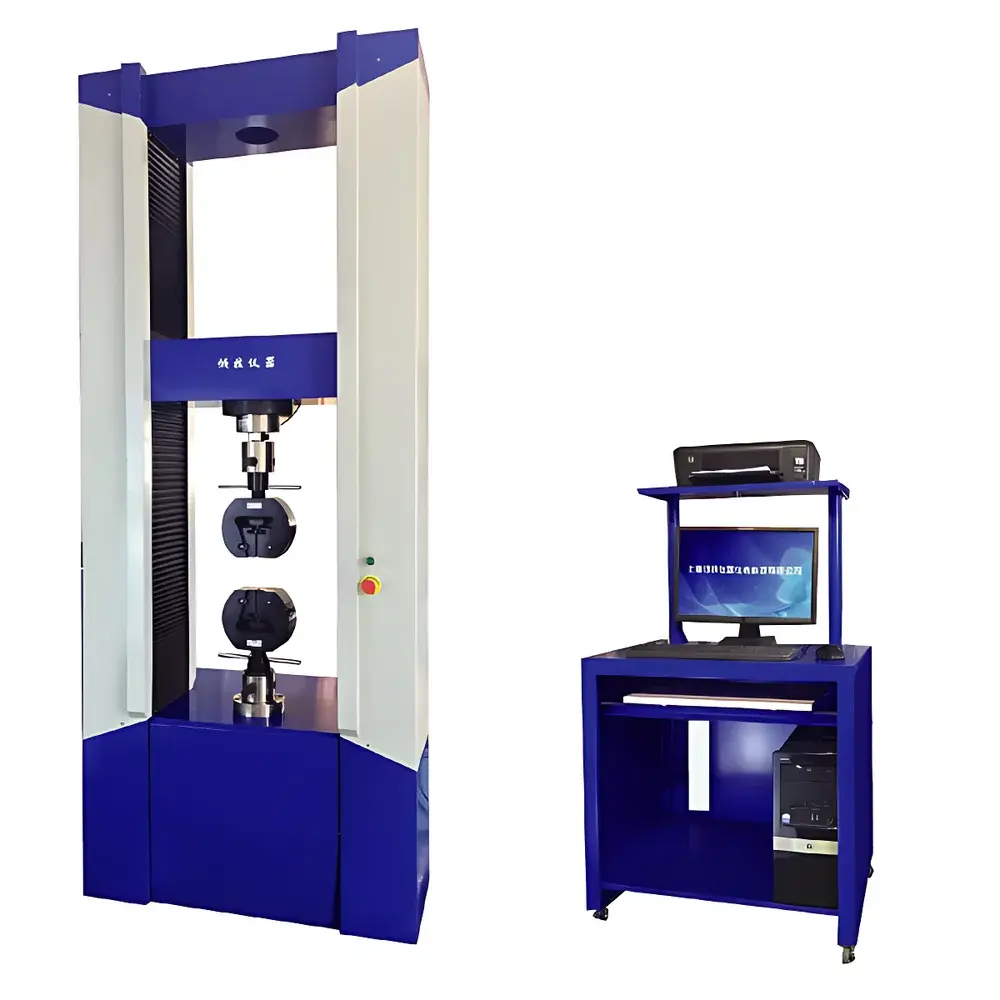
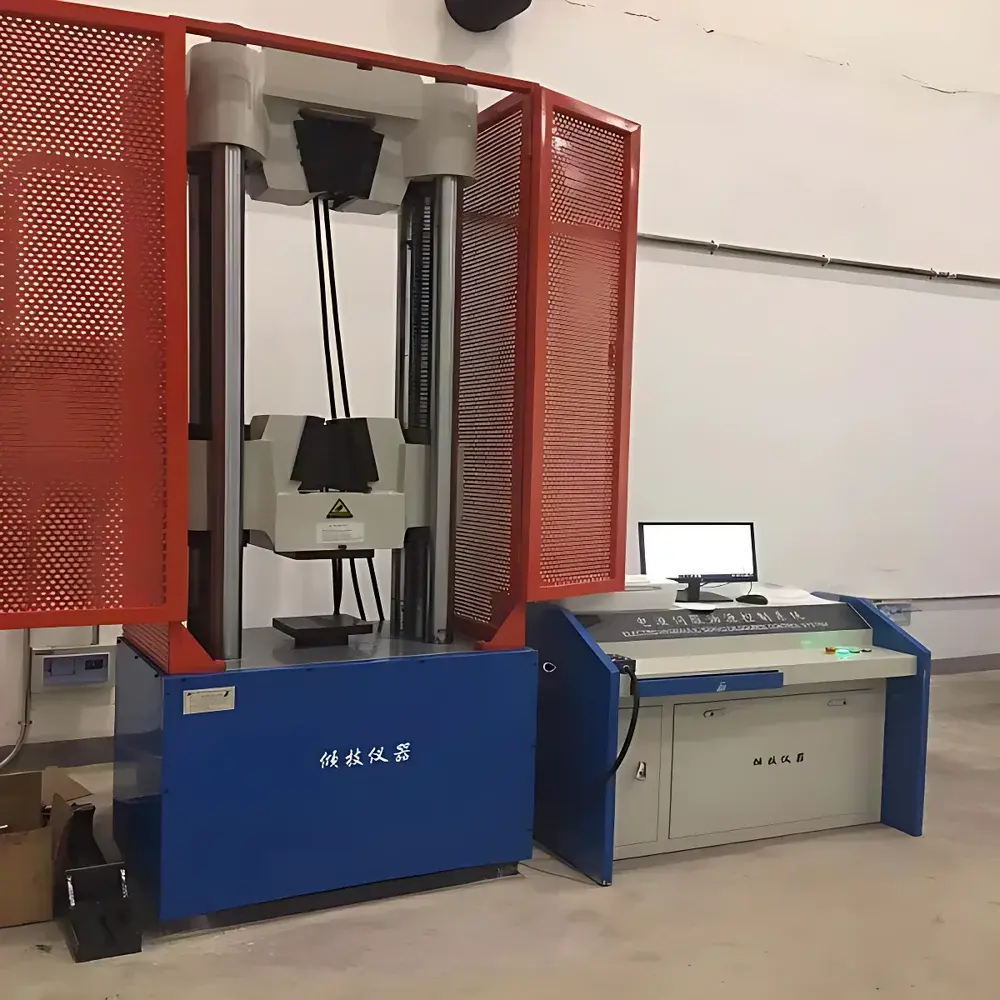
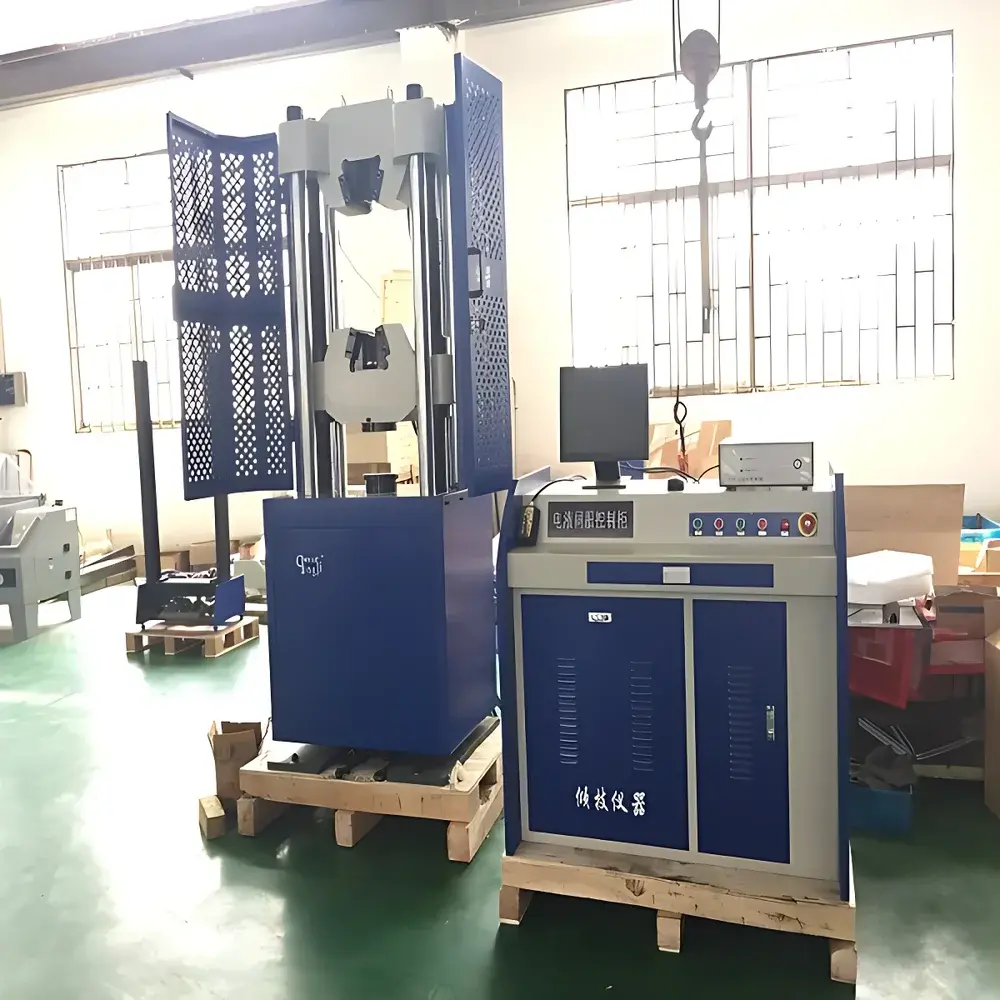
Qinji QJ-212 Electronic Tensile Testing Machine
| [Brand | Qinji |
|---|---|
| Origin | Shanghai, China |
| Model | QJ-212 |
| Max Test Load | 500 kN |
| Load Accuracy Class | 0.5 |
| Test Stroke | 500 mm |
| Displacement Resolution | ±0.5% of reading |
| Effective Test Width | 520 mm |
| Effective Tensile Travel | 800 mm |
| Speed Range | 0.01–1000 mm/min (standard: 300 mm/min) |
| Speed Accuracy | ±0.5% of set value |
| Force Resolution | 500,000 counts full scale, no internal range switching |
| Control System | Panasonic full-digital AC servo controller |
| Load Cell | High-precision U.S.-sourced sensor |
| Software | Full-digital closed-loop control supporting constant stress, constant strain, and constant displacement modes |
| Safety Protection | Automatic overload cutoff at 110% FS, electronic limit switches, software-based fault diagnosis |
| Power | 2–5 kW |
| Dimensions (W×D×H) | 1000 × 680 × 2450 mm |
| Weight | ~1450 kg] |
Overview
The Qinji QJ-212 Electronic Tensile Testing Machine is a high-capacity, microprocessor-controlled universal testing system engineered for precise mechanical characterization of high-strength fibrous, cordage, and structural materials under uniaxial tensile loading. Based on the principle of force transduction via calibrated load cells and position feedback from high-resolution linear encoders, the QJ-212 delivers traceable, repeatable measurements in accordance with ASTM E4, ISO 7500-1, and GB/T 228.1 standards. Its modular frame architecture supports static tensile, compression, bending, shear, and tear testing—making it suitable for evaluating breaking strength, elongation at break, Young’s modulus, yield point, and load–displacement hysteresis in ropes, cables, synthetic fibers, geotextiles, composite laminates, and metallic wires. Designed for industrial QA/QC laboratories and academic materials research centers, the system integrates metrological-grade hardware with deterministic motion control to ensure data integrity across extended test cycles.
Key Features
- 500 kN maximum capacity with seamless load range selection (50–500 kN), eliminating manual range switching and preserving resolution continuity
- 0.5-class accuracy certified per ISO 7500-1, supported by NIST-traceable calibration protocols
- Panasonic full-digital AC servo drive system delivering stable speed control from 0.01 to 1000 mm/min (±0.5% deviation)
- U.S.-sourced high-stability load cell with 500,000-count A/D resolution and thermal drift compensation
- Dual-speed crosshead actuation (fast jog + precision fine-tune) for rapid specimen alignment and controlled loading initiation
- Integrated safety architecture: electronic end-limit switches, real-time software diagnostics, and automatic overload shutdown at 110% of full-scale load
- Robust welded steel frame (1450 kg mass) with vibration-damped base and rigid column design to minimize deflection-induced measurement error
- Modular fixture interface compatible with wedge-action, pneumatic, hydraulic, and custom-designed grips for diverse specimen geometries
Sample Compatibility & Compliance
The QJ-212 accommodates specimens up to 520 mm wide and 800 mm effective gauge length, enabling standardized evaluation of braided ropes (e.g., Dyneema®, HMPE, nylon, polyester), wire rope assemblies, cable harnesses, and reinforced polymer tapes. Fixture customization ensures compliance with ASTM D4268 (tensile strength of cordage), ISO 2062 (yarn tensile properties), EN 1497 (life-saving rope testing), and MIL-STD-2060A (military-grade fiber rope qualification). All force, displacement, and strain data are recorded with timestamped audit trails, supporting GLP/GMP documentation requirements and FDA 21 CFR Part 11-compliant electronic records when paired with validated software configurations.
Software & Data Management
The system operates via a proprietary closed-loop control platform supporting real-time PID parameter tuning, multi-step test profiles (pre-load → ramp → hold → unload), and synchronized acquisition of force, displacement, and optional extensometer-derived strain. Raw data export is available in CSV, Excel, and XML formats; graphical overlays support comparative analysis across batches or material lots. Calibration certificates—including linearity, hysteresis, and repeatability reports—are digitally archived with user-accessible revision history. Optional integration with LIMS environments enables automated result transfer to enterprise quality databases.
Applications
- Mechanical validation of marine mooring lines and offshore towing cables per OCIMF and DNV-OS-E301
- Quality conformance testing of elevator suspension ropes and aircraft control cables (AS4373, ARP4761)
- R&D evaluation of high-modulus polyethylene (HMPE) and aramid fiber performance under cyclic loading
- Compression testing of composite pulley blocks and load-bearing textile structures
- Bending fatigue assessment of coated steel wire ropes using wrap-around mandrel fixtures
- Shear strength measurement of spliced rope terminations and thimble-secured eyelets
FAQ
What international standards does the QJ-212 comply with for tensile testing?
The system meets ISO 7500-1 (static calibration), ASTM E4 (load verification), and GB/T 228.1 (metallic materials tensile testing), with optional configuration for ISO 1798 (flexible cellular polymeric materials) and ASTM D882 (thin plastic sheeting).
Can the machine perform tests beyond tensile loading?
Yes—it supports compression, three-point bending, shear, and tear modes using interchangeable fixtures and appropriate test method programming.
Is the software compliant with regulatory data integrity requirements?
When deployed with audit trail enabled and user access controls configured, the system supports ALCOA+ principles and can be validated for 21 CFR Part 11 compliance in regulated environments.
What maintenance is required during the warranty period?
Annual verification of load cell linearity and encoder accuracy is recommended; Qinji provides remote diagnostic support and on-site recalibration services under the standard one-year parts-and-labor warranty.
Are third-party calibration services accepted?
Yes—certificates from ISO/IEC 17025-accredited laboratories are accepted for periodic verification, provided traceability to national standards (e.g., NIST, PTB, NIM) is documented.



