
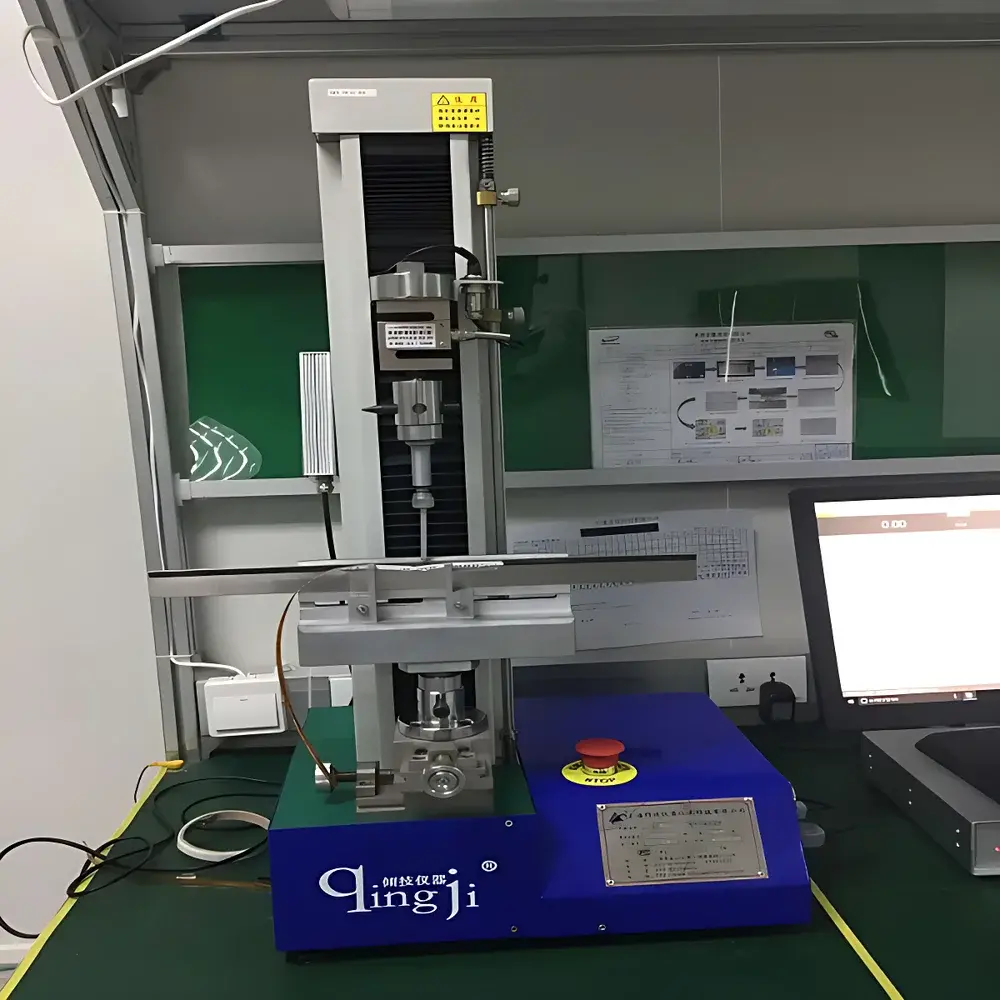
QJ210 Automotive Lithium-Ion Battery Electrode Coating Peel Tester
| Origin | Shanghai, China |
|---|---|
| Manufacturer Type | Authorized Distributor |
| Origin Category | Domestic (China) |
| Model | QJ210 |
| Price | USD 4,200 (FOB Shanghai) |
| Load Capacity | 2500 N |
| Accuracy Class | 0.5 |
| Effective Test Width | 150 mm |
| Vertical Travel | 300 mm |
| Speed Range | 0.01–1000 mm/min |
| Speed Accuracy | ±0.5% of reading |
| Force Resolution | 500,000 counts (full-scale, no range switching) |
| Displacement Accuracy | ±0.5% of reading |
| Protection | Electronic limit switch, overload protection at 110% F.S., manual/auto return, dual-speed crosshead control |
| Motor | 200 W servo motor with precision timing belt drive |
| Dimensions (L×W×H) | 430 × 315 × 855 mm |
| Weight | 40 kg |
Overview
The QJ210 Automotive Lithium-Ion Battery Electrode Coating Peel Tester is a precision mechanical testing system engineered for quantitative evaluation of interfacial adhesion strength between active material coatings and current collector foils in lithium-ion battery electrodes—specifically designed for high-reliability validation in automotive traction battery R&D, pilot-line process development, and quality control laboratories. It operates on the principle of controlled tensile separation under standardized peel geometry (e.g., 90° or 180° peel configuration), delivering traceable, repeatable force-displacement data essential for assessing coating integrity, binder performance, calendering effects, and electrode aging behavior. Compliant with ISO 8510-2, ASTM D903, GB/T 2790, and JIS Z 0237, the instrument supports both manual parameter setup via its high-contrast LCD interface and full automation through PC-based control software—enabling seamless integration into GLP-compliant workflows and audit-ready documentation.
Key Features
- High-fidelity force measurement system with 0.5-class accuracy and 500,000-count resolution across the full 2500 N range—no auto-ranging or signal degradation due to internal gain switching.
- Low-inertia servo-driven actuation (200 W motor + optimized timing belt transmission) ensures stable velocity control from 0.01 mm/min (for creep-sensitive delamination studies) to 1000 mm/min (for high-throughput screening), with speed accuracy maintained within ±0.5% of setpoint.
- Compact monolithic frame (430 × 315 × 855 mm; 40 kg) eliminates structural compliance issues common in larger universal testers—critical for minimizing parasitic deflection during low-force peel measurements on thin electrode laminates (typically <150 µm total thickness).
- Dual-mode crosshead control: programmable fast/slow positioning with jog functionality and electronic end-stop protection prevents overtravel damage to delicate samples and fixtures.
- Real-time dynamic display of load, displacement, strain rate, and test time on integrated LCD; all parameters—including target peel angle, dwell time, and break criteria—are fully configurable pre-test.
- Comprehensive safety architecture including 110% overload cutoff, automatic return-to-start post-test, and hardware-enforced travel limits—meeting IEC 61000-6-2 EMC and ISO 12100 functional safety requirements for laboratory equipment.
Sample Compatibility & Compliance
The QJ210 accommodates standard electrode strip specimens (up to 150 mm wide × 300 mm long) mounted on rigid backing plates or custom peel fixtures compatible with industry-standard 90° T-peel, 180° roll-back, or modified floating-roller configurations. It supports testing of anode (graphite/SiOx on Cu foil) and cathode (NMC, LFP, or NCA on Al foil) architectures, including dry-processed, aqueous-processed, and solvent-based coated electrodes. All mechanical and data acquisition subsystems conform to ISO/IEC 17025 calibration traceability requirements when used with accredited force transducers and displacement encoders. The system satisfies clause 4.3 of ASTM E4 for verification of static loading systems and is validated for use in environments compliant with ISO 17025, IATF 16949, and UL 1642 battery safety certification protocols.
Software & Data Management
The included Windows-based control software provides real-time graphical monitoring, multi-curve overlay, automatic peak detection (peel initiation, plateau force, maximum pull-off), and statistical reporting per test series. Raw data export is supported in CSV, Excel (.xlsx), and XML formats—with embedded metadata (operator ID, sample ID, environmental conditions, calibration certificate IDs). Audit trail functionality logs all user actions, parameter changes, and test executions in tamper-evident binary files, satisfying FDA 21 CFR Part 11 requirements for electronic records and signatures when deployed with domain-authenticated login and digital certificate validation. Optional API integration enables direct linkage to LIMS platforms (e.g., LabWare, Thermo Fisher SampleManager) and MES systems for automated result ingestion.
Applications
- Quantification of binder efficacy (e.g., SBR/CMC vs. PVDF) under variable drying schedules and calendering pressures.
- Assessment of interfacial degradation following thermal cycling (45–85 °C), humidity exposure (30–90% RH), or electrolyte soaking (LiPF6 in EC/DMC).
- Validation of novel current collector surface treatments (e.g., carbon coating, etching, plasma activation) on adhesion robustness.
- Comparative analysis of electrode architecture variations—single-layer vs. double-layer coating, gradient formulations, or patterned deposition.
- Supporting DOE-driven optimization of slurry rheology, solid content, and dispersant selection prior to pilot-scale coating trials.
- Root-cause analysis of field failures linked to coating delamination observed in post-mortem cell dissection.
FAQ
What peel angles does the QJ210 support?
The system is mechanically configured for standardized 90° and 180° peel geometries using interchangeable fixture sets; custom angular fixtures (e.g., 45°) can be supplied upon request.
Is calibration certification included with delivery?
Yes—a NIST-traceable calibration certificate covering force (2500 N), displacement (300 mm), and speed (0.01–1000 mm/min) is provided with each unit, valid for 12 months.
Can the QJ210 be integrated into an automated battery manufacturing line?
While primarily designed for lab-based QC and R&D, optional PLC-compatible I/O modules (digital inputs/outputs, analog 0–10 V feedback) enable supervised integration into semi-automated inline inspection stations.
Does the software support multi-language UI and report generation?
The control software features English and Chinese language interfaces; PDF and Excel reports are generated in UTF-8 encoding and support localized number/date formatting per regional settings.
What maintenance is required to sustain measurement accuracy?
Annual recalibration is recommended; routine checks include timing belt tension verification, encoder alignment, and load cell zero-drift assessment—full service manuals and remote diagnostics support are available to certified technicians.



