
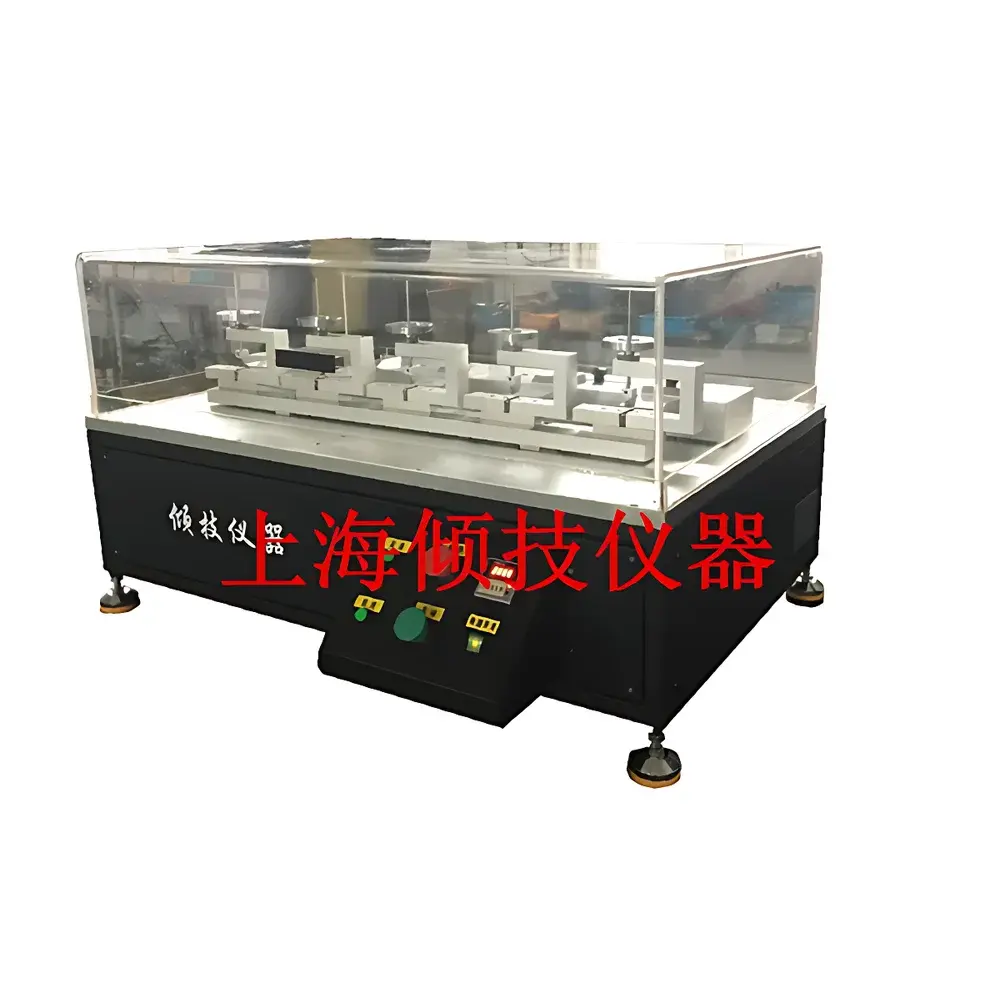
QJICHL-5 Station Tri-Roller Card Durability Tester
| Brand | QJICHL |
|---|---|
| Origin | Shanghai, China |
| Model | QJICHL- |
| Compliance | ISO/IEC 10373-3:2001 |
| Test Load Range | 3 N, 5 N, 7 N, 8 N (adjustable via calibrated weights) |
| Cycle Count Range | 0–200 cycles (programmable) |
| Cycle Frequency | 0.5 Hz ±0.05 Hz |
| Power Supply | AC 220 V, 50 Hz |
| Dimensions (L×W×H) | 500 × 400 × 400 mm |
| Weight | 12 kg |
| Test Stations | 5 independent, simultaneously controlled and monitored |
| Roller Initial Position & Height | Manually adjustable |
| Roller Support Configuration | Dual-side support plates |
Overview
The QJICHL-5 Station Tri-Roller Card Durability Tester is an electromechanical test system engineered for standardized mechanical stress evaluation of contact-type integrated circuit (IC) cards, including EMV-compliant payment cards, SIM cards, and ID cards with embedded silicon chips. It operates on the principle of controlled cyclic three-point rolling indentation—where three precision-ground rollers apply repeated compressive load along defined paths across the card surface—to simulate real-world wear mechanisms such as insertion/removal in readers, friction during handling, and long-term mechanical fatigue at chip-contact interfaces. Designed in strict accordance with ISO/IEC 10373-3:2001 (“Identification cards — Test methods — Part 3: Cards with integrated circuits”), this instrument enables reproducible assessment of structural integrity, bond strength between chip and substrate, and functional continuity after mechanical loading. Its five-station architecture supports parallel testing under identical parametric conditions—critical for batch qualification, supplier audits, and QC release protocols in card manufacturing and personalization facilities.
Key Features
- Five independent test stations with synchronized motion control and individual status monitoring—ensuring statistical relevance in multi-sample durability studies.
- Tri-roller assembly with manually adjustable initial vertical position and lateral offset, enabling precise alignment to card geometry and contact zone specification per ISO/IEC 7816-1.
- Calibrated static load application via interchangeable stainless-steel weights (3 N, 5 N, 7 N, and default 8 N), traceable to national metrological standards and compliant with CQM (Card Quality Management) project requirements.
- Programmable cycle count (0–200 cycles) and fixed-frequency actuation at 0.5 Hz ±0.05 Hz—meeting repeatability tolerances specified in ISO/IEC 10373-3 Annex A.
- Movable support plate on one side accommodates dimensional variance across card types (e.g., standard ID-1, thin-profile cards), minimizing edge deflection artifacts during rolling.
- Robust aluminum-alloy frame with vibration-damped base, designed for stable operation in shared laboratory or production-floor environments without external isolation.
Sample Compatibility & Compliance
The tester accepts all ISO/IEC 7816-1 conformant identification cards measuring 85.6 mm × 53.98 mm × 0.76 mm (ID-1 format), including PVC, PET, polycarbonate, and composite laminates. It supports both single-chip and dual-interface (contact + contactless) cards, provided the chip location falls within the central 25 mm × 25 mm zone defined by ISO/IEC 10373-3 Figure 1. All operational parameters—including force magnitude, cycle count, and dwell time—are documented in machine-readable logs to support GLP-compliant reporting. The system satisfies essential requirements for use in ISO/IEC 17025-accredited laboratories performing conformance testing against ISO/IEC 10373-3, EMV Level 1 Physical Interface Specifications, and national smart card certification schemes (e.g., China’s GB/T 17554 series).
Software & Data Management
While the QJICHL- operates via front-panel keypad interface without embedded firmware or PC connectivity, full test configuration and result documentation are managed through standardized procedural checklists aligned with ISO/IEC 17025 clause 7.7 (Reporting of Results). Each test run generates a manual log entry capturing: date/time, operator ID, sample lot number, applied load (N), cycle count, observed visual defects (e.g., delamination, cracking), and post-test electrical functionality verification per ISO/IEC 7816-3. For laboratories requiring electronic audit trails, optional integration with LIMS platforms is supported via RS-232 serial output (available upon request), enabling timestamped export of cycle completion signals and error flags. All calibration records for applied weights and frequency verification are retained per ISO/IEC 17025 clause 6.4.10.
Applications
- Pre-release mechanical validation of IC card batches prior to mass personalization.
- Root cause analysis of field failures related to chip detachment or contact degradation.
- Supplier qualification testing for card substrate suppliers and module embedders.
- Internal process capability studies for lamination pressure, adhesive cure profiles, and die-attach reliability.
- Supporting evidence generation for regulatory submissions under banking industry guidelines (e.g., PCI DSS Appendix A.2.2) and national identity program specifications.
FAQ
Does the QJICHL- comply with EMVCo physical interface requirements?
Yes—the tri-roller loading profile, force tolerance, and positional repeatability meet EMVCo Level 1 test criteria referenced in “EMV Integrated Circuit Card Specifications for Payment Systems,” particularly Section 7.2.2 (Mechanical Stress Tests).
Can the roller speed be adjusted beyond 0.5 Hz?
No—the drive mechanism is mechanically locked to 0.5 Hz to ensure compliance with ISO/IEC 10373-3 timing constraints; variable-speed operation would invalidate conformance claims.
Is third-party calibration certification available for the supplied weights?
Yes—certified calibration reports (traceable to NIM, China) can be provided at time of order for an additional fee; weight uncertainty is ±0.1 N at k=2.
What maintenance intervals are recommended for long-term accuracy?
Roller surface inspection and lubrication every 5,000 cycles; annual verification of weight calibration and cycle counter accuracy using external timing reference and load cell.
Are replacement rollers and support plates available as spare parts?
Yes—all mechanical consumables—including hardened steel rollers (HRC 60), PTFE-coated support plates, and alignment jigs—are stocked and supplied with full dimensional drawings for in-house replication if required.



